
Attaque par ransomware à 3 h du matin dans un établissement scolaire britannique : identifiants Veeam, domaines frauduleux et suspicion de boucle d’IA
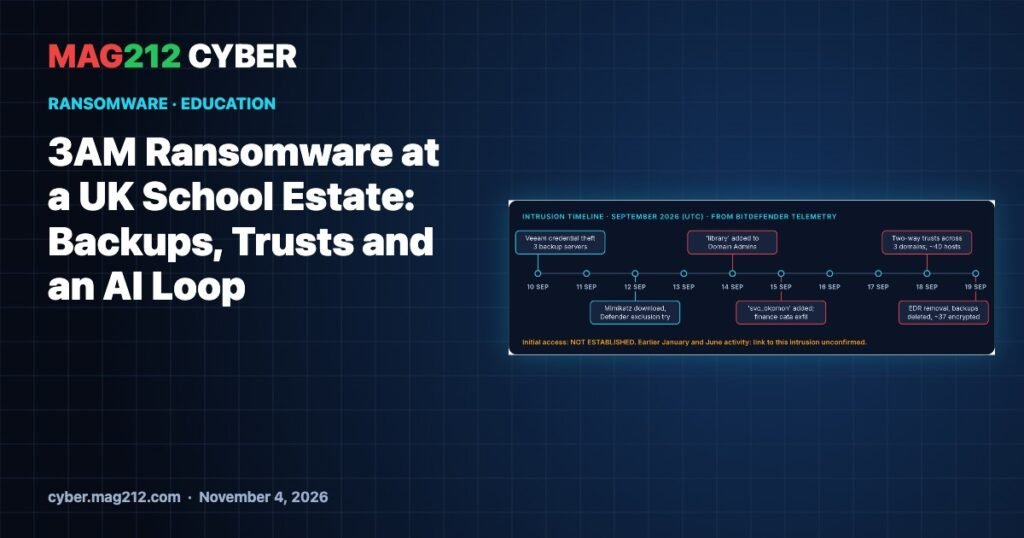
Bitdefender has published a detailed reconstruction of a September 2026 intrusion at a UK school estate by a 3AM (ThreeAM) ransomware affiliate. Over ten days the intruder took stored credentials from the school’s Veeam backup servers, created two backdoor Domain Admin accounts, joined three previously separate Active Directory domains with new trusts, stole finance data, and encrypted about 37 machines.
Bitdefender also suspects the attacker used an automated, AI-assisted command loop. The more useful lesson for school IT teams and MSPs is how the intrusion could have been caught: almost every step was noisy and repetitive.
Faits clés
| Article | Détail |
|---|---|
| Victim | A UK school estate with several separate AD domains |
| Intrusion window | September 10–19, 2026 (UTC) |
| Report | Bitdefender, November 3, 2026 |
| Encryptor | ThreeAM, Rust-based (host.exe) |
| Impact | About 37 machines encrypted; system-state backups deleted; finance data exfiltrated |
| Initial access | Not established; the attacker worked from an unmanaged host |
How the intrusion unfolded
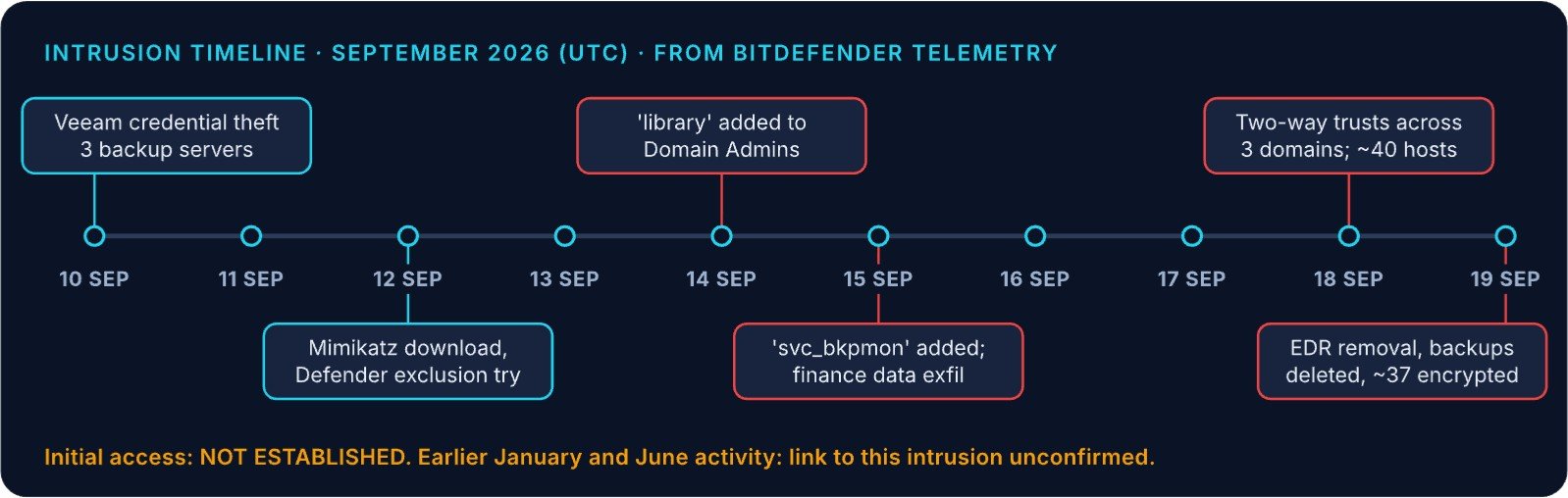
- Sep 10–11, backup credentials: a modified public PowerShell script read stored credentials from the Veeam configuration database on three backup servers and decrypted them with DPAPI. A Chrome login database was copied from a terminal server.
- Sep 12–14, credential theft and recon: a Mimikatz download (later renamed
sysmon64.exe), a Defender exclusion attempt, registry hive saves, domain-trust discovery withnltest, and SYSVOL searches for other schools. - Sep 14–15, backdoor admins: accounts
libraryetsvc_bkpmonwere created and added to Domain Admins. Names were chosen to blend into a school’s account list. Finance data was staged in registry values and sent out. - Sep 18, domain trusts: DNS conditional forwarders and two-way trusts were created among three separate domains, then access was pushed to about 40 machines.
- Sep 19, impact: scripts tried to remove Sophos and Bitdefender protection,
wbadmindeleted system-state backups, and the encryptor ran between 05:07 and 05:33 UTC.
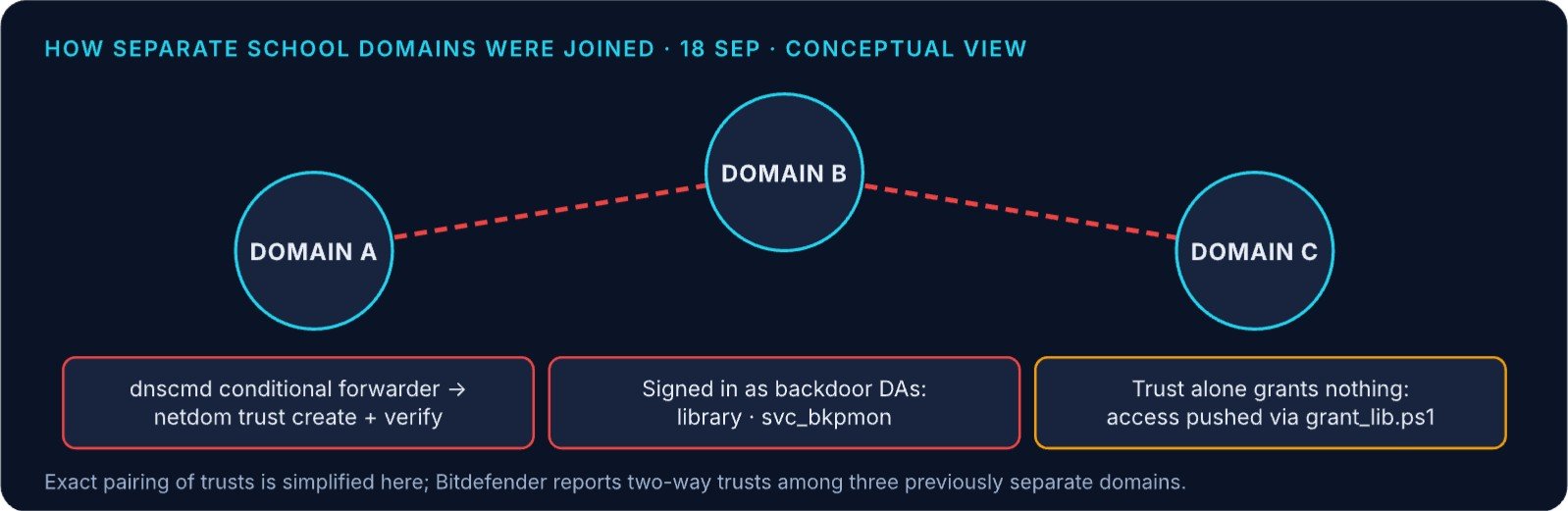
A trust on its own grants no permissions. That is why the attacker followed it with a script that pushed the backdoor account’s access across the estate.
Was AI involved?
Bitdefender points to sequences of slightly modified retries issued every 40 to 100 seconds, which look like an automated agent loop. But it could not see the attacker’s machine. It cannot name a model, say whether one ran locally, or rule out a human copying output between tools. It presents the “hybrid” human-plus-agent reading as a working model, not a fact, and calls this one case, not a trend.
For defenders the takeaway is the same either way. Self-logging, repetitive scripts leave loud traces. This intrusion succeeded because nobody was alerted when backup credentials were read or when new domain trusts appeared.
What to look for in your environment
- Security log: 4720 (account created), 4728 (member added to a global group such as Domain Admins), 4706 (new domain trust), 4698 (scheduled task created). System log: 7045 (service installed).
- Behavior:
reg saveof SAM, SECURITY or SYSTEM by non-backup tools;netdom trustounltest /domain_trusts; any process querying the Veeam credentials database. - Case-specific artifacts: tasks
VEEAMPROBEetWindowsTempDiag, registry keyHKLM\SOFTWARE\VC31, scriptsgrant_lib.ps1etav_remove*.ps1. Bitdefender publishes the full IOC set on GitHub. Expect different names in other intrusions, and hunt for the behavior.
Read-only checks (PowerShell 5.1+ with the RSAT ActiveDirectory module; run the event and task queries elevated, on each DC or server):
Get-ADTrust -Filter * -Properties whenCreated | Select-Object Name,Direction,whenCreated
Get-ADGroupMember 'Domain Admins' -Recursive | Select-Object SamAccountName
$since = (Get-Date).AddDays(-60)
Get-ADUser -Filter 'whenCreated -ge $since' -Properties whenCreated |
  Select-Object SamAccountName,whenCreated
Get-WinEvent -FilterHashtable @{LogName='Security'; Id=4706,4720,4728} -MaxEvents 200
Get-ScheduledTask -TaskName 'VEEAMPROBE','WindowsTempDiag' -ErrorAction SilentlyContinue
Escalate any trust you cannot account for, and any admin added outside change control. These commands were checked against Microsoft documentation but not run against live systems for this article.
Contain, recover and prevent
- Isolate backup servers and rotate every credential the backup product stores. Treat them as compromised if they could have been read.
- Disable unknown admin accounts and remove unapproved trusts. If domain compromise is confirmed, reset the krbtgt account twice, following Microsoft guidance.
- Restore only from immutable or offline copies, and only after the environment is clean.
- Prevent repeats: keep backup accounts scoped per domain, keep backup servers off general admin networks, put trusts and Domain Admin changes under change control, and deploy an endpoint agent on every machine. Bitdefender specifically recommends alerting on backup-credential access and new trusts.
Foire aux questions
How did the attackers get in?
Bitdefender could not establish initial access. The attacker operated from a host the school did not manage, outside Bitdefender’s visibility.
Why target the Veeam servers first?
Backup products often store privileged credentials for the systems they protect. Reading them gave the attacker wide access early, and controlling backups weakens recovery.
Is AI-driven ransomware now common?
Not on this evidence. Bitdefender calls this a single case and says such “vibeware” accounts for about 0.07% of the samples it collects monthly.
Sources
- Bitdefender: 3AM ransomware hybrid AI-assisted attack on a UK school estate (Nov 3, 2026)
- BleepingComputer: UK school estate hit by 3AM ransomware in suspected AI-assisted attack
Articles connexes sur MAG212 CYBER
- When the Update Becomes the Attack: MAG212 CYBER Daily, 4 November 2026
- CVE-2026-119977: The WordPress Core Update Race in CISA KEV
- cPGuard Update Channel Hijacked
- APT29 Watering Holes Target Outdated Phones
- Synology C3RB3R Ransomware: Safe DSM Builds
- Drupal Commerce Core CVE-2026-118539 Exploited
- Chaque numéro de la bibliothèque de magazines