
Barracuda Breach: How One Unretired Vendor Key and the ARTEX AI Framework Opened 10 Cloud Accounts in 44 Hours
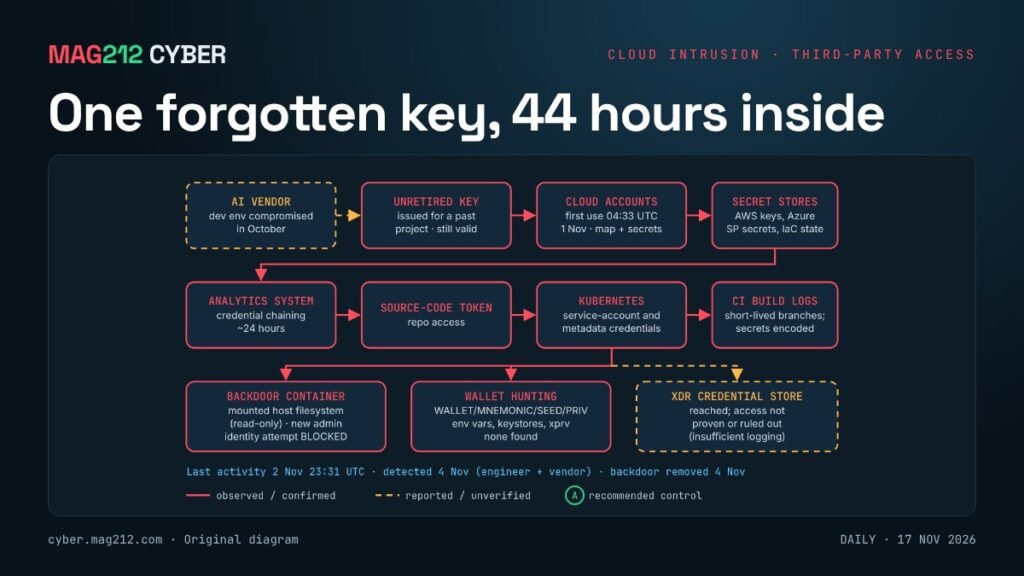
De la part de MAG212 CYBER Daily, 17 November 2026. Chaque commande est copiée de la documentation officielle ou de l'analyse citée et a été non testé par MAG212; exécutez-le uniquement sur les systèmes que vous êtes autorisé à administrer.
Statut: Confirmed by Barracuda. Barracuda published a Trust Center advisory on 10 November and a detailed blog post on 11 November 2026; press coverage followed on 16 November. Barracuda matched the tooling to ARTEX but has not attributed the attack to a group. No indicators of compromise were published. [1][2][3][4]
Ce qui s'est passé
Between 1 and 2 November 2026, an attacker accessed about 10 Barracuda cloud accounts over roughly 44 hours. The entry point was not a software vulnerability. It was a valid cloud access key that Barracuda had issued to a third-party AI vendor for an earlier project and never retired. The vendor’s development environment was compromised in October, and Barracuda believes the attacker found the key there. [1]
Barracuda discovered the intrusion on 4 November, when an engineer reported unusual activity on their own account and, the same day, the vendor contacted Barracuda about its own incident. By then the activity had stopped. [1]
Chronologie
| Date (UTC) | Événement |
|---|---|
| October | AI vendor’s development environment compromised; the key was likely taken there |
| 1 Nov, 04:33 | First use of the key; the attacker maps what it can reach and reads stored secrets |
| 1–2 Nov | About 24 hours of credential chaining across accounts and systems |
| 2 Nov, early hours | About four hours of CI abuse to expose build secrets |
| 2 Nov, 23:31 | Last recorded activity |
| 4 Nov | Engineer reports anomaly; vendor reports its incident; backdoor container removed in the evening (Pacific) and rotation begins |
| 10-11 novembre | Trust Center advisory and blog post published |
Source: Barracuda. [1]
Qui est concerné ?
- Barracuda Managed XDR Cloud et Monitored Endpoint customers whom Barracuda contacted directly. The attacker reached a system storing the API integration credentials Barracuda uses to collect data from customers’ connected systems. Barracuda found no direct evidence those credentials were accessed, but its logging could not rule it out. [1][2]
- Customers who were not contacted need no action, according to Barracuda. [1]
Pourquoi c'est important
This is a security vendor describing its own breach in detail, and the root cause is ordinary: a credential that outlived the project it was created for. ARTEX made the intrusion fast, but the door was opened by access management, which every organisation can fix this week. (Analyse MAG212)
Comment fonctionne l'attaque
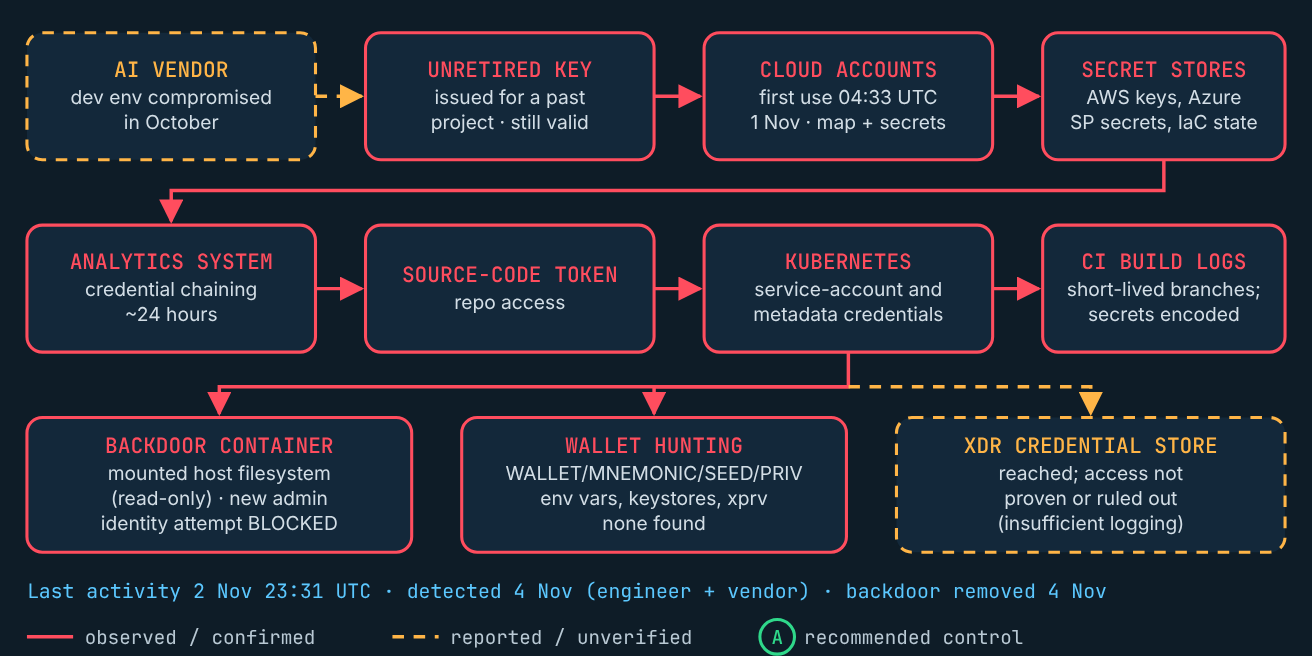
Barracuda’s account describes a chain of credentials, each unlocking the next: [1]
- Accès initial : the unretired vendor key gives access to cloud accounts; stored secrets, including AWS access keys and Azure service principal secrets, are read.
- Credential chaining: cloud accounts lead to a data analytics system, which yields a source-code access token, which leads to Kubernetes clusters.
- Harvesting: the attacker decrypts infrastructure-as-code state files, which often contain credentials, and pulls credentials from server metadata services and Kubernetes service accounts.
- CI abuse: over about four hours on 2 November, the attacker pushes short-lived branches to several repositories to trigger a build workflow that prints build-system secrets to the job log, encoded to get past log masking.
- Persistance: a container deployed in a Kubernetes cluster mounts the host server’s file system read-only, enough to harvest the server’s credentials. An attempt to create a new administrative cloud identity is blocked.
- Wallet hunting: on servers where it gets a shell, the attacker searches for environment variables named WALLET, MNEMONIC, SEED and PRIV, Ethereum keystore files, extended private keys, seed-phrase files and wallet-named Kubernetes secrets. None were present.
Why Barracuda links it to ARTEX
ARTEX is an open-source agentic penetration-testing framework released in July 2026: a planner sets tasks, and worker agents carry them out while sharing a map of the target. Barracuda matched the machine-style resource labels (“i” followed by digits), the order of operations and the credential- and wallet-hunting routines to ARTEX. Because many groups use ARTEX, Barracuda says the match describes the method, not the actor. [1][3]
The FBI warned on 13 November that ARTEX lets low-skilled actors run complex, multi-target operations, and Censys counted about 1,500 exposed ARTEX consoles in early November. Barracuda compares the intrusion to an October attack on cloud platform Railway. [3][5][6][7]
Ce que les défenseurs doivent surveiller
- API calls from a vendor’s key outside its project window or from new networks.
- Bulk reads from secret stores (AWS Secrets Manager, Azure Key Vault) and downloads of infrastructure-as-code state files.
- Short-lived branches that trigger CI and are then deleted; base64-like strings in build logs.
- New pods that mount host paths; attempts to create administrative identities.
- Resource names consisting of “i” plus digits, which Barracuda tied to ARTEX. [1]
Without published IPs or hashes, detection depends on behaviour.
Comment enquêter
These commands are lecture seule. They use the AWS CLI, Azure CLI, kubectl and jq as documented by their vendors. Non testé par MAG212. [8][9][10][11]
Review keys held by a vendor’s IAM user in AWS:
aws iam list-access-keys --user-name <VENDOR_USER>
aws iam get-access-key-last-used --access-key-id <ACCESS_KEY_ID>
aws cloudtrail lookup-events --max-results 50 \
  --lookup-attributes AttributeKey=AccessKeyId,AttributeValue=<ACCESS_KEY_ID>
A key with no business use for months is a candidate for removal. CloudTrail event history covers 90 days of management events only.
List an Azure service principal’s secrets and expiry dates, and find Kubernetes pods that mount host paths:
az ad sp credential list --id <APP_ID> --query "[].{id:keyId,end:endDateTime}"
kubectl get pods -A -o json | jq -r '.items[]
  | select(any(.spec.volumes[]?; .hostPath)) | "\(.metadata.namespace)/\(.metadata.name)"'
Legitimate agents (networking, logging, monitoring) also mount host paths, so compare the list with what you expect.
Comment contenir et remédier
- Barracuda XDR customers who were contacted: revoke and recreate API integration credentials following the Trust Center guidance. [2]
- Revoke vendor keys tied to finished work; replace the rest with short-lived, narrowly scoped credentials. [1]
- Treat every secret reachable from a compromised key as exposed and rotate it, as Barracuda did with its “worst-case” scoping. [1]
- Remove unknown containers and identities; rebuild affected nodes from known-good images.
- Prevent secrets from reaching CI logs and require review for workflow changes.
Comment vérifier la récupération
- Revoked keys fail; new keys work only from expected sources.
- No pods with host-path mounts beyond your approved list.
- Secret-store and CI audit logs show no unexpected access.
Prévention et sensibilisation
Barracuda’s own lessons: remove standing, long-lived credentials, especially those held by third parties; use short-lived, narrowly scoped credentials so no single key opens the next system; plan to rotate secrets at scale and rebuild from known-good states; and share indicators early. [1]
- Administrateurs : keep an inventory of every credential issued to a vendor, with an owner and an expiry date.
- Project owners: end every vendor engagement by revoking its access.
- Employés: report unusual activity on your account at once; that is how Barracuda found this intrusion.
Sujets connexes sur MAG212 CYBER
- MAG212 CYBER Daily, 17 November 2026: Keys that outlived the job (numéro complet et PDF)
- MAG212 CYBER Daily, 16 novembre 2026 : Les boîtes que personne ne répare
- MAG212 CYBER Hebdomadaire, 14 novembre 2026
- Abonnez-vous gratuitement à MAG212 CYBER
Sources
- [1] Barracuda, “Anatomy of a machine-speed intrusion“, 11 Nov 2026.
- [2] Barracuda Trust Center, “Barracuda XDR integration credentials advisory“, 10 Nov 2026.
- [3] SecurityWeek, “Barracuda hacked amid surge in Artex-powered cyberattacks“, 16 novembre 2026.
- [4] BleepingComputer, “Barracuda links cloud breach to ARTEX AI-powered cyberattack“, 16 novembre 2026.
- [5] FBI, “Cybersecurity advisory on ARTEX (FLASH, PDF)“, 13 novembre 2026.
- [6] Censys, “ARTEX: agentic asbestos (exposed consoles)“, novembre 2026.
- [7] Railway, “Incident report: October security incident“, Oct 2026.
- [8] AWS CLI reference, “iam get-access-key-last-used“, docs 2026.
- [9] AWS CLI reference, “cloudtrail lookup-events“, docs 2026.
- [10] Microsoft Learn, “az ad sp credential list“, docs 2026.
- [11] Kubernetes, “Volumes: hostPath“, docs 2026.
Written and edited by El Mostafa Ouchen for MAG212 CYBER. Facts checked against the sources above as of 17 November 2026, 6:00 AM PT.