
“ Ici le service juridique ” : Comment fonctionnent les appels d'hameçonnage MFA en temps réel et pourquoi Passkeys les bloquent
A plain-language lesson on the vishing playbook Okta and Unit 42 describe, with rules for staff, administrators and leaders
De la part de MAG212 CYBER Quotidien, 25 novembre 2026. Cet article a été rédigé avec l'aide d'une IA et édité par El Mostafa Ouchen. Les commandes, lorsqu'elles sont incluses, sont génériques et ont été non testé par MAG212; exécutez-les uniquement sur les systèmes que vous êtes autorisé à administrer.
Ce que vous apprendrez
- How a “legal department” phone call can defeat one-time codes and push approvals
- Why passkeys and device-bound sign-in break the attack
- Four rules every employee can remember
- What administrators and business leaders should change this week
La version courte
The Hacker News reports, citing Okta and a Unit 42 alert, that a vishing (voice phishing) crew Okta tracks as O-UNC-053 phones employees while posing as their company’s legal department or help desk. The caller steers the victim to a fake sign-in page and talks them into reading out a one-time code or approving a push prompt. The phishing kit relays the real login in real time. Les actualités des hackers
Okta links the cluster to a data-leak site called INCEPTION and says it may be a rebrand of ShinyHunters; INCEPTION denies this. Les actualités des hackers
Lesson 1: How the call works
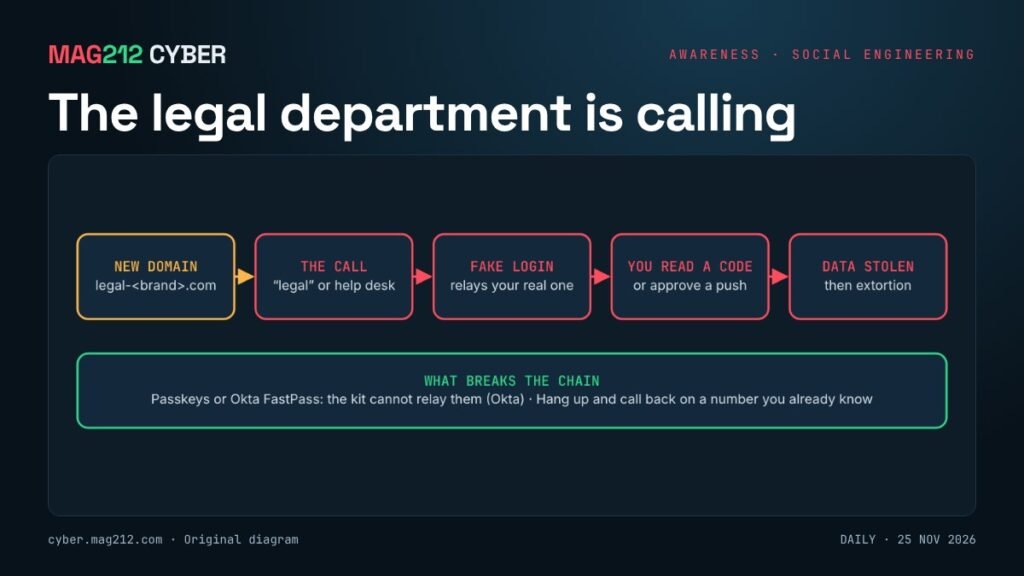
- A new domain. The crew registers a domain for each target, often a day before the campaign. Since October 2026 they use a legal theme, with patterns like legal-yourcompany.com or yourcompany.legal.
- The call. Someone claiming to be from legal or the help desk calls and sends you to that page.
- The fake login. The page passes your username and password to the real identity provider (Okta or NetIQ were observed) as you type.
- The code or the push. The caller asks you to read out a code, or to approve the prompt that appears on your phone.
- The theft. With your session, they reach company SaaS apps, take data, and extort the company.
Unit 42 counts more than 70 such domains since October 2026. Domains seen in the campaign imitate well-known brands; that does not mean those companies were victims. Les actualités des hackers
Lesson 2: Why codes and pushes fail here
A one-time code proves you have your phone. It does not prove which website you are typing it into. If you read it to a caller, or type it into a relay page, the attacker uses it within seconds.
Passkeys work differently: the browser only releases them to the real website’s domain, so a lookalike page cannot collect them. Okta says this kit is not designed to bypass phishing-resistant methods such as passkeys and Okta FastPass. Les actualités des hackers
La leçon : the fix is not “train people harder”. It is giving them a sign-in method that cannot be phished. (MAG212 analysis)
Four rules for every employee
- No one from legal, IT or security needs your one-time code. Ever.
- Don’t approve a sign-in prompt you didn’t start.
- Hang up and call back on a number from the intranet or company directory.
- Report the call, even if you did nothing wrong.
For administrators
- Move privileged and help-desk accounts to passkeys or another phishing-resistant method first.
- Watch for newly registered domains that combine your brand name with “legal”.
- Alert on MFA approvals that follow a burst of denied prompts, and on sign-ins from new devices right after a phone call is reported.
- Require identity checks before the help desk resets MFA or passwords by phone.
For business leaders
- Fund phishing-resistant MFA for the people attackers call first: executives, finance, legal, IT and the help desk.
- Make “call back on a known number” a company rule, not a suggestion.
- Thank people who report suspicious calls, and never punish them.
Three questions for your next team meeting
- Who in our company would get this call first?
- Could a caller reset an account by phone today?
- How fast would we spot a lookalike domain with our name in it?
Sujets connexes sur MAG212 CYBER
- MAG212 CYBER Daily, 25 novembre 2026 : Maîtrisez la console, maîtrisez le réseau (numéro complet et PDF)
- Maîtrisez vCenter, maîtrisez tout : Guide pratique des correctifs critiques de novembre de VMware
- Quand les attaquants prennent le contrôle de votre gestionnaire de pare-feu : Leçons tirées des intrusions Check Point GT13
- Quand l'installateur devient l'attaque : comprendre la faille critique du noyau de Drupal
- Abonnez-vous gratuitement à MAG212 CYBER
Sources
- Les actualités des hackers : thehackernews.com
Rédigé et édité par El Mostafa Ouchen pour MAG212 CYBER. Informations vérifiées auprès des sources ci-dessus le 25 novembre 2026 à 7 h 00 (heure du Pacifique).