
SignDrop : une faille de sécurité publique de Windows exploite les privilèges de Microsoft Defender pour accéder au système. Aucun correctif n’est encore disponible.
The researcher known as Nightmare Eclipse has released another Windows zero-day, and this one turns Microsoft’s own antivirus into the helper. SignDrop lets a standard local user become SYSTEM by combining a quirk in how the Windows Common Log File System signs log files with Microsoft Defender’s signature-update interface. Security firm Cyderes compiled and tested the proof of concept. There is no CVE, no fix and, so far, no sign of exploitation in the wild.
Ce qui s'est passé
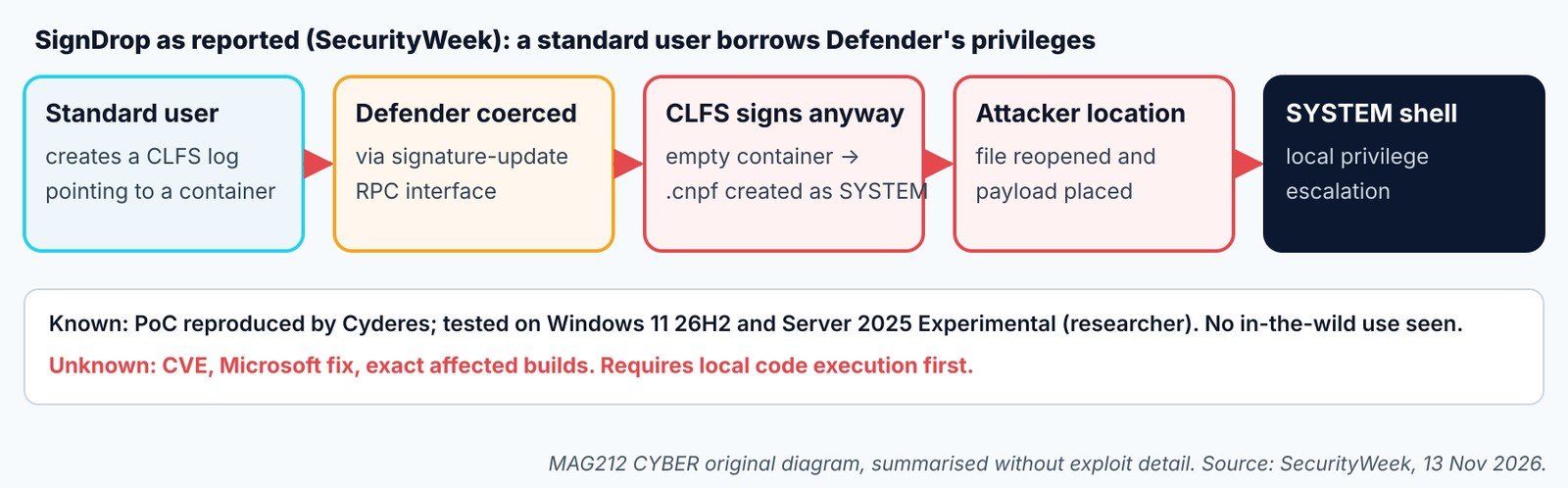
[Signalé] Researcher Abdelhamid Naceri (“Nightmare Eclipse”) released SignDrop this week. It lets a local, standard user become SYSTEM by abusing how the Common Log File System (clfs.sys) creates its .cnpf authentication file. Cyderes compiled and tested the proof of concept and has seen no exploitation in the wild. SecurityWeek asked Microsoft for comment. (Semaine de la sécurité) [Inconnu] At our cutoff we found no Microsoft advisory, CVE or fixed build.
Qui est concerné et comment cela fonctionne
[Signalé] The researcher says he tested it on Windows 11 26H2, Windows 11 26H2 Experimental and Windows Server 2025 Experimental. He claims it works on most Windows installations and that you’re “generally vulnerable” if Windows is older than 90 days; neither claim is verified. The trick: if a log’s container is empty, CLFS signs it whether or not a signature file exists. A user can point a log at a chosen path, make Defender open it through its signature-update interface, and so get a SYSTEM-owned file created where they choose. (Semaine de la sécurité) [Analyse MAG212] This doesn’t let anyone in from outside: an attacker first needs code running as a user, from phishing or a stolen login. That’s exactly when ransomware crews want SYSTEM.
Inventory what you’ll need when Microsoft responds
OS: Windows 10/11, Server 2019+ · Shell: PowerShell 5.1 · Privileges: standard user · READ-ONLY
# OS build and update revision (UBR)
$cv = Get-ItemProperty 'HKLM:\SOFTWARE\Microsoft\Windows NT\CurrentVersion'
'{0} {1}.{2}' -f $cv.DisplayVersion, $cv.CurrentBuild, $cv.UBR
# Defender platform and engine versions
Get-MpComputerStatus | Select-Object AMProductVersion, AMEngineVersion, AntivirusSignatureLastUpdated
Record these per device so you can match them to Microsoft’s fix when it ships. Commandes non testées par MAG212 CYBER.
Contain, remediate and prevent
- Keep Windows and Defender platform updates current, and watch the Microsoft Security Response Center for a SignDrop advisory.
- [Analyse MAG212] Hunt: look for Defender processes (
MsMpEng.exe) creating files in user-writable folders, followed by a new SYSTEM-level process, service or scheduled task started from that location. - Reduce the first step: no local admin for daily use, application control on workstations, and fast isolation for any machine running unknown code.
Vérifier la récupération : once Microsoft ships a fix, confirm the build and UBR across the fleet and re-run your hunt over the period before patching.
Putting the risk in proportion
[Analyse MAG212] SignDrop is a local privilege escalation: it doesn’t let anyone in from the internet. An attacker first needs code running on the machine as an ordinary user, through phishing, a malicious download or stolen credentials. That is a real step, but it is exactly the step most intrusions already achieve. Privilege escalation is how they go from one user’s files to disabling security tools and spreading.
[Signalé] The researcher claims the exploit works on most Windows installations and that systems older than 90 days are generally vulnerable. Neither claim has been independently verified, and he tested it on a small set of builds. Until Microsoft publishes an advisory, the safest assumption is that supported Windows versions are affected.
[Analyse MAG212] Public exploits like this tend to be adopted by ransomware crews and red teams quickly, because they are free and reliable. The window between release and a Microsoft fix is when behavioural detection matters most.
Pourquoi c'est important
Almost every Windows machine runs Microsoft Defender, so a privilege escalation that abuses it has a very wide footprint. With working code public and no patch, defenders have to rely on reducing the first step, catching the abnormal behaviour, and being ready to patch quickly when Microsoft responds.
En résumé
Keep Windows and Defender platform updates current and watch the Microsoft Security Response Center for a SignDrop advisory. In the meantime, record OS builds and Defender versions across the fleet, hunt for Defender creating files in user-writable folders followed by new SYSTEM-level processes or tasks, and keep daily accounts free of local admin rights.
Comment nous étiquetons les preuves : [Confirmé] provient d'une source primaire telle qu'un fournisseur ou la CISA ; [Signalé] à partir d'une sortie secondaire ; [Revendiqué] d'un attaquant ou d'une partie non vérifiée ; [Analyse MAG212] est notre jugement; [Inconnu] Les termes « non établi » n'étaient pas encore disponibles au moment de la publication. Les commandes et indicateurs sont tirés des sources citées et n'ont pas été testés par MAG212 CYBER.
Cette histoire fait partie de MAG212 CYBER Daily, 13 November 2026, Retrouvez également les autres informations vérifiées du jour, la rubrique Action Desk du Defender et un registre complet des sources. Recevez gratuitement le briefing quotidien : abonnez-vous à MAG212 CYBER. Par El Mostafa Ouchen.