
OPTIMJACK: How a Hijacked Optimizely Script Served a Crypto Clipper, Card Skimmer and iPhone Exploit Loader to 178 Websites
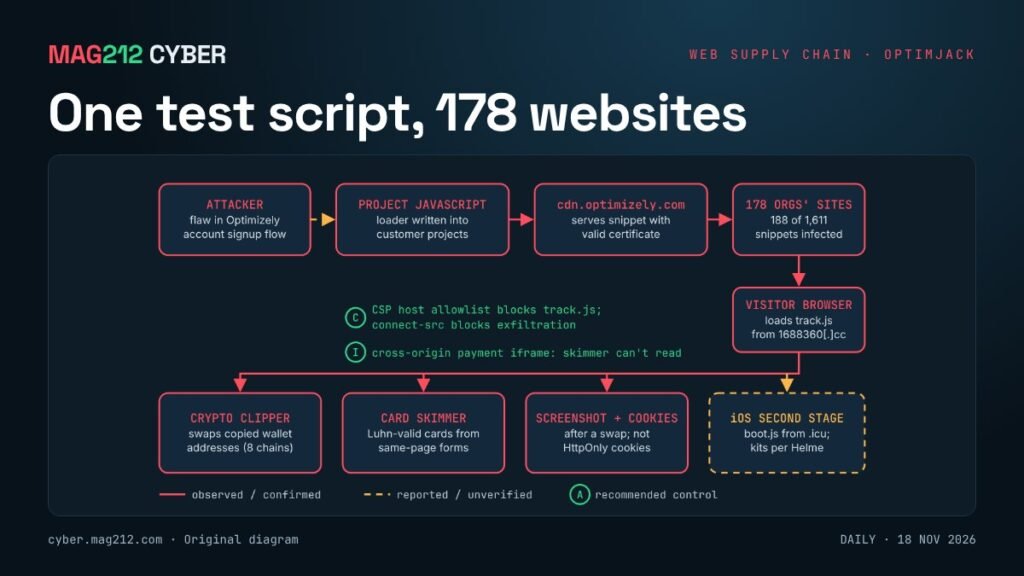
De la part de MAG212 CYBER Quotidien, 18 novembre 2026. Chaque commande est copiée de la documentation officielle ou de l'analyse citée et a été non testé par MAG212; exécutez-le uniquement sur les systèmes que vous êtes autorisé à administrer.
Statut: Observed on 16 November 2026 by multiple researchers; Optimizely fixed the flaw and removed the code early on 17 November, according to Palo Alto Networks Unit 42. Payload behaviour and indicators below come from StepSecurity’s analysis, which draws on Report URI and public scan data. Exploit pages for iPhones were served, but actual iOS infections are not confirmed. [1][2]
Ce qui s'est passé
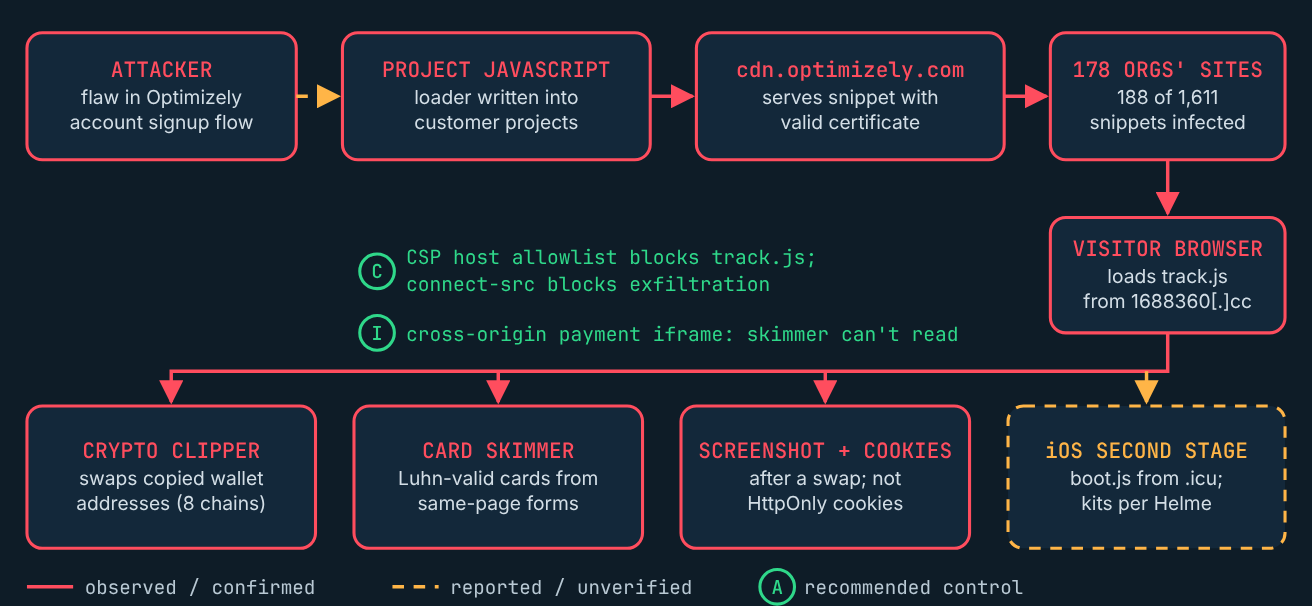
Optimizely Web Experimentation lets websites run A/B tests by loading a per-project JavaScript snippet from Optimizely’s CDN. On 16 November 2026, an attacker exploited a vulnerability in the platform and wrote malicious code into the custom Project JavaScript field of customer projects. Optimizely’s CDN then delivered that code, under Optimizely’s own certificate, to everyone visiting the affected sites. [1][2]
Report URI founder Scott Helme checked 1,611 Optimizely snippets and found the injected code in 188 of them, belonging to 178 organisations; StepSecurity notes this is a floor. Named sites include the BBC, CNN, Fox News, Zoom, Salesforce, GitLab, HSBC, KLM, IKEA, Equifax, Air France-KLM, Ledger and Peacock. Optimizely’s own website and login page carried the loader too. [2][3][4]
Chronologie
| Time (UTC) | Événement |
|---|---|
| 16 Nov, 04:21 | BBC snippet begins loading the injector from webshell[.]lol |
| 16 Nov, 05:23 | Payload domain 1688360[.]cc registered; first public scan hit at 08:28 |
| 16 Nov, 13:43 | Card-skimmer block added to the payload |
| 16 Nov, 20:40–21:10 | Mass cleanup; one snippet still infected at 21:52 |
| 16 Nov, 23:11 | Report URI: all files clean |
| 17 Nov, early | Optimizely patches the flaw; payload and injector domains placed on registry hold |
Sources: StepSecurity (citing Report URI) and Unit 42. [1][2]
Qui est concerné ?
- Site owners using Optimizely Web Experimentation whose projects were modified, including those serving the snippet from their own domain. Optimizely says it notified affected customers. [2]
- Visitors to affected sites during the window, especially anyone who copied a cryptocurrency address, entered card details on a same-page checkout form, or browsed on an iPhone or iPad. [2]
Pourquoi c'est important
None of the 178 organisations was breached, yet their visitors were attacked under their brand, from a domain they trusted, with a valid certificate. Third-party scripts on login and checkout pages carry the same trust as your own code, and most organisations cannot say who can change them. (Analyse MAG212)
Comment fonctionne l'attaque
- Entrée: Optimizely attributes the entry point to its account signup flow, but has not explained how that gave write access across unrelated customer projects. [2]
- Injection: the attacker wrote a loader into each project’s Project JavaScript field, a custom-code field that runs on every page. StepSecurity stresses this was not CDN cache poisoning: the CDN served exactly what the project contained. [2]
- Three loader variants: a plain script tag pointing at
1688360[.]cc/track.js; the same URL base64-encoded and decoded withatob(), so a text search for the domain misses it; and a full inline copy of the payload with anevalfallback that keeps working if the domain is blocked. [2] - Charge utile: the script changed 26 times that day and did four things: [2]
- Crypto clipper: swaps checksum-valid wallet addresses for eight chains (ETH, TRX, BTC, TON, SOL, LTC, BCH, DOGE) when nearby text mentions words such as wallet, deposit or send, hooking copy events, the clipboard API and page text.
- Screenshot and cookie theft: after a swap, captures the visible page and up to 8,000 characters of non-HttpOnly cookies and posts them to
/hit.php. - Card skimmer: watches form submissions and network calls for Luhn-valid card numbers with expiry and CVV and beacons them to
/card.php. It cannot read cross-origin payment iframes. - iOS second stage: on iPhone, iPad and iPod user agents it loads scripts from
.icudomains; on iOS 18.6 or earlier it adds a hidden iframe. Helme attributes the chains to the Coruna and DarkSword exploit kits; StepSecurity did not analyse those files itself. [1][2]
Unit 42 describes the same three behaviours: wallet swapping, card skimming and attempts to deliver Coruna and DarkSword to iPhones and iPads. [1]
What was taken
Helme counted about $7,040 taken by 19:25 UTC on 16 November, including stablecoins. Galaxy’s Alex Thorn estimated about $2,300 actually sent by victims, suggesting some on-chain flows were the attacker’s own funds; this is not independently confirmed. Card losses are not known. [2]
Vendor and customer response
According to StepSecurity and Unit 42, Optimizely blocked the vulnerable path, deployed a fix, removed injected code, ended sessions and revoked tokens for affected accounts, blocked delivery through Cloudflare and notified customers. Cybernews reports that Salesforce disabled the altered scripts and that Equifax stopped using Optimizely and found no compromise of its own systems. [1][2][4]
Ce que les défenseurs doivent surveiller
Indicators below are defanged and come from StepSecurity, which lists hashes and wallet addresses in full. [2]
- Domains:
1688360[.]cc(payload and exfiltration),webshell[.]lol(injector), and iOS-stage hosts includingios-hack[.]icu,eil786npto9u5bq[.]icu,5vobauua3ojpklx[.]icuetl7bcsnwc7nzr3uo[.]icu. - IPs:
136[.]113[.]106[.]136,34[.]87[.]36[.]58,34[.]96[.]213[.]201. - Paths:
/track.js,/html2canvas.min.js,/hit.php,/card.php,/boot.js,/JIUJIU888/weifile.html. - Browser artefacts: globals
window._k7,_cc,_qxc,_shot; sessionStorage keys beginningcc_.
The domains were placed on hold on 17 November. Block them anyway and search DNS, proxy and CSP report logs from 04:00 UTC on 16 November.
Comment enquêter
This check is lecture seule and uses only curl and grep. Non testé par MAG212. It fetches the snippet your pages load today and counts suspicious markers. A clean result now does not prove you were clean on 16 November, and legitimate experiments may use atob ou eval. [2]
URL='https://cdn.optimizely.com/js/<PROJECT_ID>.js'
curl -s "$URL" \
  | grep -oE '1688360|webshell|atob\(|eval\(|\.icu' \
  | sort | uniq -c
The source of truth is each project’s Project JavaScript field. StepSecurity recommends that site owners: [2]
- Read the Project JavaScript field of every Optimizely Web project, looking for
atob(), base64 strings and inline code with anevalfallback. - Check snippets served from your own domain as well as from cdn.optimizely.com.
- Review users and API tokens in your Optimizely account and remove any you do not recognise.
- Ask Optimizely which of your projects were modified, when and through which accounts.
- Check CSP reports and browser telemetry for blocked requests to the payload host.
Comment contenir et remédier
- Clean the source: remove injected code from Project JavaScript; a domain block alone misses the inline variant. [2]
- Treat exposure as compromise: card data entered on affected checkout pages during the window should be treated as compromised, and your PCI and breach-notification processes should start. Unit 42 gives the same advice. [1][2]
- Audit changes: review every project modification made while the code was live. [1]
- Reduce the blast radius: remove non-essential marketing, experimentation and analytics tags from authentication and checkout pages, and collect payments in the provider’s hosted fields inside a cross-origin iframe. [1][2]
- Constrain scripts: a Content Security Policy host allowlist in
script-srcblockstrack.js, etconnect-srcblocks exfiltration. A nonce-basedstrict-dynamicpolicy does not block scripts that a trusted script adds. Subresource Integrity rarely fits snippets that change with every experiment. [2]
Comment vérifier la récupération
- Every project’s Project JavaScript field has been read after cleanup and contains only known code.
- Unknown Optimizely users and tokens are removed and remaining credentials rotated.
- CSP reports show no further requests to the payload or iOS hosts.
Advice for visitors
- If you paid by card on an affected site on 16 November, watch your statements and consider asking your bank for a new card.
- If you copied a crypto wallet address from an affected site, verify the destination on your hardware wallet’s screen before sending anything.
- If you visited affected sites on an iPhone or iPad running iOS 18.6 or earlier, update now. People at high risk, such as journalists or executives, should consider a forensic check. [2]
Prévention et sensibilisation
- For leaders: ask your web team which outside scripts load on login and checkout pages, who can change them, and how you would know.
- For web teams: treat tag managers and experimentation platforms as production code paths with change control, least-privilege accounts and monitoring.
- For security teams: collect CSP reports. They are often the first and only signal that a trusted script started talking to a new host.
Sujets connexes sur MAG212 CYBER
- MAG212 CYBER Quotidien, 18 novembre 2026 : Un signe égal de trop (numéro complet et PDF)
- MAG212 CYBER Daily, 17 novembre 2026 : Des clés qui ont survécu à l’emploi
- MAG212 CYBER Daily, 16 novembre 2026 : Les boîtes que personne ne répare
- MAG212 CYBER Hebdomadaire, 14 novembre 2026
- Abonnez-vous gratuitement à MAG212 CYBER
Sources
- [1] Palo Alto Networks Unit 42, “Borrowed code, real consequences: what OPTIMJACK teaches us“, 17 novembre 2026.
- [2] StepSecurity, “OPTIMJACK: Optimizely-hosted scripts loaded a crypto clipper and card skimmer“, 17 novembre 2026.
- [3] Affaires de sécurité, “OPTIMJACK: BBC, CNN and Zoom among targets of Optimizely script hijacking“, 17 novembre 2026.
- [4] Cybernews, “Zoom, IKEA, HSBC among 178 websites infected with hidden malware“, 17 novembre 2026.
Rédigé et édité par El Mostafa Ouchen pour MAG212 CYBER. Informations vérifiées auprès des sources ci-dessus le 18 novembre 2026 à 6h00 (heure du Pacifique).