
Cold Relic (COLDRIVER): How a Russian Group Turned One Victim’s Staff Into a Lure for the Next
De la part de MAG212 CYBER Daily, 19 November 2026. Chaque commande est copiée de la documentation officielle ou de l'analyse citée et a été non testé par MAG212; exécutez-le uniquement sur les systèmes que vous êtes autorisé à administrer.
Statut: Signalé par Google’s threat intelligence group (GTIG) on 18 November 2026, as summarised by SecurityWeek and The Hacker News. We could not load Google’s original post, so details here are second-hand. No indicators of compromise were published in the coverage. Neither victim is named. [1][2]
Ce qui s'est passé
Google’s threat intelligence group described two intrusions by a group it calls Cold Relic, also tracked as COLDRIVER, UNC4057, Star Blizzard, Callisto and Gossamer Bear. SecurityWeek notes the US government has associated Star Blizzard with Russia’s FSB, and that the group has been active for more than a decade against government officials, defence contractors and NGOs in Europe and North America. [1][2]
Pourquoi c'est important
This campaign used no malware. Everything ran on built-in cloud features: admin consoles, data export tools, passkeys and MFA device registration. A password reset did not remove the attackers, and the stolen identities outlived the eviction and were turned against partners. Any organisation that shares a professional network with a breached company is a potential next target. (Analyse MAG212)
Victim 1: a Google Workspace takeover
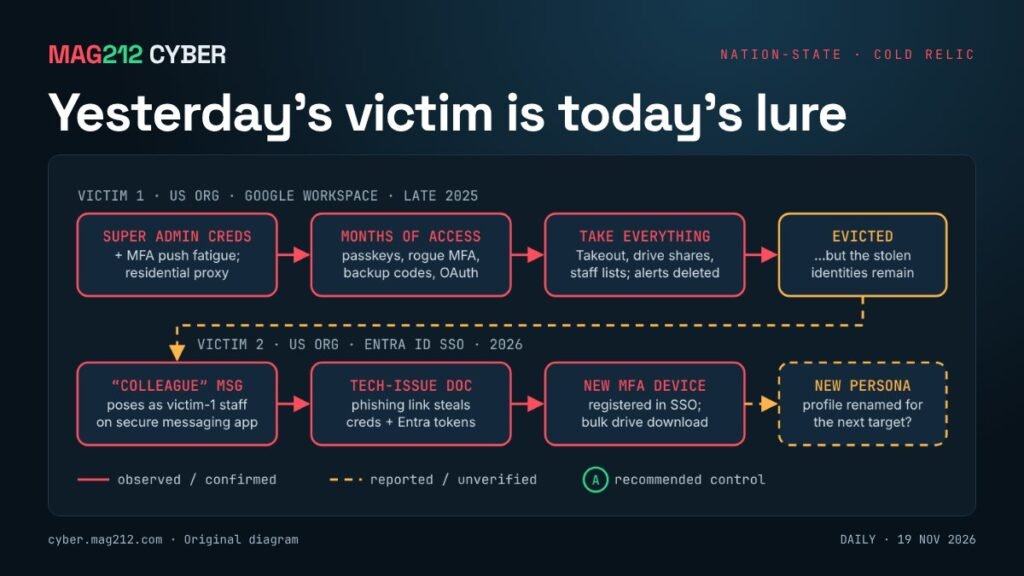
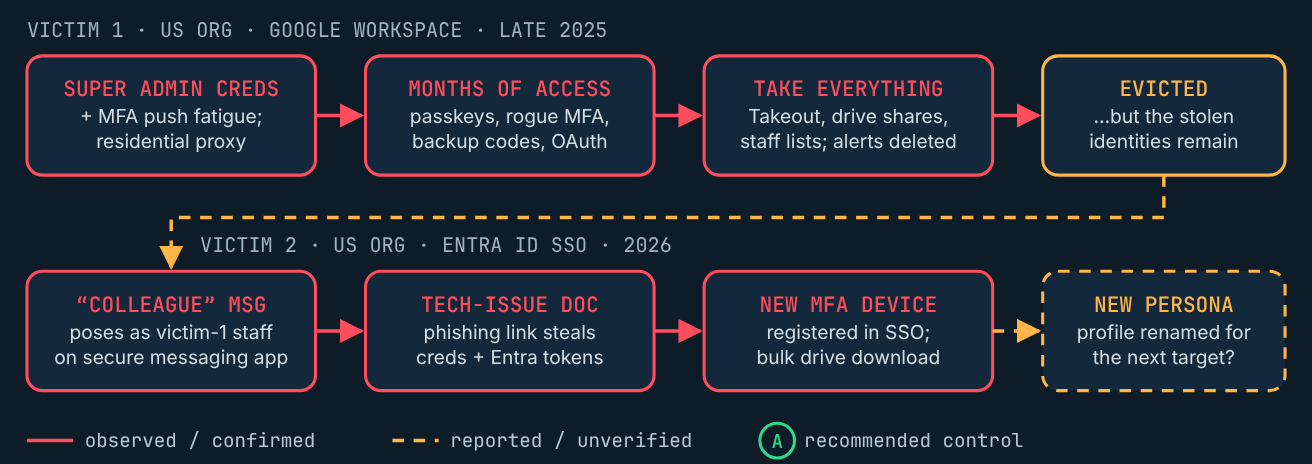
In late 2025 the group compromised a US organisation’s Google Workspace. According to The Hacker News’s summary of Google’s report: [2]
- Accéder: the attackers used compromised Super Admin credentials, connected through a residential proxy network close to the victim, and bombarded the user with MFA push requests until one was accepted. They then registered their own MFA device.
- Collection: they mass-shared files to an account they controlled, downloaded the organisation’s entire cloud drive, and used the Admin Console and Google Takeout to export employee lists and domain-wide data.
- Evasion: they read the admin security-investigation and email audit logs to judge what defenders could see, and viewed, changed and deleted Alert Center notifications.
- Persistence for months: OAuth sync of mailboxes to external email clients, rogue MFA devices, MFA backup codes and passkeys. Passkeys that were never revoked survived password and session resets.
After the organisation evicted them, Google observed the group using email accounts that impersonated the victim’s employees to target its staff and contacts in the same professional circles. [1]
Victim 2: the borrowed identity
In 2026 the group targeted a second US organisation that uses Microsoft Entra ID to sign in to Google Workspace. Posing as an employee of the first victim, the attacker contacted a user through a secure messaging app, which the coverage does not name. The lure offered a document about a “technical issue”; the phishing link harvested the user’s credentials and Entra ID authentication tokens. [1][2]
The attacker then registered a new MFA device in the sign-in system and bulk-downloaded files from the user’s cloud drive. The messaging account’s profile was later renamed to a different persona, possibly to target other organisations in the same network. [2]
Google, as quoted by both outlets, described the campaigns as showing “the convergence of human-centric social engineering and cloud identity abuse”. [1][2]
What defenders should do
Google’s own recommendations were not available to us. These are MAG212 takeaways from the reported facts, not GTIG guidance:
- Evict completely. Revoke passkeys, MFA devices, backup codes, OAuth grants and app passwords, not only passwords and sessions.
- Watch the watchers. Alert on deletion of Alert Center items, on admins reading audit logs unusually, and on Google Takeout use by administrators. Restrict Takeout where it is not needed; The Hacker News links Google’s help page on doing so. [2]
- Stop push fatigue. Use phishing-resistant MFA (security keys or passkeys bound to managed devices) for administrators, and at minimum number matching for everyone.
- Alert on new MFA devices and passkeys, especially on administrator accounts and right after a sign-in from a new location or proxy network.
- Warn your people when a partner is breached. Messages from that partner’s staff, particularly on new channels, should be checked by phone using a number you already have.
Comment enquêter
In Google Workspace, review admin audit logs for Takeout exports, mass sharing to external accounts, new OAuth grants and MFA or passkey enrolments. In Entra ID, review sign-in logs for token use from unfamiliar addresses and new authentication methods registered shortly after a sign-in. Because no IoCs were published, focus on these behaviours over the period since your last confirmed clean state.
Prévention et sensibilisation
Run a tabletop: if a partner told you today that it had been breached, who would warn your staff, and how quickly? Make “verify by a call to a number you already have” a habit for any unexpected document or sign-in request, whatever the channel.
Sujets connexes sur MAG212 CYBER
- MAG212 CYBER Daily, 19 November 2026: A ten-year-old counter (numéro complet et PDF)
- MAG212 CYBER Quotidien, 18 novembre 2026 : Un signe égal de trop
- MAG212 CYBER Daily, 17 novembre 2026 : Des clés qui ont survécu à l’emploi
- MAG212 CYBER Hebdomadaire, 14 novembre 2026
- Abonnez-vous gratuitement à MAG212 CYBER
Sources
- [1] SecurityWeek, “Un groupe APT russe se fait passer pour un employé d'une entreprise piratée afin d'infiltrer une autre organisation américaine.“, 18 Nov 2026.
- [2] The Hacker News, “Russian COLD RELIC Hackers Use Stolen Google Workspace Data to Breach Second U.S. Organization“, 18 Nov 2026.
Written and edited by El Mostafa Ouchen for MAG212 CYBER. Facts checked against the sources above as of 19 November 2026, 6:00 AM PT.