
Meta Muse AI Agent Hijacked by One Web Page: How NebuSec’s Browser and Kernel Exploit Chain Worked, and the Lessons for AI Agents
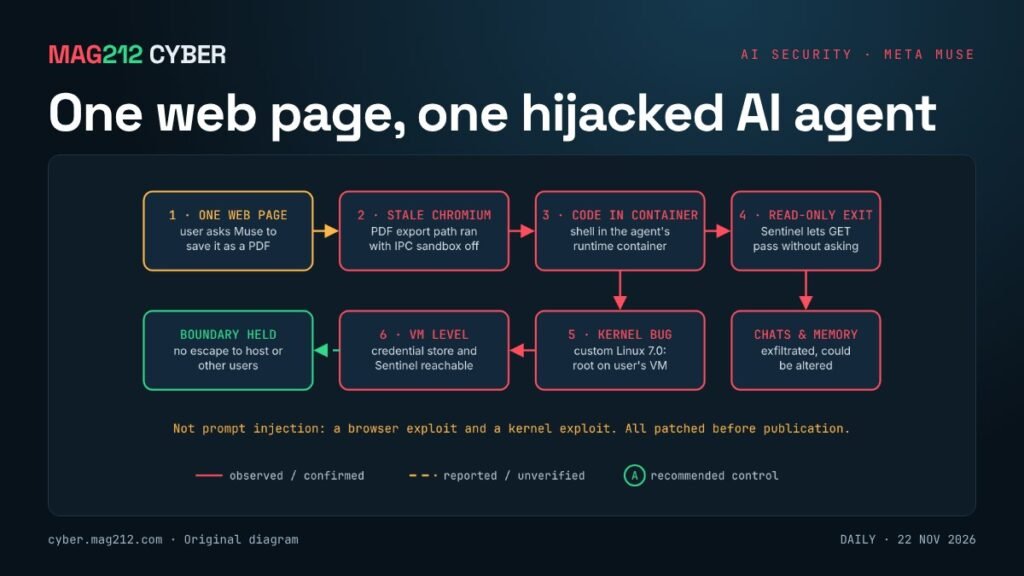
De la part de MAG212 CYBER Daily, 22 November 2026. This article was written with AI assistance and edited by El Mostafa Ouchen. Commands, where included, were non testé par MAG212; run them only on systems you are authorised to administer.
Statut: Fixed before publication, according to NebuSec. No exploitation of real users reported. Meta has not commented publicly, and no report or fix dates were given. [1][3]
Ce qui s'est passé
On 20 November 2026 the security firm NebuSec published two write-ups on Meta Muse, Meta’s AI agent product. They show that if a user asks Muse to save or export an attacker’s web page as a PDF, the attacker can run code inside the agent’s environment and, from there, take over the user’s cloud machine. NebuSec calls it a “0.5-click” attack. [1][2]
The Hacker News covered the research on 21 November under the headline that a single malicious webpage let researchers hijack Muse and access private chats. [3]
Pourquoi c'est important
AI agents browse the web, save files and remember conversations on a user's behalf. That makes them a new kind of endpoint: one that runs a browser, holds private data and has credentials to other services. This research shows such agents inherit every bug in the browser and kernel underneath them, and that an outbound filter is only as good as its rules. (Analyse MAG212)
Comment fonctionne l'attaque
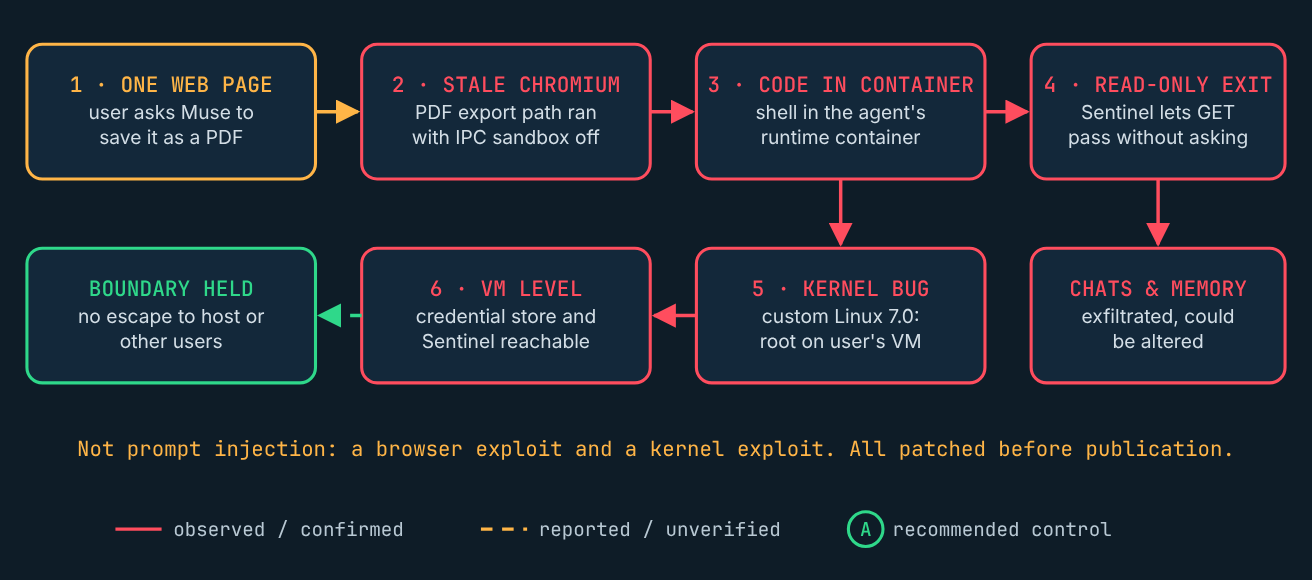
Each Muse user gets a small cloud virtual machine. The agent runs in a container inside it, and a guard called Sentinel controls outbound network traffic. [1]
- Entry. Muse’s bundled Chromium lagged behind upstream releases, and the PDF export path ran with Chromium’s internal IPC sandbox turned off. A crafted page gave NebuSec shell commands in the agent’s container.
- Getting data out. Under the default setting, Sentinel asks the user before “write” requests but lets “read” requests (GET, HEAD, OPTIONS) through without asking. NebuSec used those to send out conversation history and stored memories without a prompt; they could also be altered.
- Taking the machine. A kernel exploit against Muse’s custom Linux 7.0 kernel gave root on the user’s VM. NebuSec does not name a CVE.
- Past the guard. Sentinel’s hook covered container processes only, so VM-level processes could bypass it. The credential store and Sentinel itself were reachable. [1][2]
NebuSec does not say connector credentials were actually extracted. The compromise stayed inside one user’s VM: there was no escape to the host or to other users. [2]
This was not prompt injection
The headline trigger is “one web page”, but the mechanism is browser memory corruption followed by a kernel exploit, not text that tricks the AI model. Do not confuse it with Meta’s separate disclosure earlier in November of about $1.2 million paid in Muse bug bounties, which included a prompt-injection-style finding. [1][3]
Lessons for teams running AI agents
These are MAG212’s recommendations.
- Patch the agent’s browser and kernel on the browser’s schedule, not the product’s release cycle. Bundled engines go stale fast.
- Do not trust “read-only” traffic. GET requests can carry data in their query strings. Egress filters should inspect them and limit volume.
- Keep one tenant per VM. It is what stopped this chain from spreading to other users.
- Log what the agent fetches and exports, and alert on spikes.
- Keep credentials out of the agent’s reach, and assume the agent can be compromised, as Meta’s own design document says it does. [4]
What is still unknown
When NebuSec reported each bug and when each was fixed, which kernel CVEs applied, and whether any real user’s data was touched before the fixes.
Sujets connexes sur MAG212 CYBER
- MAG212 CYBER Daily, 22 November 2026: Can police trust the record? (numéro complet et PDF)
- MAG212 CYBER Weekly, 21 November 2026: Machine Speed
- MAG212 CYBER Daily, 20 novembre 2026 : Les clés de vSphere
- Abonnez-vous gratuitement à MAG212 CYBER
Sources
- [1] NebuSec, “Inside Meta Muse: browser, Sentinel and the shared-kernel boundary“, 20 novembre 2026.
- [2] NebuSec, “Meta Muse credential exposure“, 20 novembre 2026.
- [3] The Hacker News, “A single malicious webpage let researchers hijack Meta Muse and access private chats“, 21 Nov 2026.
- [4] Muse (Meta), “Security and safety for AI agents: our approach with Muse“, Sep 2026.
Written and edited by El Mostafa Ouchen for MAG212 CYBER. Facts checked against the sources above as of 22 November 2026, 7:00 AM PT.