
CISA’s KEV List Explained: How to Use the Known Exploited Vulnerabilities Catalog to Decide What to Patch First
A practical guide for small teams, with the deadlines that fall due on 23 and 24 November 2026 and the next ones coming up
De la part de MAG212 CYBER Daily, 23 November 2026. This article was written with AI assistance and edited by El Mostafa Ouchen. Commands, where included, are generic and were non testé par MAG212; run them only on systems you are authorised to administer.
What you will learn
- What the KEV catalog is and why it is more useful than a raw CVSS score
- How to read a KEV entry and its due date
- Which entries fall due this week
- A simple weekly routine for teams of any size
What KEV is
The Known Exploited Vulnerabilities (KEV) catalog is a list kept by the US Cybersecurity and Infrastructure Security Agency (CISA). A flaw goes on the list when there is reliable evidence that attackers are already exploiting it and there is a clear fix or mitigation. US federal civilian agencies must fix listed flaws by a due date. Everyone else can use it as a free, curated “patch this first” list.
You can read it as a web page or download it as JSON or CSV. MAG212 checked the JSON feed at 06:00 PT on 23 November 2026: it was catalog version 2026.11.20 with 1,790 entries, and nothing had been added on 21, 22 or 23 November at that time. CISA usually publishes during US working hours, so more may be added later today. CISA KEV JSON
Lesson 1: Exploited beats severe
There are tens of thousands of CVEs each year, and no team can patch them all at once. A high CVSS score says how bad a flaw could be. A KEV listing says attackers are using it now. For most organisations, “being exploited and present on my network” is the strongest signal for what to do first. (MAG212 analysis)
Lesson 2: How to read an entry
Each KEV entry includes the CVE ID, vendor and product, a short description, the date added, the due date, the required action, and whether the flaw is known to be used in ransomware campaigns. The due date is usually a few weeks after the date added; the federal deadline is your useful outside limit, not your target.
This week’s deadlines
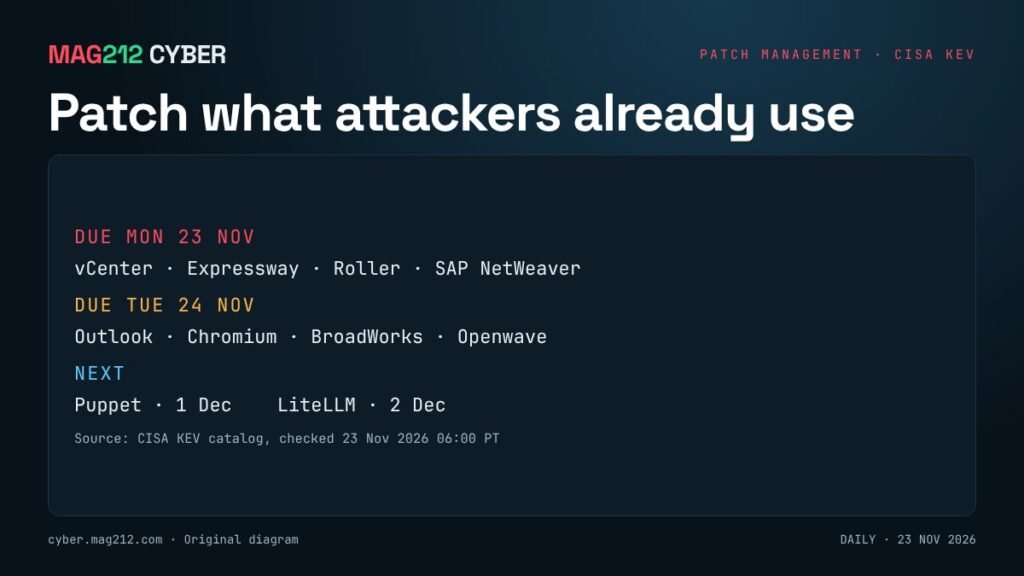
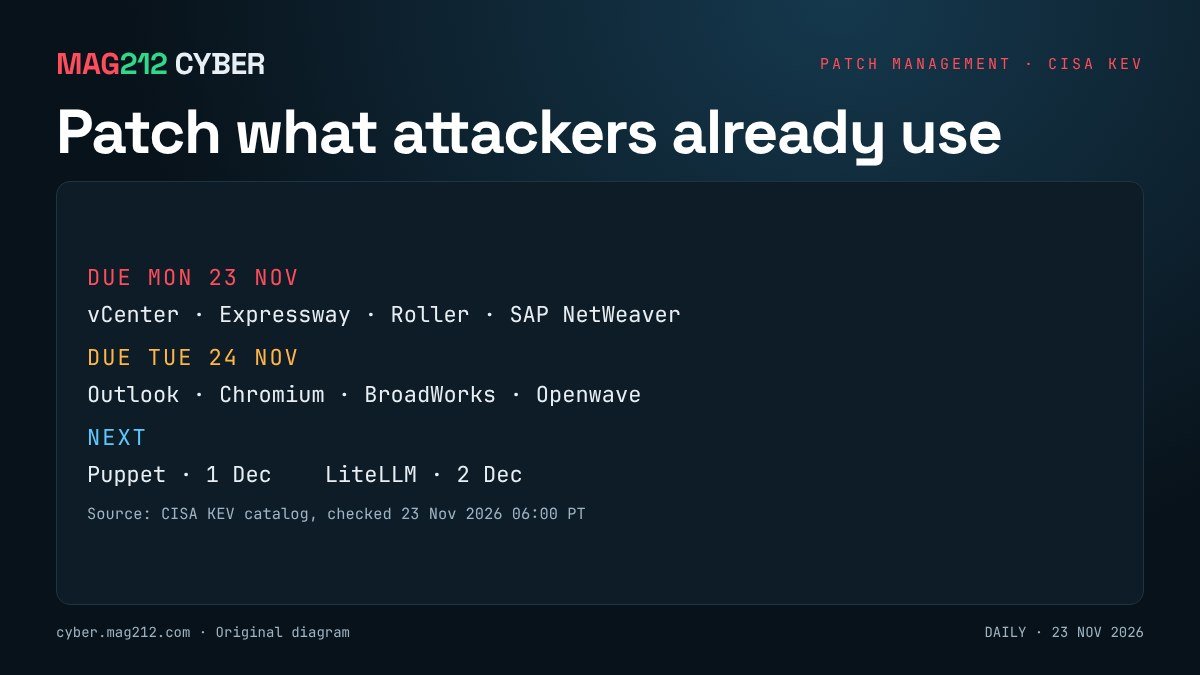
Due Monday 23 November (all added 20 November):
- CVE-2026-123890: VMware vCenter authentication bypass
- CVE-2026-76466: Cisco Expressway hard-coded credentials
- CVE-2026-129448: Apache Roller deserialization
- CVE-2025-42884: SAP NetWeaver JNDI injection
Due Tuesday 24 November (all added 10 November):
- CVE-2026-124194: Microsoft Outlook
- CVE-2026-125350: Chromium XML use-after-free
- CVE-2026-20320: Cisco BroadWorks XXE
- CVE-2026-111793: Openwave Webtop Media Transcoder
Coming up: Puppet CVE-2026-115731 is due on 1 December and LiteLLM CVE-2026-40217 on 2 December. CISA KEV JSON
The Puppet flaw is a good example of why KEV matters. It lets any client holding a CA-signed agent certificate run code on the Puppet Server, and with weak autosign settings an attacker may be able to obtain such a certificate. Fixed versions include Puppet Core 8.22.2 and 9.1.3 and OpenVox Server 9.2.0 / 8.18.0; restart after upgrading. If you find signs of compromise, treat the CA as compromised. Aide à la sécurité du réseau
Lesson 3: KEV is not the whole picture
KEV only lists flaws with reliable evidence of exploitation and a clear remediation. Some serious flaws are not on it:
- Ghostscript CVE-2026-125396 (Upload2Shell) has a public proof of concept but no reported exploitation, and is not in KEV. pwn.ai
- Idunno.AntiCsrf CVE-2026-131914, an old ASP.NET module, is exploited in the wild according to Mandiant, has no fix and no maintainer, and was not in KEV when we checked. The answer there is to find and remove the module. Mandiant
Use KEV as your floor, then add vendor advisories and researcher reports for what you actually run.
A weekly KEV routine for small teams
- Monday: pull the KEV feed and filter it to the vendors and products in your asset inventory.
- Match: compare it with your vulnerability scanner; anything listed and present becomes a ticket with an owner.
- Fix by risk: internet-facing systems first, then identity systems (VPNs, email, directory), then the rest.
- Vérifier: re-scan, and confirm the fix is in place after a restart.
- Record exceptions: if you cannot patch, document the mitigation and the date you will revisit it.
Points clés à retenir
- KEV is a free, curated list of flaws attackers already use.
- Treat its due dates as the latest acceptable date, not the target.
- Check it weekly against your own inventory.
- Do not stop at KEV: exploited flaws without a fix, and serious flaws with public proofs of concept, need attention too.
Sujets connexes sur MAG212 CYBER
- MAG212 CYBER Daily, 23 November 2026: One upload, one shell (numéro complet et PDF)
- How a file upload becomes a shell (Ghostscript Upload2Shell)
- Where do your AI prompts really go?
- No malware needed: Webworm’s VPN spy bridge
- Abonnez-vous gratuitement à MAG212 CYBER
Sources
- CISA KEV JSON: contenu utilisateur brut de Github.com
- Help Net Security: www.helpnetsecurity.com
- pwn.ai: pwn.ai
- Mandiant: github.com
Written and edited by El Mostafa Ouchen for MAG212 CYBER. Facts checked against the sources above as of 23 November 2026, 7:00 AM PT.