
No Malware Needed: How the Webworm Group Turned a Legitimate VPN Into a Spy Bridge, and How Defenders Can Spot It
A beginner-friendly look at "living off legitimate tools", using Rapid7's new research on a rebuilt SoftEther VPN Bridge in European government networks
De la part de MAG212 CYBER Daily, 23 November 2026. This article was written with AI assistance and edited by El Mostafa Ouchen. Commands, where included, are generic and were non testé par MAG212; run them only on systems you are authorised to administer.
What you will learn
- Why attackers like legitimate tools more than custom malware
- What a VPN bridge does, and why it is dangerous in the wrong hands
- How Webworm disguised its SoftEther build
- What to hunt for, and why indicators like these age quickly
The story
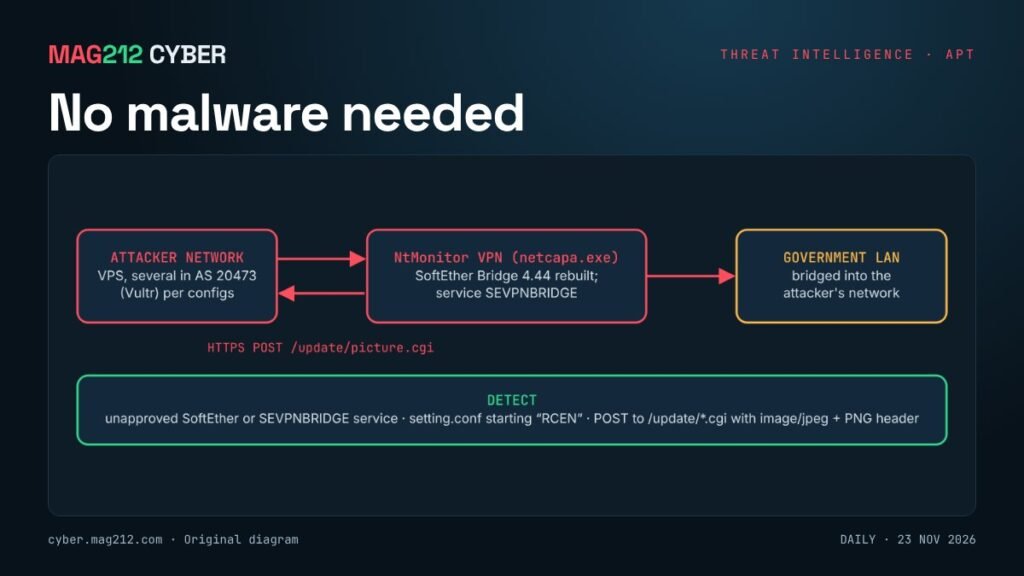
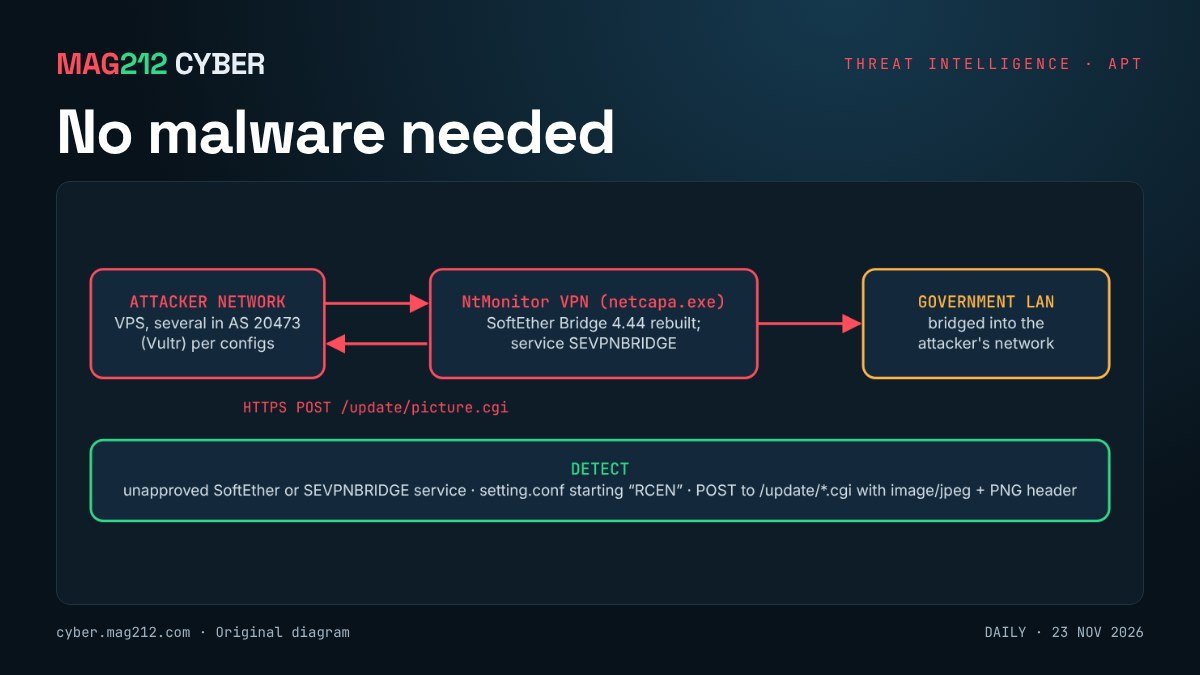
On 19 November 2026, Rapid7 researcher Milan Spinka published research on Webworm, a group Rapid7 assesses with moderate confidence to be China-aligned. The group targeted government organisations, mainly in Europe. Instead of deploying custom malware, it rebuilt the open-source SoftEther VPN Bridge from source, renamed it “NtMonitor VPN” and used it to bridge a network it controlled into the victims’ local networks. Rapid7
Rapid7 stresses that the software was “not trojanized, but rebuilt from source”. In other words, it is real VPN code doing what VPN code does.
Lesson 1: Why “living off legitimate tools” works
Antivirus and many detection tools look for known-bad files. A legitimate VPN is not known-bad; administrators install SoftEther on purpose. If an attacker uses it, hash checks and reputation lookups will usually say it is fine.
The lesson (MAG212 analysis): the question changes from “is this file malicious?” to “should this tool be here, on this host, talking to that server?” That is a question only your asset inventory and baselines can answer.
Lesson 2: What a VPN bridge does
A normal VPN client connects one computer to a remote network. A bridge joins two networks at layer 2, so machines on the far side behave as if they were plugged into the local network. For an intruder, that means broad, quiet access without needing tools on every machine.
Lesson 3: How Webworm disguised its build
According to Rapid7, the group:
- Kept the Windows service name SEVPNBRIDGE but rebranded the product as “NtMonitor VPN”, with the file name netcapa.exe presented as network monitoring software
- Replaced SoftEther’s standard web endpoints with /update/alive.cgi et /update/picture.cgi, so traffic looks like routine updates or image uploads
- Changed the handshake watermark so stock SoftEther clients cannot connect
- Renamed and encrypted the configuration file as setting.conf, which begins with the bytes “RCEN”; Rapid7 published a decryptor
- Used SoftEther’s own features to add host firewall rules
Several decrypted configurations pointed to infrastructure in AS 20473 (Vultr). Rapid7
Lesson 4: What defenders can hunt for
These suggestions are drawn from Rapid7’s indicators:
- Unapproved VPN bridges. Look for the SEVPNBRIDGE service, netcapa.exe, or any SoftEther component on hosts where no one approved it.
- Odd config files. A setting.conf whose contents begin with “RCEN”.
- Odd web traffic. Where you inspect TLS, look for POST requests to /update/picture.cgi labelled as JPEG images whose content actually starts with a PNG header. Rapid7 gives the exact byte pattern.
- Rapid7’s YARA rule and full IOC list, published on Rapid7’s GitHub, for file scanning. (MAG212 did not review that list.)
Rapid7 warns the group is likely to change endpoints and watermarks, so these indicators may not last. Rapid7
A generic, read-only check on a Windows host you administer (non testé par MAG212):
sc query SEVPNBRIDGELesson 5: Behaviour beats indicators
File names and URL paths are cheap for an attacker to change. What is expensive to change is behaviour: a new long-lived tunnel from a government server to a cloud VPS, a new service installed outside change control, firewall rules added by an application. Alert on those patterns and you will catch the next variant too. (MAG212 analysis)
What we do not know
The public article does not name victim countries or give victim counts, and it lists no IP addresses or domains in its body. Attribution is Rapid7’s, at moderate confidence.
Points clés à retenir
- Clean software can still be an attacker’s tool; context decides.
- Keep an allowlist of remote-access and VPN software, and alert on anything outside it.
- Hunt for the SEVPNBRIDGE service and setting.conf files, but build behaviour-based alerts too, because indicators change.
Sujets connexes sur MAG212 CYBER
- MAG212 CYBER Daily, 23 November 2026: One upload, one shell (numéro complet et PDF)
- How a file upload becomes a shell (Ghostscript Upload2Shell)
- Where do your AI prompts really go?
- CISA’s KEV list explained
- Abonnez-vous gratuitement à MAG212 CYBER
Sources
- Rapid7: www.rapid7.com
Written and edited by El Mostafa Ouchen for MAG212 CYBER. Facts checked against the sources above as of 23 November 2026, 7:00 AM PT.