
EggStreme Malware Rebuilt: Passive Agents That Listen on Port 5060, New Ciphers and How to Hunt Them
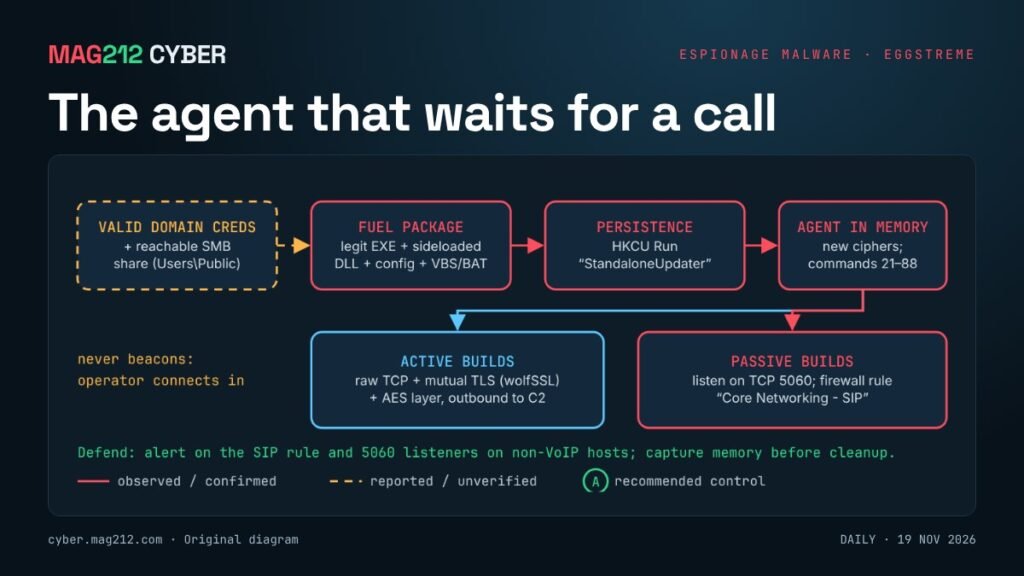
De la part de MAG212 CYBER Daily, 19 November 2026. Chaque commande est copiée de la documentation officielle ou de l'analyse citée et a été non testé par MAG212; exécutez-le uniquement sur les systèmes que vous êtes autorisé à administrer.
Statut: Signalé par Bitdefender on 18 November 2026. Attribution: suspected Chinese APT, which Bitdefender calls a technical assessment. Victims: multiple Philippine government organisations (high confidence); Taiwan is a lower-confidence lead. Bitdefender published indicators on GitHub (MD5 hashes and network indicators). The initial access vector is unknown. [1][2][3]
Ce qui s'est passé
In September 2025 Bitdefender published research on EggStreme, a multi-stage malware framework used against a Philippine military company. Its new report, “EggStreme Malware: Rebuilt Under Scrutiny”, by Bogdan Zavadovschi, describes how the operators responded. [1][3]
Bitdefender says the first Fuel component with a new configuration format was compiled on 29 September 2025, twelve days after the first article, and the first new-format loader on 13 October. Instead of just changing servers and recompiling, the operators changed the encryption, the communication protocol and the command set. [1]
Qu'est-ce qui a changé ?
- Loader encryption moved from XOR and RC4 to RC5-32 and then two custom cipher variants between October and December 2025. [1]
- Fuel configuration moved from RC4 to AES-256-CBC. Fuel’s command-and-control traffic still uses RC4, with a random key generated each run. [1]
- Agent transport moved from gRPC over mutual TLS to raw TCP with mutual TLS using the wolfSSL library, plus an extra AES layer. [1]
- New commands add Active Directory reconnaissance, WMI execution with credentials, token impersonation, in-memory .NET and PowerShell, TCP proxying and a reflective PE loader. The keylogger was dropped from newer builds. [1][3]
Bitdefender’s point, as quoted by The Hacker News: when attackers are exposed, the cheap response is to rotate. A recompile changes a file hash and a domain costs a few dollars, but traits such as DLL sideloading, staging through file shares, running from memory and requiring mutual TLS persist. [3]
Pourquoi c'est important
Most network hunting looks for malware calling home. EggStreme's passive builds never do: they open a port and wait, hidden behind a firewall rule named to look like a Windows default. The operators also showed they will rebuild rather than abandon tools after exposure, which means hash-based detection ages fast. Defenders need behaviour-based checks. (Analyse MAG212)
Comment fonctionne l'attaque
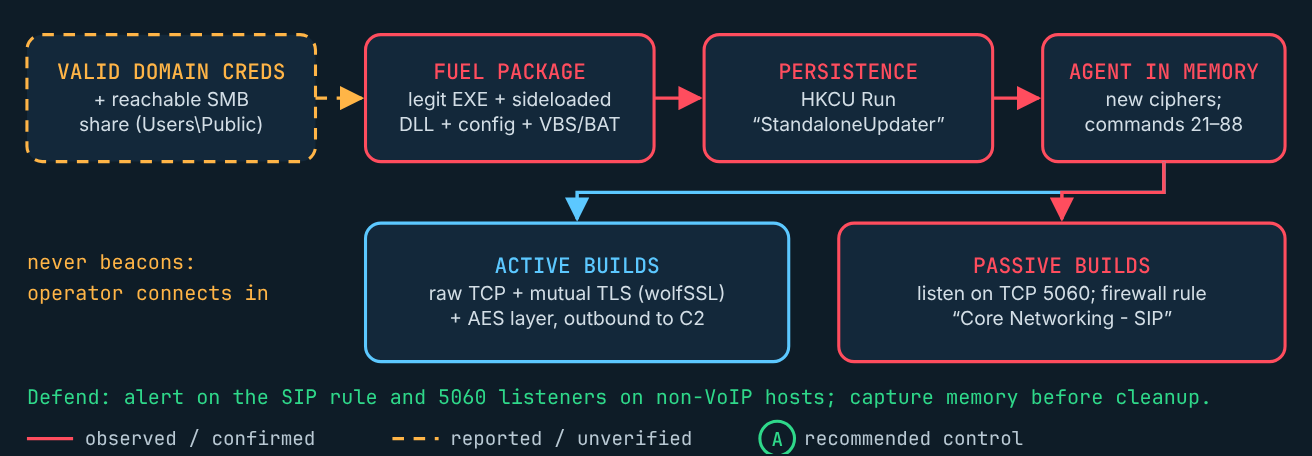
In the recent case Bitdefender describes, the operators already held valid domain credentials. They staged a package on an unmanaged host reachable over SMB, containing a legitimate executable, a malicious DLL for sideloading, a configuration file and VBS and batch scripts. A script copied the package to targets and set persistence. [1]
Persistence used a registry Run value named StandaloneUpdater sous HKEY_CURRENT_USER\Software\Microsoft\Windows\CurrentVersion\Run, pointing to %LOCALAPPDATA%\Microsoft\OneDrive\setup\logs\StandaloneUpdater.exe. Execution used C:\Users\Public\Officelog.bat et C:\Users\Public\prncnfg.vbs run through WScript.exe. [1]
The passive agent
Two agent builds, compiled on 2 September and 5 November 2025, do not contact a server at all. They open TCP port 5060, the port normally used by SIP voice-over-IP, and create an inbound Windows Firewall rule named “Core Networking – SIP” for all profiles, with edge traversal enabled. The operator then connects in. Bitdefender is withholding the handshake key and will share it with vetted defenders. [1]
The name and port appear chosen to blend in with VoIP traffic and Windows’ built-in firewall rules. For defenders this inverts the usual model: there is no outbound beacon to find, so hunting must look at listening ports and firewall changes. (Analyse MAG212)
Indicateurs
Bitdefender’s GitHub file lists 101 indicators: loader DLLs, encrypted payload paths, Fuel and Agent files, 43 domains, 12 IP addresses and certificate identifiers. All hashes are MD5. Examples, defanged as published: [2]
| Taper | Examples |
|---|---|
| Sideloaded DLL names | advapi32.dll, dbghelp.dll, dwmapi.dll, iscsiexe.dll, DevicesPlatform.dll, xwizards.dll |
| Fuel configuration | %LOCALAPPDATA%\Microsoft\Windows\Notifications\wpndatabase.dat |
| Agent C2 domains (newer) | fsstore[.]org, rodosdeals[.]com, eusurvey[.]org, bigitx[.]com |
| Fuel C2 | mepintei[.]com, 45[.]115[.]225[.]73, 109[.]248[.]24[.]84 |
| Passive agent MD5 | e5929aa608ae036c1959a74ba069ecd8, a7e14a929591d2dbb5944c58d11db695 |
Use the full CSV for blocking and retro-hunting. Some domains resemble legitimate services; Bitdefender notes that does not imply those services are involved. [2]
How to hunt and defend
Bitdefender recommends detecting behaviours and constants rather than hashes: [1]
- Alert on a “Core Networking – SIP” firewall rule that is not part of your Windows baseline, and on new TCP 5060 listeners on hosts that are not VoIP systems.
- Detect DLLs with system library names loaded from non-system folders.
- Restrict WScript.exe, cmd.exe, reg.exe and attrib.exe where roles do not need them.
- Inventory unmanaged hosts that reach workstations over SMB, and monitor scripts launched over SMB.
- Detect PowerShell and .NET runtimes loaded in unexpected processes, and enable PowerShell script block logging.
- Alert when a non-Windows process reads
wpndatabase.dat.
Comment enquêter
Capture process memory before cleaning up. Fuel’s per-run RC4 key exists only in memory, so reimaging first destroys the only way to decrypt captured command traffic. Collect the sideloaded DLL together with any encrypted payload file you find; the loader alone is not enough to recover the payload. [1]
Because the operators used valid domain credentials, treat an EggStreme finding as a domain credential compromise: reset affected accounts, review privileged group changes and look for the same package on other hosts reachable over SMB.
Prévention et sensibilisation
Baseline your Windows Firewall rules and alert on additions. Remove or manage the unmanaged hosts that can reach workstations over SMB. Government and defence organisations in Southeast Asia should assume continued targeting and prioritise these checks.
Sujets connexes sur MAG212 CYBER
- MAG212 CYBER Daily, 19 November 2026: A ten-year-old counter (numéro complet et PDF)
- MAG212 CYBER Quotidien, 18 novembre 2026 : Un signe égal de trop
- MAG212 CYBER Daily, 17 novembre 2026 : Des clés qui ont survécu à l’emploi
- MAG212 CYBER Hebdomadaire, 14 novembre 2026
- Abonnez-vous gratuitement à MAG212 CYBER
Sources
- [1] Bitdefender (B. Zavadovschi), “EggStreme Malware: Rebuilt Under Scrutiny“, 18 Nov 2026.
- [2] Bitdefender (GitHub), “2026_11-eggstreme-iocs.csv“, 18 Nov 2026.
- [3] The Hacker News, “Une nouvelle variante du malware EggStreme devient silencieuse pour échapper aux outils de sécurité lors d'attaques gouvernementales.“, 18 Nov 2026.
Written and edited by El Mostafa Ouchen for MAG212 CYBER. Facts checked against the sources above as of 19 November 2026, 6:00 AM PT.