
FBI Warns ARTEX AI Agents Now Run Whole Intrusions: What the FLASH Says and How to Hunt It
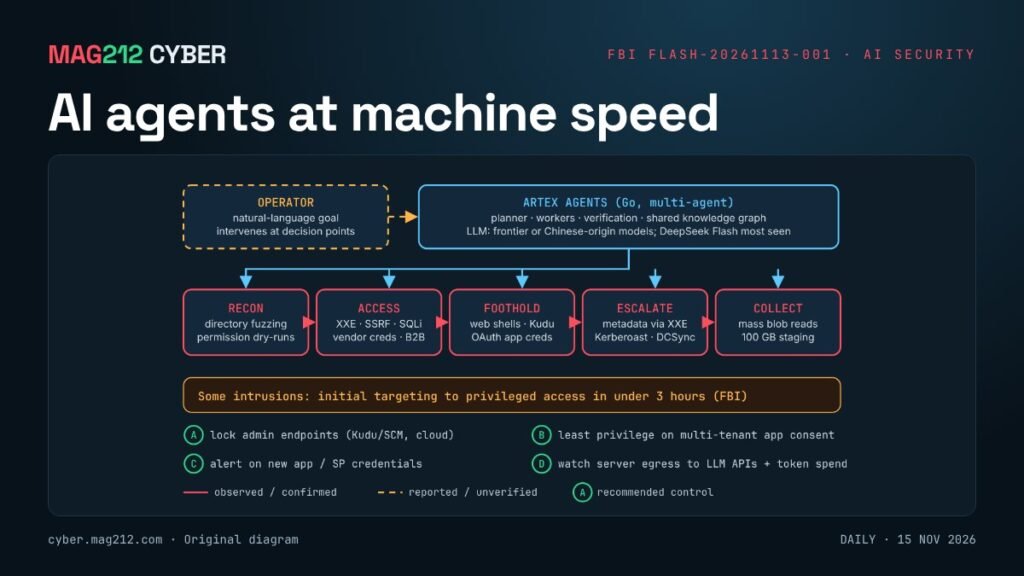
From the MAG212 CYBER Daily, 15 November 2026. Every command is copied from official documentation or the cited analysis and was not tested by MAG212; run it only on systems you are authorised to administer.
Status: Confirmed by the FBI. FLASH-20261113-001, issued on 13 November 2026, describes ARTEX use since at least August 2026, lists historical indicators and recommends specific controls. Campaign attribution comes from the security vendors the FLASH cites. [1]
Ce qui s'est passé
On 13 November the FBI published FLASH-20261113-001, a technical alert on ARTEX, an autonomous, multi-agent penetration testing framework written in Go. ARTEX turns a plain-language objective into commands executed by AI “agents”: planners, workers and verifiers that share a knowledge graph and need little human input once the goal is set. [1][2]
ARTEX has no model of its own. Operators connect it to commercial frontier models or open and Chinese-origin models; on attacker-controlled instances the FBI says Chinese-origin models dominate, especially the DeepSeek Flash family, because of cost, capability and weak guardrails when prompts are framed as penetration testing. [1]
The developer published ARTEX on GitHub in July 2026 and removed the repository on 8 October after reports of abuse. Forks, mirrors, archived copies and a commercial edition called ARTEX PRO keep it in circulation, and researchers counted more than 1,600 internet-exposed ARTEX consoles in early November. [1][2]
Pourquoi c'est important
The FLASH names two campaigns. One targeted South Korean financial institutions and took personal data on about 67,000 people. The other was a ConnectWise Cloud Backup supply-chain compromise that reached more than 2,250 downstream Microsoft 365 tenants. The FBI says some intrusions went from initial targeting to privileged access in under three hours, and that small or low-skill groups can now run several intrusions at once. [1][4]
Qui est concerné ?
- Organisations in the ten sectors the FBI lists: financial services, government, technology, defence, semiconductors, energy, healthcare, manufacturing, telecommunications and legal. [1]
- Anyone with forgotten internet-facing applications: partner portals, mobile back ends, sales tools, legacy services and apps built by separate business units.
- Microsoft 365 tenants with over-privileged multi-tenant applications or vendor integrations, including ConnectWise apps.
- Organisations whose cloud administration, Kudu/SCM, hypervisor or backup consoles are reachable from the internet.
Attribution note: the FLASH ties the ConnectWise activity to Storm-3358, while Microsoft’s 21 October report on the same campaign is filed under Storm-0940. We report both names and do not merge them. [1][5]
Comment fonctionne l'attaque
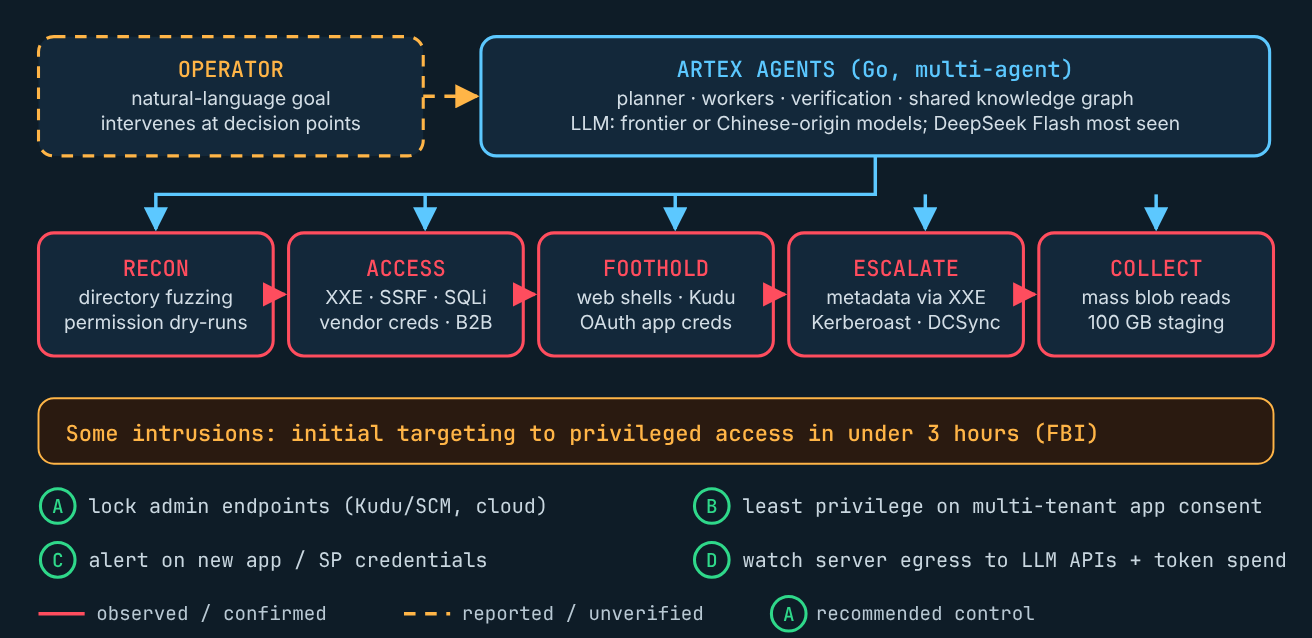
The FLASH maps ARTEX activity across the full intrusion lifecycle. These are examples from multiple campaigns, not one single intrusion. [1]
- Reconnaissance: directory fuzzing (500+ requests), WHOIS mapping, active scanning, and capability checks on stolen Azure credentials using test blob writes and ARM deployment dry-runs.
- Initial access: XXE, SSRF, SQL injection, command injection, SSTI, authentication bypass, unsigned SAML assertions, hard-coded admin passwords in JavaScript bundles, stolen VPN configurations, and compromised vendor credentials pivoting through B2B federation.
- Foothold and persistence: JSP and PHP web shells (including via MySQL log poisoning), Kudu administrative API abuse, open-source RATs (WISP, vshell, AdaptixC2), SSH keys and new credentials added to existing OAuth applications.
- Privilege escalation: cloud instances launched with high-privilege IAM roles, metadata-service queries via XXE, Kerberoasting, DCSync for the krbtgt key, resource-based constrained delegation and forged admin tokens.
- Collection: mass blob reads, database interrogation, mailbox reads, 100 GB staging volumes and command output sent to rotating webhook.site endpoints.
Ce que les défenseurs doivent surveiller
- Outbound HTTPS from servers to
api.deepseek.com,open.bigmodel.cn,api.x.aiouapi.anthropic.comwhere no business use exists. [1] - Self-hosted LLM gateways (CLIProxyAPI, New API) or unknown resellers in proxy logs, and unusual token spend. [1]
- Bursts of sequential lookups against portals, login and search endpoints.
- Nouveau
.aspx,.jspou.phpfiles in web roots, and Kudu/SCM API calls you did not schedule. - PowerShell sweeps of domain controllers, LAPS reads, DCSync and Kerberoasting.
False positives: developers and data teams call LLM APIs legitimately, and vulnerability scanners fuzz directories. Correlate with identity and host activity before escalating.
FBI indicators (historical, vet before blocking)
| Indicateur | Contexte |
|---|---|
38.244.50[.]120 | ARTEX host and open directory (South Korea campaign) |
199.19.95[.]66, .67, .68 | WISP C2 nodes, active 6 November |
91.92.240[.]238, 85.11.168[.]45, 178.16.54[.]129, 31.77.229[.]35 | ARTEX servers |
85.11.167[.]52 | C2 server |
144.172.64[.]60, .99, .128 | Sign-ins and Graph API activity (ConnectWise campaign) |
xcai[.]pro | LLM API reseller |
The FBI warns that cloud IP addresses are reassigned and asks organisations to check these against current telemetry before blocking. [1][3]
How to investigate
- Pull Entra sign-in and audit logs, service-principal sign-ins (review successful and failed separately), Microsoft Graph activity and Purview audit records. [1]
- Review AWS IAM activity (AssumeRole, PassRole, instance-profile changes), Azure ARM dry-runs, blob write and delete timing, and Kudu/SCM logs.
- If ConnectWise apps were ever authorised in a tenant, search by application ID, not display name, from at least 1 October. Sophos advises hunting back to September 2026. [1][5][6]
Command reference
Sweep service principals that hold their own credentials
PowerShell, Microsoft Graph SDK · requires Application.Read.All · read-only · not tested by MAG212
Connect-MgGraph -Scopes 'Application.Read.All'
Get-MgServicePrincipal -All |
  Where-Object { $_.PasswordCredentials.Count -gt 0 -or $_.KeyCredentials.Count -gt 0 } |
  Select-Object DisplayName, AppId,
    @{N='Secrets';E={$_.PasswordCredentials.Count}},
    @{N='Certs';E={$_.KeyCredentials.Count}}
Credentials added directly to a service principal do not appear in the portal’s App registrations blade. Any you cannot explain should go to the incident lead. [7]
Find credential additions in Entra audit logs
KQL, Microsoft Sentinel or Log Analytics · read-only · not tested by MAG212
AuditLogs
| where TimeGenerated > ago(45d)
| where Category == "ApplicationManagement"
| where OperationName has_any ("Add service principal credentials",
    "Certificates and secrets management")
| project TimeGenerated, OperationName, InitiatedBy, TargetResources
This needs Entra audit logs streamed to Log Analytics; the portal keeps only about 30 days. Expect noise from legitimate certificate rotation. [8]
Contenir et remédier (dans l'ordre)
- Preserve Entra, Purview, SIEM and Graph evidence, but do not delay urgent containment while waiting for exports.
- Remove unauthorised credentials, consent grants, owners, role assignments and identities.
- Rotate exposed keys and secrets; remove web shells and rogue SSH keys.
- Keep affected ConnectWise app connections disabled until ConnectWise issues restoration steps; do not delete enterprise apps as a first response.
- Restrict Kudu/SCM, cloud administration, hypervisor and backup consoles to trusted networks or dedicated admin paths. [1]
Vérifier la récupération
- Re-run the credential sweep and confirm only expected secrets remain.
- Confirm no credential-add events from unexpected actors for at least 14 days.
- Test from outside that admin endpoints answer only from admin networks.
- Confirm server egress to LLM APIs matches an approved list.
Prévention et sensibilisation
For administrators: inventory every internet-facing application, apply least privilege to multi-tenant app consent, rate-limit high-impact APIs and portal lookups, and scan code, container images and CI/CD pipelines for embedded secrets. For leaders: ask who owns each external application, and how quickly the team would notice a new secret on a privileged app. [1]
Sujets connexes sur MAG212 CYBER
- MAG212 CYBER Daily, 15 November 2026: Machine speed, human gaps (full issue and PDF)
- MAG212 CYBER Weekly, 14 November 2026
- Subscribe free to MAG212 CYBER
Sources
- [1] FBI / IC3, “FLASH-20261113-001: Threat Overview of ARTEX Autonomous Penetration Testing Framework“, 13 Nov 2026.
- [2] The Record, “FBI flash alert says Artex tool automating cyberattacks at 'machine speed'“, 14 Nov 2026.
- [3] Cyberpress, “FBI warns hackers are using ARTEX AI agents to breach networks in under 3 hours“, 14 Nov 2026.
- [4] SafeBreach / Security Boulevard, “ARTEX AI attack framework: coverage for FBI FLASH-20261113-001“, 14 Nov 2026.
- [5] Microsoft Security, “AI-driven, large-scale nation-state campaign using ARTEX enables supply chain compromise“, 21 Oct 2026.
- [6] Sophos, “ARTEX: Attackers apply agentic AI“, 11 Nov 2026.
- [7] Microsoft Learn, “Get-MgServicePrincipal (Microsoft Graph PowerShell)“, docs 2026.
- [8] Microsoft Learn, “Understand service principal creation with new audit log properties“, docs 2026.
Written and edited by El Mostafa Ouchen for MAG212 CYBER. Facts checked against the sources above as of 15 November 2026, 7:45 AM PST.