
AI Developer Platform Breaches: WorkOS, Trigger.dev, Chainstack and the Keys You Need to Rotate
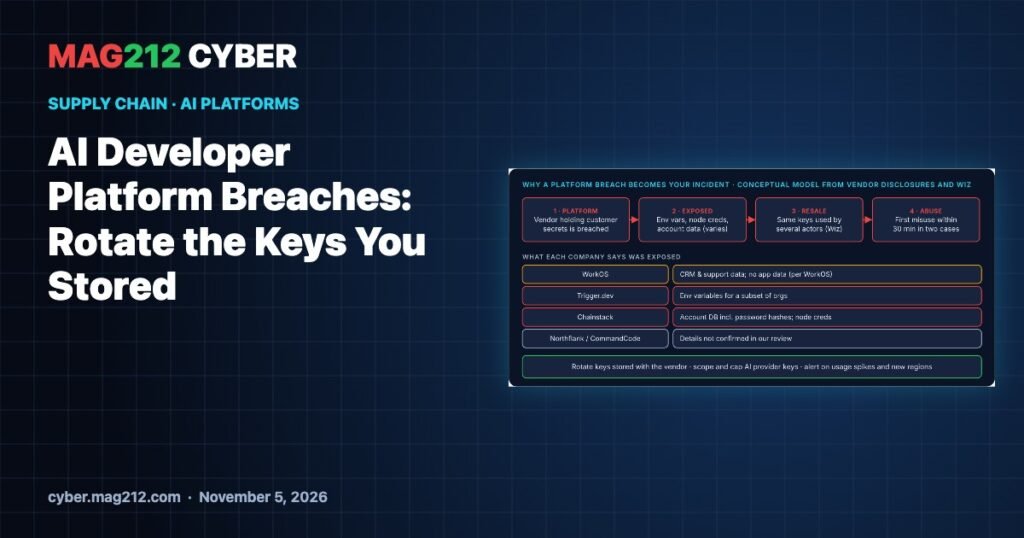
In one week, several AI developer platforms disclosed intrusions: WorkOS, Trigger.dev, Chainstack, Northflank and CommandCode. Attackers are interested in the secrets customers store with these services, especially AI-provider API keys, and Wiz says stolen keys were abused within half an hour in two cases. But what each company lost is different. Read each notice before you decide what to rotate.
Key facts
| Item | Detail |
|---|---|
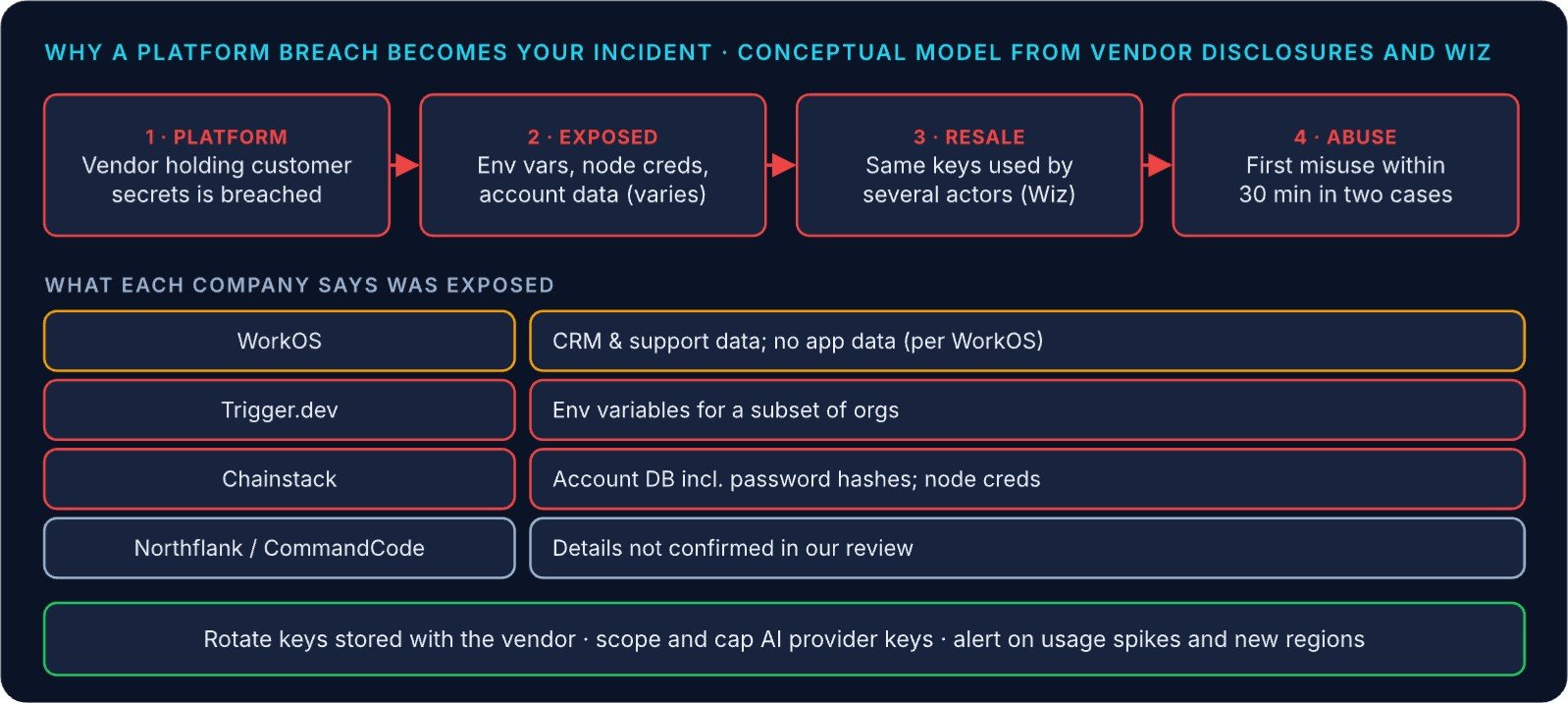
| Chainstack | Attacked Oct 26; customer account database accessed, including password hashes; customers told to rotate node credentials (per SecurityWeek) |
| WorkOS | Found Oct 30; internal sales/support app; CRM and support data affected; no evidence application data was accessed (per WorkOS) |
| Trigger.dev | Nov 1; environment variables exposed for a subset of organizations; exploit blocked (per Trigger.dev) |
| Northflank, CommandCode | Listed by SecurityWeek; details not confirmed in our review |
| Wiz | Same keys used by several actors; first misuse within 30 minutes in two cases |
What each company says
WorkOS identified unauthorized access on October 30 to an internal application used by its sales and customer-facing teams. It says the affected data is CRM and support information: business contacts, account histories, notes from sales calls, support conversations and customer Slack threads, and product usage. It says there is no evidence that WorkOS application data or production services were affected, and that the attackers used AI-based offensive tooling. Its advice to customers is to watch for phishing that uses those real details.
Trigger.dev says an exploit gave an attacker access to environment variables for a subset of organizations on November 1, that the exploit has been blocked, and that affected account owners were emailed mitigation steps. It does not say which variables were exposed.
Chainstack, attacked on October 26, had a customer account database accessed, including organization names, account holder names, emails and password hashes, according to SecurityWeek. Node credentials may also have been exposed, and customers were told to rotate them.
Why this matters even if you weren’t breached
Wiz found that several threat actors used the same stolen keys, which suggests they are being sold, and in two cases the first unauthorized activity came within 30 minutes of the credentials being exposed. Wiz links the surge to LLM-jacking: running AI workloads on stolen tokens or reselling access. SecurityWeek also reports that multiple companies link the open-source Artex AI pentest framework to some of these attacks and to Storm-0940, a Chinese threat group. We could not confirm whether this is the same “ARTEX” tooling India’s CERT-In names in its Crafty Falcon advisory.
What to do
- Inventory. List every secret you stored with each affected vendor: AI provider keys, cloud keys, database URLs, node or RPC credentials, webhook secrets.
- Rotate in priority order, starting with AI provider keys and cloud credentials, and revoke the old values rather than just adding new ones.
- Contain cost and blast radius: one key per project, spend caps, and alerts on usage spikes, new models or new regions.
- Follow each vendor’s emailed instructions and status page.
- Warn staff that phishing may now quote real support cases and sales conversations, as WorkOS cautions.
Rotation worksheet
| Secret | Where to rotate | Done when |
|---|---|---|
| AI provider API keys | Provider console | Old key revoked; usage normal for 48 hours |
| Cloud access keys in env vars | IAM | Old key IDs absent from audit logs |
| Database URLs and passwords | Database and app config | Old credentials fail; app healthy |
| Node / RPC credentials | Provider dashboard | New credentials deployed; old revoked |
| Webhook signing secrets | Each integration | Old signatures rejected |
For decision-makers
Ask each platform vendor where your secrets are stored, who inside the vendor can read them, and how quickly they will tell you about a breach. Prefer short-lived, workload-scoped credentials over long-lived keys in environment variables, and treat any third party that holds your keys as part of your attack surface.
Frequently asked questions
I use WorkOS. Do I need to rotate keys?
Based on WorkOS’s statement, the affected data was CRM and support information, not application data or secrets. The main risk is targeted phishing. Follow any direct instructions WorkOS sends you.
How fast do stolen AI keys get abused?
In two cases Wiz saw the first misuse within 30 minutes of exposure. Rotate first, then investigate.
Are these breaches connected?
Some are reportedly linked to the Artex framework and Storm-0940, but a single actor behind all of them has not been established.
Sources
- SecurityWeek: AI-linked breaches mount as WorkOS, Northflank, Trigger.dev disclose hacks (Nov 4)
- WorkOS: October 30th, 2026 data security incident
- Trigger.dev: Security incident, November 2026
- Chainstack: Security incident notice
- Wiz: Black October for AI developer platforms
Related coverage on MAG212 CYBER
- The Patch That Didn’t Hold: MAG212 CYBER Daily, 5 November 2026
- Zyxel GS1900 Zero-Day: Why the June Patch Didn’t Hold
- Crafty Falcon: CERT-In Warns of AI-Assisted Attacks on Payment Firms
- Rails Active Storage: Upgrade, Then Rotate Your Secrets
- Barracuda ESG Chain: From Admin Interface to Root
- Android CVE-2026-58868 and Chrome 157: November’s Patch Load
- Every issue in the Magazine Library