
VMware vCenter Zero-Day CVE-2026-123890: How ARMORY CASTLE Stole the Keys to vSphere, and How to Patch and Hunt
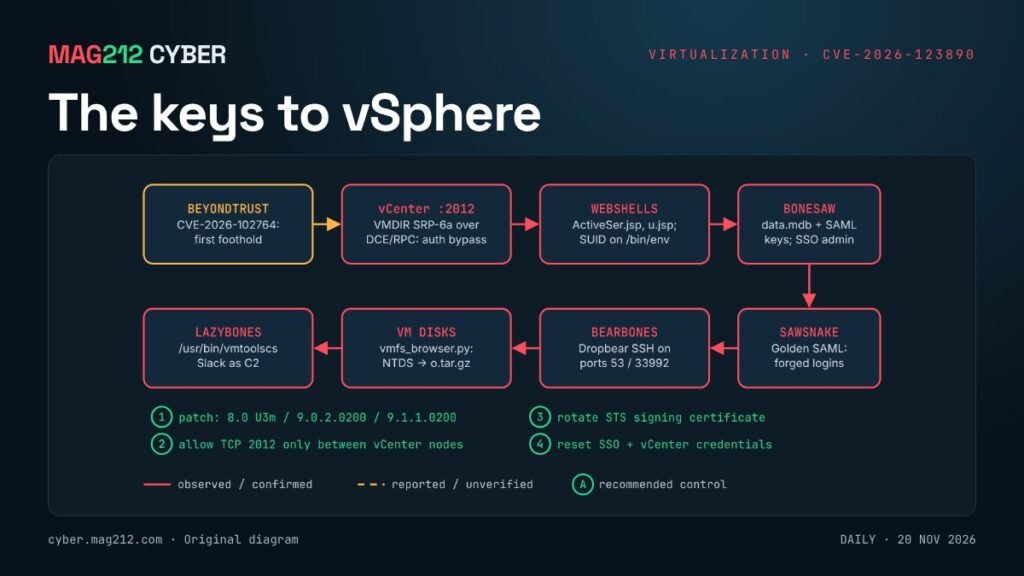
De la part de MAG212 CYBER Daily, 20 November 2026. Chaque commande est copiée de la documentation officielle ou de l'analyse citée et a été non testé par MAG212; exécutez-le uniquement sur les systèmes que vous êtes autorisé à administrer.
Statut: Fixed on 19 November 2026 in vCenter 9.1.1.0200, 9.0.2.0200 and 8.0 U3m, and in VMware Cloud Foundation 5.2.5. Exploited as a zero-day since early September, according to Google’s threat intelligence group (GTIG) and Mandiant. Broadcom lists no workaround. CVSS 9.8. Broadcom’s advisory does not itself flag exploitation, and the CVE was not in CISA’s KEV catalog as of 20 November, according to the outlets we cite. [1][3][4][5]
Ce qui s'est passé
On 19 November 2026 Broadcom published VMSA-2026-0009, fixing CVE-2026-123890 in vCenter Server. It is an authentication bypass in the VMware Directory Service (VMDIR), reached over DCE/RPC on TCP port 2012. An unauthenticated attacker who can reach that port can become administrator@vsphere.local, the top single sign-on account. Broadcom updated the advisory to VMSA-2026-0009.1 on 20 November. [1][2]
The same day, GTIG and Mandiant published an investigation showing the flaw had already been used for about ten weeks. GTIG writes that it “attributes this activity to the suspected PRC-nexus espionage actor ARMORY CASTLE (formerly tracked as UNC5221)”. The group is also tracked as Warp Panda. Victim names and numbers are not public. [3][4][5]
Pourquoi c'est important
vCenter controls every virtual machine it manages. An attacker who becomes its administrator can read domain controllers' disks without logging in to Windows, forge single sign-on tokens, and hide in an appliance that few security tools watch. This flaw needs no password, only network reach to one port that many organisations never filter internally. And because the attackers stole the signing key, a patch alone does not lock them out. (Analyse MAG212)
Comment fonctionne l'attaque
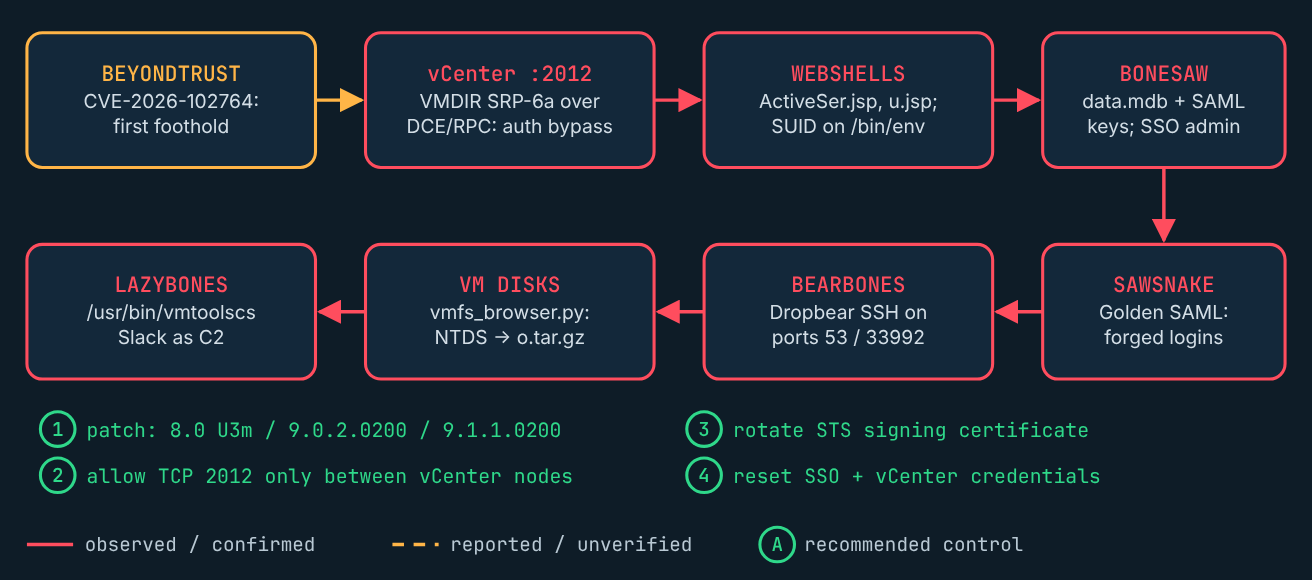
Mandiant’s reconstruction of one intrusion runs like this: [3]
- Entry through another product. The actor first got in through a BeyondTrust Remote Support appliance using CVE-2026-102764, which gave it a foothold inside the network.
- Directory bypass. From inside, it reached vCenter on TCP 2012 and abused the SRP-6a password exchange in VMDIR to become SSO administrator.
- Webshells. It dropped two JSP webshells,
ActiveSer.jsp(SLIMSAVAGE) andu.jsp(CAGEMATCH), and set the SUID bit on/bin/envto keep root. - Key theft. A tool Mandiant calls BONESAW (
/tmp/123) copied the directory databasedata.mdband the SAML signing keys, and created an extra SSO administrator. - Forged logins. SAWSNAKE (
/tmp/sss) used the stolen key to mint “Golden SAML” tokens, valid admin logins that never touch a password. - Persistence. BEARBONES (
/tmp/dbr), a Dropbear SSH backdoor, listened on ports 53 and 33992 with the bannerSSH-2.0-pulsesecure_23345. The actor added a roguesps-*@vsphere.localaccount and switched SSH on and off through the appliance REST API. - Domain secrets. A script,
vmfs_browser.py, read Windows domain controllers’ virtual disks directly from the datastore and packed NTDS intoo.tar.gz. - Command and control. LAZYBONES (
/usr/bin/vmtoolscs) used Slack as its channel.
Qui est concerné ?
| Produit | Version corrigée | Note |
|---|---|---|
| vCenter Server 9.1 | 9.1.1.0200 | no workaround |
| vCenter Server 9.0 | 9.0.2.0200 | no workaround |
| vCenter Server 8.0 | 8.0 U3m | not available as a Quick Patch |
| VMware Cloud Foundation 5.2 | 5.2.5 | updates the bundled vCenter |
| vCenter Server 7.0 | none public | contact Broadcom support |
Source: Broadcom VMSA-2026-0009.1 and its FAQ. The same advisory also fixes SDDC Manager (CVE-2026-123891, -123892, -123893) and VMware Tools (CVE-2026-123894). Check your exact build against the advisory before upgrading. [1][2]
How to check your environment
These read-only checks come from Ostorlab’s write-up or are MAG212 suggestions built from GTIG’s indicators. They were non testé par MAG212. Exécutez-les uniquement sur les systèmes que vous administrez. [3][6]
In PowerCLI, check the version and look for accounts matching the rogue-account pattern:
$global:DefaultVIServer.BuildGet-VIAccount | Where-Object { $_.Name -like 'sps-*' }On the vCenter appliance shell, look for GTIG’s file and port indicators:
ls -la /tmp/123 /tmp/sss /tmp/dbr /usr/bin/vmtoolscs 2>/dev/nullss -ltnp | grep -E ':(53|33992) 'From an ordinary user network, this test should fail. If it connects, port 2012 is reachable from places it should not be:
nc -vz vcenter.example.com 2012Any hit on these indicators means incident response, not cleanup.
Indicateurs
- Files:
ActiveSer.jsp,u.jsp,/tmp/123,/tmp/sss,/tmp/dbr,/usr/bin/vmtoolscs,o.tar.gz, plus/tmp/gdb_file,/tmp/rar,/tmp/123.keyand a hidden.adirectory on a VMFS volume. [3] - Réseau: SSH banner
SSH-2.0-pulsesecure_23345on ports 53 and 33992. GTIG lists 11 “suspected obfuscation network” IP addresses, including 103.147.251[.]5 and 103.190.38[.]3; see its report for the full list. [3] - Accounts:
sps-<random>@vsphere.local. [3] - Detection content: GTIG published YARA rules for SLIMSAVAGE, CAGEMATCH, SAWSNAKE, BONESAW, BEARBONES and LAZYBONES. No file hashes are public. [3]
Contenir, corriger et vérifier
- Limitez d'abord l'accès. Allow TCP 443, 2012, 22 and 5480 on vCenter only from admin and peer networks. Mandiant’s vcsa-hardening-tool helps with this. [3][7]
- Patch every vCenter, including lab, test and disaster-recovery instances. [1]
- If any indicator hits, rotate the STS signing certificate, reset SSO and vCenter credentials, and treat Active Directory as exposed: the actor may hold NTDS. Patching does not revoke a stolen key. [3]
- Check BeyondTrust Remote Support appliances for the entry bug. [3]
- Vérifier: the build number matches the advisory, and TCP 2012 no longer answers from user networks.
The bigger picture
Today’s issue has two exploited bugs on infrastructure ports: vCenter’s directory service and Cisco Expressway’s cluster database. Directory and cluster ports are built for trusted peers, yet they often answer anyone on the internal network. The lesson from this case is to filter east-west traffic to infrastructure, not just the internet edge. (Analyse MAG212)
Sujets connexes sur MAG212 CYBER
- MAG212 CYBER Daily, 20 November 2026: The keys to vSphere (numéro complet et PDF)
- MAG212 CYBER Quotidien, 19 novembre 2026 : Un compteur vieux de dix ans
- MAG212 CYBER Quotidien, 18 novembre 2026 : Un signe égal de trop
- MAG212 CYBER Hebdomadaire, 14 novembre 2026
- Abonnez-vous gratuitement à MAG212 CYBER
Sources
- [1] Broadcom, “VMSA-2026-0009.1: VMware vCenter Server, Cloud Foundation and Tools updates“, 19–20 Nov 2026.
- [2] VMware (GitHub), “VMSA-2026-0009 questions and answers“, 19 novembre 2026.
- [3] Google GTIG / Mandiant, “ARMORY CASTLE exploits vSphere zero-day“, 19 novembre 2026.
- [4] The Hacker News, “China-linked hackers exploit critical VMware vCenter flaw“, 19 novembre 2026.
- [5] SecurityWeek, “Newly patched VMware vCenter flaw exploited as zero-day by Chinese APT“, 19 novembre 2026.
- [6] Ostorlab, “VMware vCenter authentication bypass CVE-2026-123890“, 19 novembre 2026.
- [7] Mandiant (GitHub), “vcsa-hardening-tool“, accessed 20 Nov 2026.
Written and edited by El Mostafa Ouchen for MAG212 CYBER. Facts checked against the sources above as of 20 November 2026, 6:00 AM PT.