
Trigram Campaign: Fake Recruiters, a Pasted Command and an Infostealer Aimed at AI and Blockchain Developers
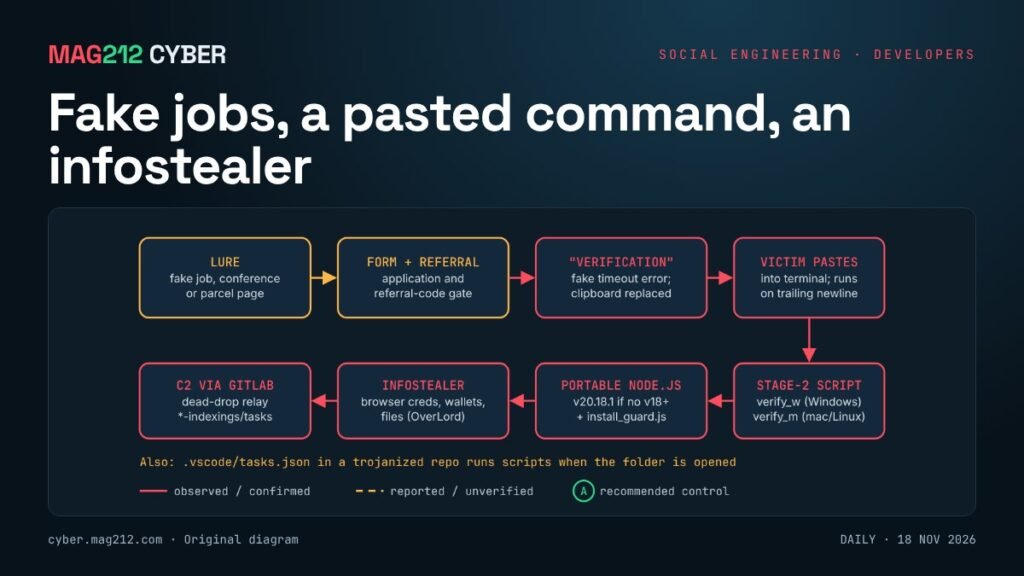
De la part de MAG212 CYBER Quotidien, 18 novembre 2026. Chaque commande est copiée de la documentation officielle ou de l'analyse citée et a été non testé par MAG212; exécutez-le uniquement sur les systèmes que vous êtes autorisé à administrer.
Statut: Researcher report. Stormshield’s Cyber Threat Intelligence team published its analysis on 11 November 2026 and updated it on 16 November; The Hacker News and others covered it on 17 November. Attribution is Stormshield’s assessment, not a confirmed identity. [1][2]
Ce qui s'est passé
Stormshield describes Trigram as a large-scale, industrialised campaign targeting the AI, blockchain and logistics sectors in Europe and the United States. Operators impersonate about 50 brands and run a dedicated back-office platform. The goal is to get developers to execute an infostealer themselves. [1]
The three lures
| Lure | What the victim sees |
|---|---|
| Recruitment | Web3, AI or tech job pages stressing high pay and fully remote work, with an application form and a referral-code gate |
| Conference | An invitation to a fake “ICAGLLMBT” conference that victims are encouraged to forward to colleagues |
| Parcel tracking | Decoy pages imitating DHL, DPD and Aramex |
Source: Stormshield. [1]
Qui est concerné ?
Developers and staff in AI, blockchain, technology, finance, education and logistics organisations, according to Stormshield and The Hacker News. Windows, macOS and Linux are all targeted. [1][2]
Pourquoi c'est important
Developers hold the keys to source code, cloud accounts and crypto wallets, and recruitment lures exploit the moment they are most willing to follow unusual instructions. The paste-a-command trick bypasses email filters and download warnings because the victim runs the attacker's code themselves. (Analyse MAG212)
Comment fonctionne l'attaque
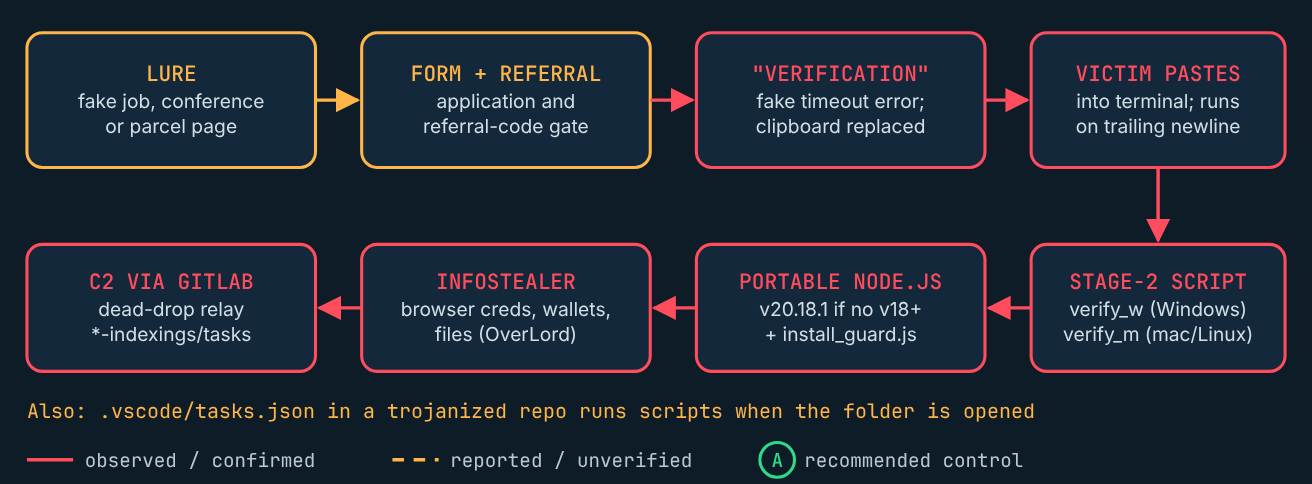
- Lure and gate: the victim fills in a fake application form and passes a referral-code gate. [1]
- Fake verification: a ClickFix-style step asks the victim to paste a command into a terminal. The page then shows a fake error, “Operation timeout. Please try again. Nonce Refreshed.”, and replaces the clipboard with a second command. A trailing newline makes it run as soon as it is pasted. [1]
- Stage two: the command fetches
verify_won Windows orverify_mon Linux and macOS from the decoy domain. Stormshield notes both commands skip TLS certificate verification. [1] - Runtime: the script installs a portable Node.js (version 20.18.1 if no version 18 or later is present) and downloads
install_guard.js, a JavaScript payload with a “deepfake guard” cover story. On Windows the chain uses VBScript and PowerShell and tries to strip the Mark-of-the-Web; on macOS and Linux a fake system password prompt appears, per SafeDep’s findings cited by Stormshield. [1] - Theft: the final stage is an infostealer, which SafeDep calls OverLord, targeting browser credentials, crypto wallets and files, followed by persistence. [1]
A separate path uses trojanized repositories: Stormshield found a project whose .vscode/tasks.json runs scripts from a vendor/ folder when the folder is opened in VS Code. [1]
Infrastructure and attribution
- GitHub for scraping targets and hosting trojanized repositories. [1]
- GitLab as a “dead drop” relay that publishes the current command-and-control address; repository paths follow a
*-indexings/taskspattern that persisted across relay generations. [1] - Brevo, Resend, Mailgun and Smartlead for bulk email; FullStory for recording victim sessions; mostly Namecheap domains on low-cost top-level domains. [1]
Stormshield links Trigram with high confidence to the UNK_DeadDrop cluster, which Proofpoint assesses as part of the North Korean ecosystem, and reports strong similarities with Kimsuky based on indicators published by Genians. Identity links rest on reused email addresses and accounts and are given confidence levels rather than presented as confirmed. [1][2]
Ce que les défenseurs doivent surveiller
- A terminal, PowerShell or
wscriptprocess started shortly after a browser, followed by a newnodebinary in a user-writable folder. curlor PowerShell downloads with certificate checks disabled from newly registered domains.- Outbound requests to GitLab repository paths matching
*-indexings/tasks. [1] - Repositories whose
.vscode/tasks.jsonruns commands on folder open. - Stormshield’s appendix lists about 200 indicators (lure domains, C2 and backup C2 domains, IPs, URLs and two file hashes) and a YARA rule,
Dropper_DeepfakeGuard_NodeLoader_Generic. [1]
Comment contenir et remédier
- Isolate a machine where a pasted command ran; do not wait to see what happens.
- Assume credentials are stolen: reset browser-stored passwords, revoke session tokens, rotate SSH keys, cloud keys and API tokens used on that machine, and move any crypto assets from wallets present on it to new wallets created on a clean device.
- Hunt for persistence and remove the portable Node.js runtime,
install_guard.jsand any startup entries it created; re-image if in doubt. - Block indicators from Stormshield’s appendix at DNS and proxy.
Comment vérifier la récupération
- The machine is re-imaged or verified clean, with no unexpected Node.js runtime or persistence entries.
- Old credentials and tokens fail; new ones are issued only to the clean machine.
Prévention et sensibilisation
- For employees: no genuine recruiter, conference or courier asks you to paste a command into a terminal. If a page does, close it and report it.
- For developers: run take-home tests and unfamiliar repositories in a disposable VM; keep wallets and production keys off that machine; read VS Code’s workspace trust prompt before trusting a folder.
- For security teams: consider restricting the Run dialog and terminal launch for non-technical staff, and alert on scripting hosts launched from browsers.
Sujets connexes sur MAG212 CYBER
- MAG212 CYBER Quotidien, 18 novembre 2026 : Un signe égal de trop (numéro complet et PDF)
- MAG212 CYBER Daily, 17 novembre 2026 : Des clés qui ont survécu à l’emploi
- MAG212 CYBER Daily, 16 novembre 2026 : Les boîtes que personne ne répare
- MAG212 CYBER Hebdomadaire, 14 novembre 2026
- Abonnez-vous gratuitement à MAG212 CYBER
Sources
- [1] Stormshield, “Trigram campaign: AI, blockchain and logistics (CTI report)“, 11 Nov, upd. 16 Nov 2026.
- [2] The Hacker News, “Trigram campaign impersonates about 50 AI and blockchain brands“, 17 novembre 2026.
Rédigé et édité par El Mostafa Ouchen pour MAG212 CYBER. Informations vérifiées auprès des sources ci-dessus le 18 novembre 2026 à 6h00 (heure du Pacifique).