
AI Pentest Agents on Both Sides: OpenAI’s Daybreak Launches the Same Week Attackers Used AntiFox
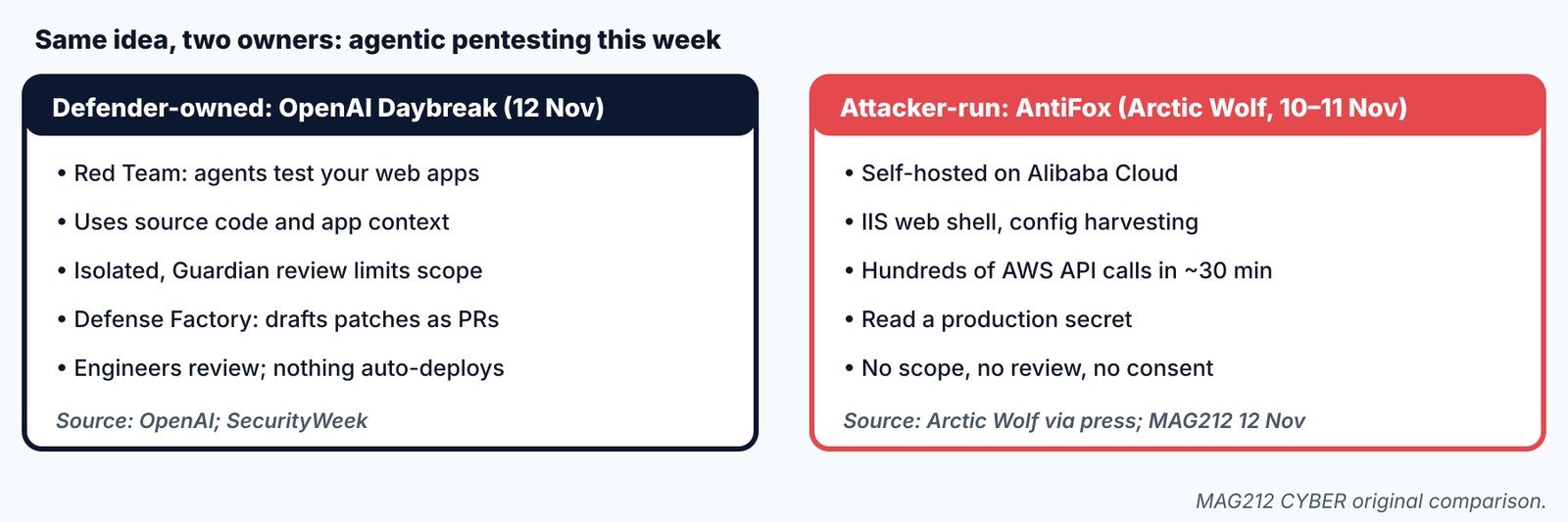
This week offered an unusually clean comparison. On 12 November OpenAI announced two security products under its Daybreak name: Red Team, which sends a coordinated team of AI agents to test web applications, and Defense Factory, which traces vulnerabilities through code and drafts fixes as GitHub pull requests. A day earlier, MAG212 CYBER reported on AntiFox, a self-hosted agentic pentest platform that attackers used to move from an IIS web shell to a stolen AWS production secret in about half an hour. The underlying technique is the same. What separates the two is scope, consent and review.
What happened
[Confirmed] OpenAI announced two Daybreak products at its “Cyber at the Frontier” event on 12 November. Daybreak Red Team puts “a coordinated team of agents” to work testing web applications, validating findings from scanners, bug bounties and disclosure reports, and checking whether patches stop the exploit. Agents use source code and app context, and scope is enforced with “isolated environments and Guardian review”. (OpenAI) [Reported] Defense Factory traces vulnerabilities through code and drafts patches as GitHub pull requests that engineers review; nothing deploys automatically. It imports findings from Wiz, Snyk and Endor Labs. Red Team is in early access; Defense Factory is a preview ChatGPT plugin. (SecurityWeek) (OpenAI)
Why it matters
[MAG212 analysis] One day earlier we reported AntiFox, a self-hosted agentic pentest platform that attackers used to move from an IIS web shell to a stolen AWS secret, making hundreds of API calls in about 30 minutes. (MAG212, 12 Nov) The technique is the same on both sides; what differs is scope, consent and review. Defenders who adopt these tools should insist on written scope, isolated test environments, logs of every agent action and human review of every patch. They should also expect attackers to test their apps at agent speed: watch for bursts of enumeration and AccessDenied errors, and fix what scanners already flag.
- Before buying: ask how scope is enforced, where code and findings are stored, and who can see agent logs.
- Before running: point agents at staging, not production, and tell your SOC so their traffic isn’t mistaken for an attack.
- After: treat AI-drafted patches like any pull request: review, test, then merge.
What to ask before you buy
[MAG212 analysis] Scope enforcement. How does the product stop agents testing systems you didn’t authorise, and can you prove that to an auditor? OpenAI points to isolated environments and Guardian review; other vendors will have their own answers.
[MAG212 analysis] Data handling. These tools read source code, configuration and findings. Ask where that data is stored, how long it is kept and who at the vendor can see it.
[MAG212 analysis] Auditability. Every agent action should be logged in a form your SOC can read, so a test can be told apart from an attack after the fact.
[MAG212 analysis] Human review. AI-drafted patches should go through the same review, testing and approval as any other change. Defense Factory opens pull requests rather than deploying, which is the right default.
Why it matters
Agentic testing compresses work that took a human team days into minutes, for defenders and attackers alike. Organisations that adopt it can find and fix flaws faster. Those that don’t should expect their applications and cloud accounts to be probed at agent speed anyway, which makes basic hygiene, such as fixing what scanners already flag and limiting what any one credential can read, more urgent.
The bottom line
If you trial AI pentest agents, insist on written scope, isolated test environments, complete action logs and human review of every patch, and tell your SOC before testing starts. Whether or not you adopt them, watch cloud logs for bursts of enumeration and access-denied errors, and make sure no single application credential can read production secrets it doesn’t need.
How we label evidence: [Confirmed] comes from a primary source such as a vendor or CISA; [Reported] from a secondary outlet; [Claimed] from an attacker or an unverified party; [MAG212 analysis] is our judgement; [Unknown] means not established at press time. Commands and indicators are copied from the cited sources and were not tested by MAG212 CYBER.
This story is part of MAG212 CYBER Daily, 13 November 2026, with the day’s other verified stories, the Defender’s Action Desk and a full source register. Get the daily briefing free: subscribe to MAG212 CYBER. By El Mostafa Ouchen.