
AI Can Now Hack Without a Human. Google and the FBI Just Showed Us What That Looks Like.
An attacker's AI read a security patch, wrote its own exploit and ran it with no person in the loop. Here is what really changed this week, what is hype, and seven things to do before it reaches you.
By El Mostafa Ouchen · MAG212 CYBER · 19 November 2026
For years, “AI will hack us on its own” was a conference-panel prediction. This week it became a line in a Google threat report.
On 16 November, Google’s Threat Intelligence Group (GTIG) said that in the past quarter it saw attackers use AI frameworks to “fully automate vulnerability discovery and exploitation without a human in the loop for the first time.” Three days earlier, the FBI published a FLASH alert about ARTEX, an open-source AI hacking framework it says criminals have been using since August, with some intrusions reaching privileged access in under three hours. [1][4][5]
Most of the coverage stopped at the scary headline. This article goes further: what the machines are actually doing, what they still cannot do, and what you should change this week, whether you run a company network or just your own accounts.
What Google actually found
The clearest evidence came from a mistake. Attackers left a staging server exposed, and on it Google’s researchers found exploit_agent, a multi-agent system wired to several commercial and locally run AI models. [1][2]
Its job was simple and alarming:
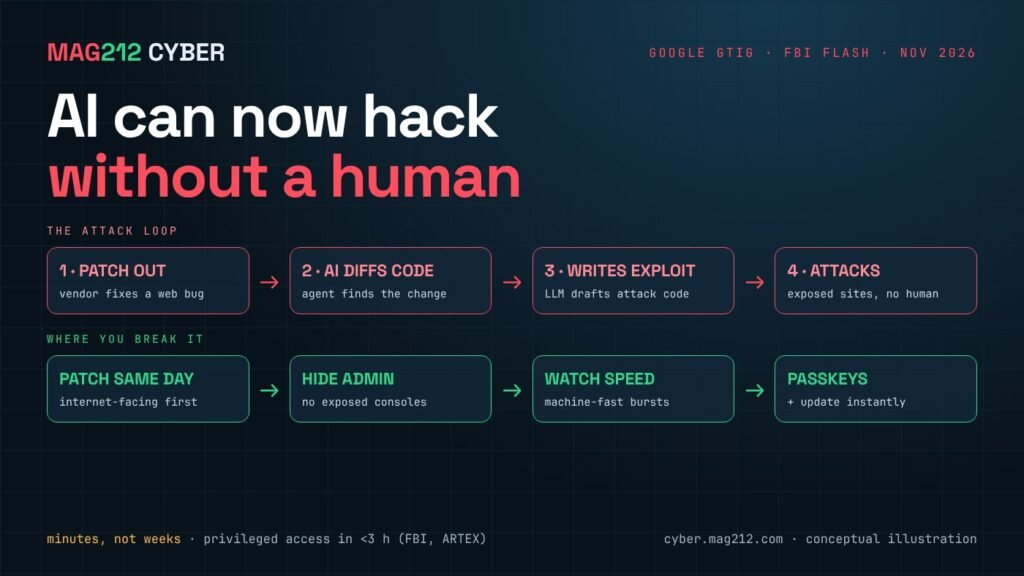
- Watch for security patches to web applications.
- Compare the code before and after the patch to find what was fixed.
- Draft an exploit for the bug the patch revealed.
- Run it against real websites.
The same server held stolen data, password-guessing scripts and tools to install and remove web shells. Comments in its configuration were written in Russian, and victim data pointed at French media, entertainment and education websites. [2]
exploit_agent is not alone. Google says attackers now routinely abuse open-source “AI pentest” suites (ARTEX, CAIRN, CyberStrikeAI, HexStrike AI and others) that were built for legitimate security testing. Users range from financially motivated gangs to suspected China-nexus espionage groups. [1][2]
The patch window is collapsing
Here is the change that matters most for defenders.
The old rhythm went like this: a vendor publishes a fix, skilled humans spend days or weeks reverse-engineering it, and only then do mass attacks begin. That delay was the time you had to patch.
AI agents compress it. The New Stack summarises Google’s finding as attackers moving from disclosure to attack in minutes. Google cites an August campaign against PaperCut print servers in which attackers reached domain administrator access within minutes of the campaign starting, according to GreyNoise. [6][3]
And the volume of targets is growing. Google reports that vulnerability disclosures more than doubled between January and August 2026, and that exploited zero-days went from about 8 a month in 2025 to 22 in August 2026. [3]
In plain words: “We’ll patch it next maintenance window” was a reasonable policy in 2023. For anything facing the internet, it no longer is.
What the FBI says about ARTEX
The FBI’s FLASH alert (FLASH-20261113-001) describes ARTEX as a multi-agent platform written in Go. An operator types a goal in plain language and AI agents turn it into commands, from reconnaissance to data theft, with little human input after that. [4][5]
Key points from the alert, as reported:
- Used since at least August 2026 against financial services, government, technology, defence, healthcare, energy and other sectors. [2][7]
- Some intrusions went from first targeting to privileged access in under three hours. [5]
- Researchers counted more than 1,600 ARTEX consoles exposed on the internet in early November, and the FBI says real use is likely far higher. [7]
What is hype, and what is not
Viral headlines are already overshooting, so here is the honest version.
Not hype: autonomous tools are in real attacks today. Google, the FBI and Anthropic now describe the same shift. Anthropic says AI-assisted attacks have become multi-agent operations that automate most of the attack cycle, letting one actor run campaigns that once needed a team. [1][4][3]
Still limited: these frameworks mostly win against low-complexity, internet-exposed flaws that an AI can easily write an exploit for. They are noisy; Google says they “trade stealth for velocity”, leaving traces that make them easier to detect. [1][2]
A new kind of noise: after PHP patched two critical flaws on 21 October, hundreds of fake, AI-generated “proof-of-concept” exploits appeared online. Defenders had to check every one. Expect this flood after every big disclosure. [2]
Coming next: Google expects unsophisticated attacks needing “little to no human interaction” within about three months, and “sophisticated, fully autonomous” ones within about six. [1]
Seven things to do this week
If you run systems or a security team
1. Treat internet-facing patches as same-day work. Keep a short list of everything exposed to the internet (VPNs, web apps, print and file servers, admin panels) and give it its own fast patch track. Google’s own advice includes shortening patch timelines. [8]
2. Wall off admin interfaces. Admin consoles, backup systems and publishing tools should never be reachable from the open internet. Put them behind VPN or zero-trust access. Reports on the FBI alert highlight partner portals, mobile backends, legacy services and integrations as weak spots. [9]
3. Hunt for “machine-speed” behaviour. Bursts of rapid, varied requests against one endpoint, many failed exploit attempts followed by a sudden success, new web shells, and new admin accounts created minutes after first contact. Noisy is detectable, if someone is watching.
4. Do not trust a public exploit until you have checked it. Many are fake. Test fixes against the vendor’s advisory, not against a random GitHub proof of concept.
5. Protect your AI keys and AI tools. Attackers break into clouds to burn victims’ AI quotas (“LLMjacking”); Mandiant saw fraudulent charges pass $100,000 in a single day, and up to $1 million before one case was stopped. Put spending limits and alerts on every AI API key. North Korean operators have even edited Claude Code settings files so that launching the tool installed a backdoor, so treat AI coding-assistant config files like code: review and monitor them. [2][8]
For everyone
6. Turn on phishing-resistant sign-in. Passkeys or a security key for email, banking and your password manager. Automated attacks love reused passwords and push-approval MFA.
7. Update the moment your devices ask. Phones, browsers, routers. When attackers can turn a patch into an exploit in minutes, the update notification you postpone is the gap they use.
The bottom line
AI did not invent new ways to break in. It made the old ways run at machine speed, around the clock, for anyone who can type a goal into a console. The organisations that will struggle are the ones whose defence still runs at human speed: monthly patching, exposed admin panels, nobody watching the logs at night.
The good news is that the fixes are not exotic. They are the basics, done faster.
If this was useful, follow for daily verified cyber intelligence, and read the full MAG212 CYBER Daily with diagrams and defender checklists at cyber.mag212.com.
Sources
- BleepingComputer, “Google warns that fully-automated AI attacks are coming soon”, 16 Nov 2026. https://bleepingcomputer.com/news/security/google-warns-that-fully-automated-ai-attacks-are-coming-soon
- Help Net Security, “Google finds AI agent writing and launching exploits with no human in the loop”, 17 Nov 2026. https://www.helpnetsecurity.com/?p=391436
- Cointelegraph, “Google says hackers use AI agents to find and exploit software flaws”, 17 Nov 2026. https://cointelegraph.com/news/google-ai-agents-automated-cyberattacks-software-flaws
- FBI / IC3, FLASH-20261113-001, “Threat Overview of ARTEX Autonomous Penetration Testing Framework”, 13 Nov 2026. https://www.ic3.gov/csa/2026/261113.pdf
- CASRAI, “FBI ARTEX AI attack framework warning”, 14 Nov 2026. https://casrai.org/news/fbi-artex-ai-attack-framework-warning-2026
- The New Stack, “Google found hackers using autonomous AI agents to turn security patches into exploits”, 16 Nov 2026. https://thenewstack.io/?p=22843793
- Let’s Data Science, “FBI Warns Artex Tool Automates Cyberattacks at Machine Speed”, Nov 2026. https://letsdatascience.com/news/fbi-warns-artex-tool-automates-cyberattacks-at-machine-speed-cd8b3296
- IT Brief UK, “Google warns of autonomous AI attacks finding flaws”, 17 Nov 2026. https://itbrief.co.uk/story/google-warns-of-autonomous-ai-attacks-finding-flaws
- WebProNews, “FBI Warns ARTEX AI Agents Are Compressing Cyberattacks Into Hours”, Nov 2026. https://www.webpronews.com/fbi-flash-alert-artex-ai-agent-cyberattacks/