
GnuPG GPGME CVE-2026-129975: One Crafted OpenPGP Key, Many Affected Applications, and How to Patch
From the MAG212 CYBER Daily, 22 November 2026. This article was written with AI assistance and edited by El Mostafa Ouchen. Commands, where included, were not tested by MAG212; run them only on systems you are authorised to administer.
Status: Fixed in GPGME 2.3.1, legacy GPGME 1.24.4 and Gpg4win 5.1.2. No exploitation reported. No CVSS score has been published. GnuPG strongly recommends updating immediately. [1][5]
What happened
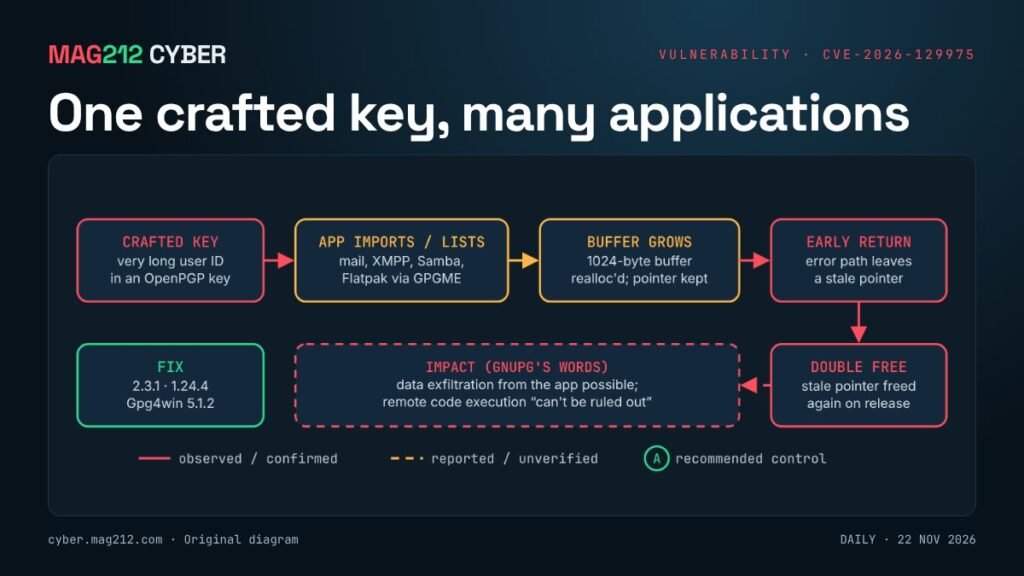
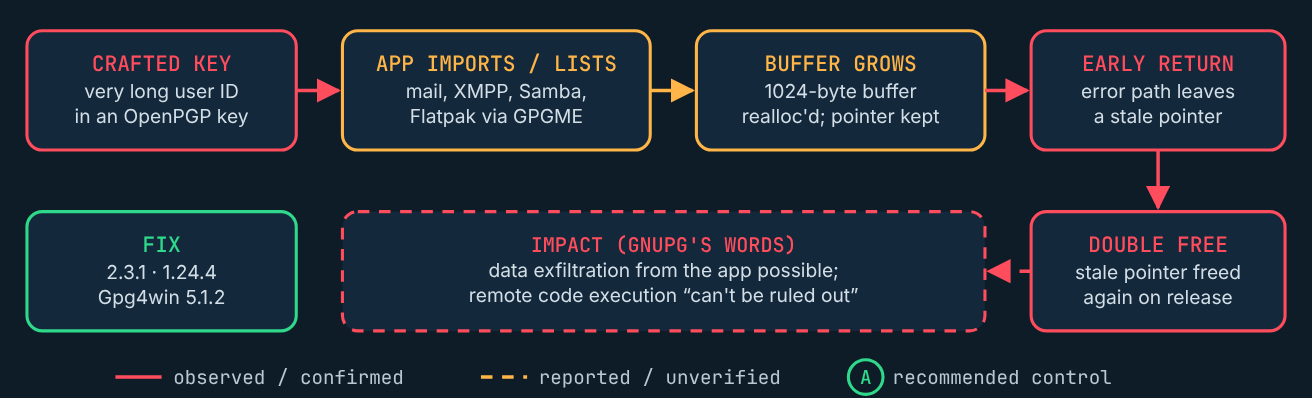
On 20 November 2026 GnuPG published a security advisory for GPGME, tracked as T8557 and CVE-2026-129975. Importing an OpenPGP key with a crafted, very long user ID can trigger a double free. [1]
Two internal functions in src/engine-gpg.c, read_status() and read_colon_line(), read status lines and key listings from gpg into a 1024-byte buffer and grow it with realloc when needed. They store the new pointer only at the end. If an error makes the function return early, a stale pointer is left behind and freed a second time when the context is released. [1][2]
The bug was found by Johan Carlsson. Disclosure was planned for 25 November but moved to 20 November because GitLab had to ship its own update early for the Ruby2Shell flaw. [1][2]
Why this matters
GPGME is plumbing. Few people know it is installed, but mail clients, chat clients, file servers and package tools call it whenever they handle OpenPGP keys. A bug that triggers on importing a key reaches every one of those programs, including ones that import keys automatically from incoming signed mail. And statically linked copies will not be fixed by a package update. (MAG212 analysis)
How serious is it
In GnuPG’s words, the double free “can be used exfiltrate data from applications by sending for example signed data”, and remote code execution “can’t be ruled out”. No attacks have been reported and no public proof of concept is known. [1][5]
Who is affected
All GPGME versions before 2.3.1, and before 1.24.4 on the legacy branch, whether used as a shared library, a Windows DLL or statically linked. GnuPG lists Gpg4win, GnuPG Desktop, GnuPG VS-Desktop, “most mail clients”, “many XMPP clients”, Samba and Flatpak as users of the library. The C++ and Qt bindings (GPGMEPP and GPGMEQT) need no update. [1]
Version 2.3.0 was never released. GnuPG warns that the legacy 1.24 branch may not “see all security patches”, so plan a move to 2.3. [1][3]
Distribution status (22 November)
- Debian 12 bookworm: fixed in 1.18.0-3+deb12u1 (DLA-4924-1).
- Debian 13 trixie: fixed in 1.24.2-3+deb13u1 (DSA-6646-1).
- Debian forky (testing): still vulnerable; sid has 2.3.1-1.
- Ubuntu, Red Hat, SUSE: we could not reach their trackers; check them directly.
Source: Debian security tracker. [4]
How to check what you have
These are generic, read-only package queries, not commands from GnuPG’s advisory. They were not tested by MAG212. Statically linked copies will not show up; ask the vendor.
# Debian / Ubuntu
dpkg -l 'libgpgme*'
# RHEL / Fedora / SUSE
rpm -q gpgme
# build hosts
pkg-config --modversion gpgme
How to fix it
- Update the GPGME package from your distribution, or build 2.3.1 from gnupg.org.
- On Windows, update Gpg4win to 5.1.2.
- Restart services that load GPGME, such as mail, XMPP and Samba.
- Rebuild anything that links GPGME statically, and update Flatpak runtimes.
- If you cannot update, GnuPG attached a patch that it says “should apply cleanly even to very old versions”. [1]
- Verify by re-running the version checks, and ask vendors of appliances and mail clients for fixed builds.
Related on MAG212 CYBER
- MAG212 CYBER Daily, 22 November 2026: Can police trust the record? (full issue and PDF)
- MAG212 CYBER Weekly, 21 November 2026: Machine Speed
- MAG212 CYBER Daily, 20 November 2026: The keys to vSphere
- Subscribe free to MAG212 CYBER
Sources
- [1] GnuPG, “GnuPG Security Advisory for GPGME (T8557, CVE-2026-129975)“, 20 Nov 2026.
- [2] GnuPG tracker, “T8557: double free in GPGME read_status / read_colon_line“, 13–20 Nov 2026.
- [3] GnuPG tracker, “T7659: GPGME 1.24.x legacy branch releases“, 20 Nov 2026.
- [4] Debian, “Security tracker: CVE-2026-129975 (gpgme1.0)“, 22 Nov 2026.
- [5] The Hacker News, “GnuPG warns critical GPGME flaw could expose app data via malicious OpenPGP keys“, 21 Nov 2026.
Written and edited by El Mostafa Ouchen for MAG212 CYBER. Facts checked against the sources above as of 22 November 2026, 7:00 AM PT.