
OpenRouter Drops Three AI Providers After Dragos Canaries Catch Months of Prompt Theft: What Happened and How to Protect Your AI Traffic
A MAG212 CYBER report, 22 November 2026. Today’s issue: MAG212 CYBER Daily, 22 November 2026. This article was written with AI assistance and edited by El Mostafa Ouchen. Commands, where included, were not tested by MAG212; run them only on systems you are authorised to administer.
Status: Dragos published its research on 19 November 2026. OpenRouter announced its response on 22 November 2026. None of the breached providers has been named by Dragos or OpenRouter, and it is not confirmed that OpenRouter’s three removed providers are the same three Dragos found breached. [1][2]
What happened
On 19 November 2026, HD Moore, chief research officer at the industrial security firm Dragos, published the results of a five-month experiment. From July to November his team sent about two million prompts to widely used AI services. Each prompt carried a unique secret that no legitimate system would ever use: web addresses, hostnames, and credentials such as AWS keys tied to empty, fully logged accounts. If a secret was ever used, Dragos could trace it back to the single request and route it came from. [1]
Three days later, OpenRouter, a service that routes customer AI requests to many different model hosting providers, said security researchers had found that “certain inference providers had data compromised” or were not upholding their data policies. It off-boarded three providers, removed 125 endpoints from Zero Data Retention (ZDR) eligibility, and notified all potentially affected customers. It says the findings “did not show any breach or unauthorized access of OpenRouter.” [2]
Why this matters
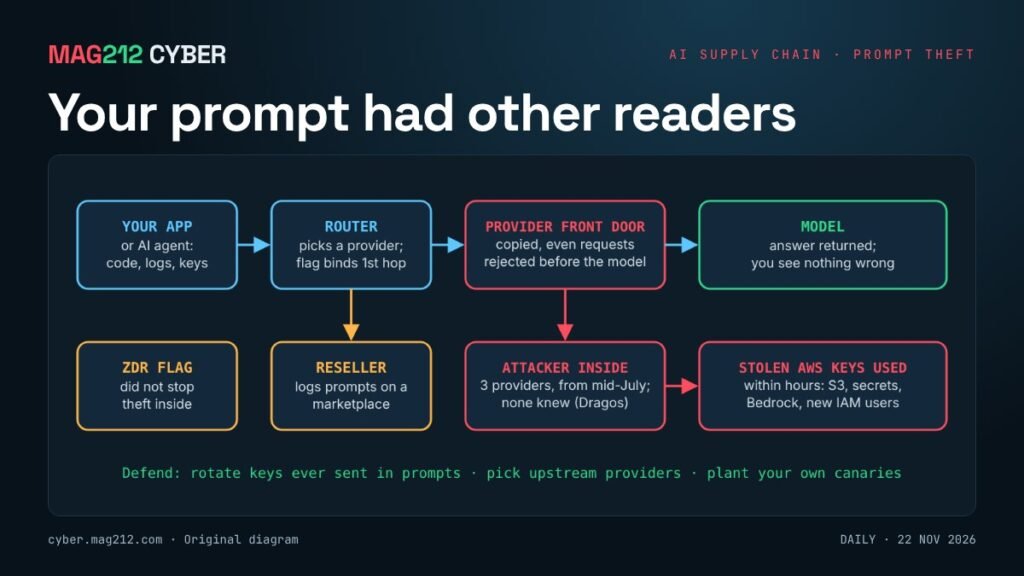
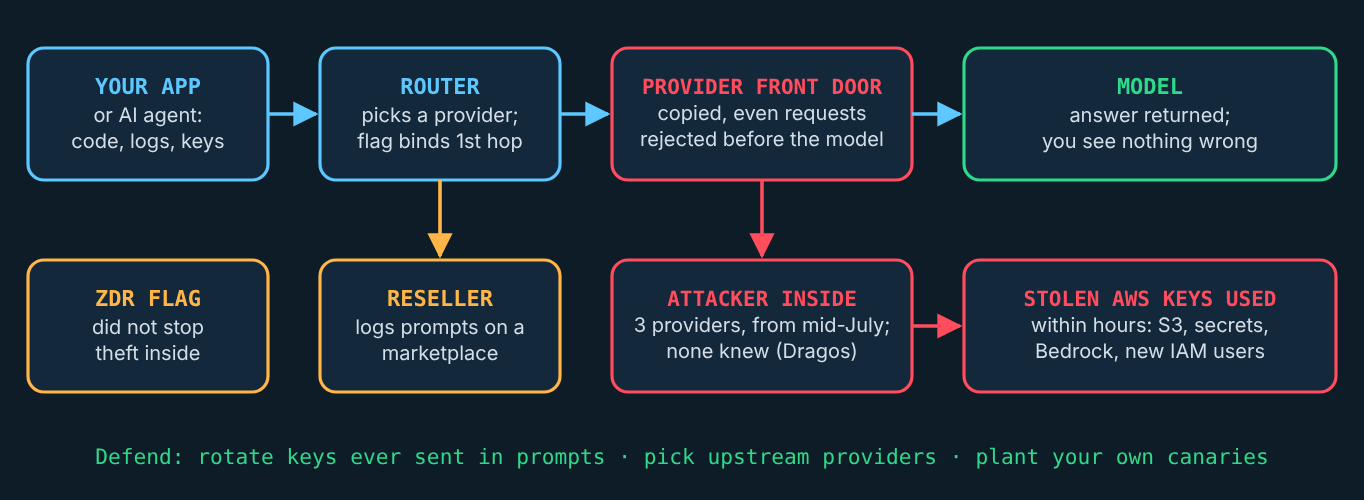
Developers paste code, logs, configuration files and keys into AI prompts every day, and AI agents send whatever they can read. Most teams assume the prompt goes to one company and is not stored. This research shows a prompt can pass through routers, resellers and hosting providers, and that a "do not retain" flag does not stop an attacker who is already inside one of them. (MAG212 analysis)
What Dragos found
- Attackers inside three hosting providers. Canary credentials were used by an attacker shortly after they were sent in prompts. In the largest breach, a couple of hundred AWS keys, each sent in a single request to one provider, were stolen during a few windows in late October. Some came from requests the provider rejected before any model ran, which points to copying at the provider’s front door. [1]
- None of the providers knew. The earliest incident dates to mid-July. Each provider learned of its breach only when Dragos told it. One provider at first blamed misconfigured internal tools, then a partner, before finding compromised internal credentials. [1]
- Zero Data Retention did not help. In two of the breaches, some stolen requests were marked ZDR. In Moore’s words, a privacy flag “doesn’t help when the attacker is already inside.” [1]
- Resellers reading prompts. Some sellers on an inference marketplace listed models cheaply, turned on request logging and collected prompts, with no exploit needed. Dragos also found one router quietly forwarding some traffic to that marketplace; the router says it stopped. [1]
- Prompts travelling further than expected. Systems at one Chinese AI lab fetched secret links from more than half of the prompts sent to its models, including about two-thirds of requests marked “no data collection” or ZDR, and US hosts reselling that lab’s models passed prompts on to it. One large US provider kept crawling a secret link more than two months after a single request. [1]
What the attackers did with the keys
Once they had the bait AWS keys, the attackers tested them within hours, listed storage buckets, searched Secrets Manager and Parameter Store, tried to enable Bedrock AI models, created Bedrock API keys and added IAM users. The bait keys drove tens of thousands of AWS API calls. One key seeded on 21 October was first used the next day and was still being used three weeks later. [1]
Which providers?
Dragos does not name the breached providers. OpenRouter does not name the three it removed. OpenRouter’s post links to notices from three providers, Novita, Phala and Together, without saying how they relate to the findings; Together’s notice concerns prompt leakage for requests in June and July 2026. Treat any list of “the three” circulating online as unconfirmed. [2]
What OpenRouter says it will do
OpenRouter says it will run the researchers’ kind of testing on an ongoing basis, technically check network paths for undisclosed forwarding of requests to third parties, and require assurances and validation before restoring ZDR to any endpoint it removed. [2]
What to do now
These steps follow Dragos’s recommendations, with MAG212’s additions marked. [1]
- Check your inbox and dashboard. OpenRouter says it has notified potentially affected customers. If you received a notice, treat the affected period as an incident.
- Rotate any secret that has ever been in a prompt sent through a router or third-party host: API keys, cloud credentials, database passwords, tokens. Review cloud logs for use of those keys. (MAG212 recommendation.)
- Choose the upstream provider yourself when you use a router, and verify that your privacy settings actually change routing. A privacy flag only binds the first hop.
- Avoid reseller marketplaces for anything sensitive.
- Use a first-tier provider directly, or self-host, when the data justifies it: one contract and one privacy policy to check, or no third party at all.
- Plant your own canaries. Put unique fake credentials in agent and pipeline context and treat any use of one as an incident.
- Keep secrets out of prompts. Turn on provider secret filtering, and strip keys from logs and files before an AI agent can read them.
Related on MAG212 CYBER
- MAG212 CYBER Daily, 22 November 2026: Can police trust the record? (full issue and PDF)
- MAG212 CYBER Weekly, 21 November 2026: Machine Speed
- MAG212 CYBER Daily, 20 November 2026: The keys to vSphere
- Subscribe free to MAG212 CYBER
Sources
- [1] Dragos (HD Moore), “Three breaches, endless leaks: Your AI supply chain needs canaries“, 19 Nov 2026.
- [2] OpenRouter, “Data Processing Incidents on Inference Providers“, 22 Nov 2026.
Written and edited by El Mostafa Ouchen for MAG212 CYBER. Facts checked against the sources above as of 22 November 2026, 7:00 AM PT.