
Vanderbilt Tells Its Campus to Shut Down Devices as the BYOD Gang Claims the Attack
Vanderbilt University is dealing with an active cyber incident serious enough that it told everyone on campus to shut down their devices immediately and get off university Wi-Fi. Officials have called it a likely ransomware attack, and a relatively new extortion group calling itself BYOD claims to hold data on more than a million people. Much of what circulates about the attack is still unverified, so this article separates what Vanderbilt has confirmed from what has only been reported or claimed.
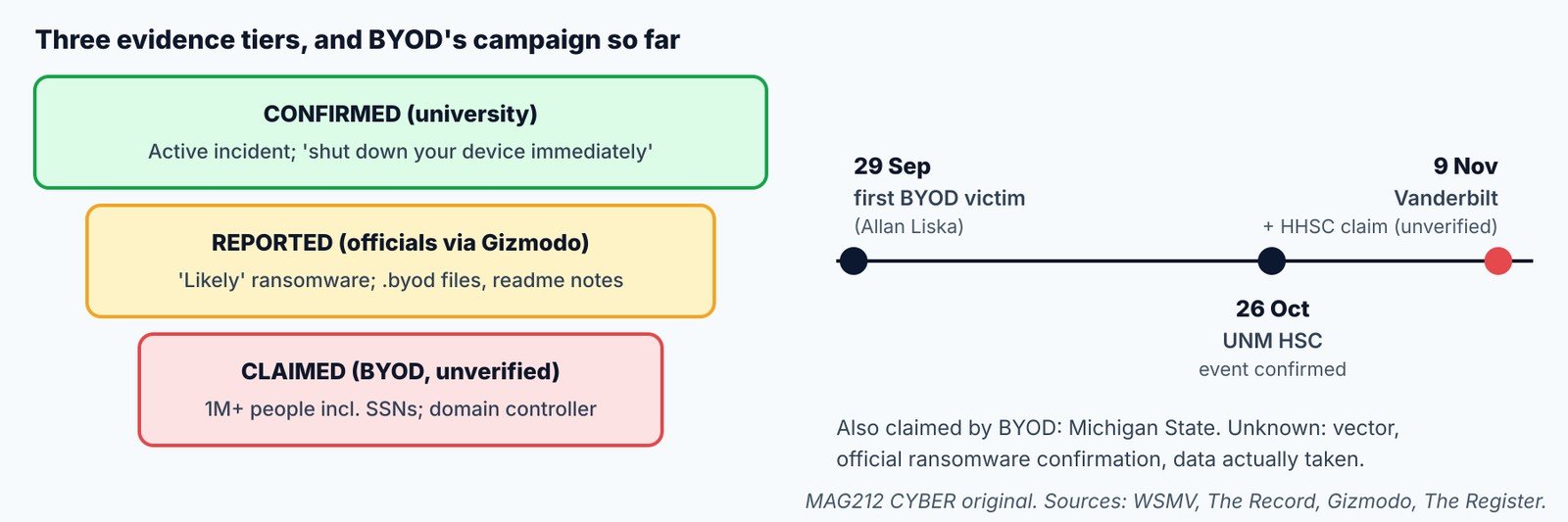
[Confirmed] Vanderbilt has an active incident that may affect devices, systems and cloud services, and told users to “SHUT DOWN YOUR DEVICE IMMEDIATELY” and leave university Wi-Fi. It has about 14,000 students and more than 6,000 staff. (WSMV) (The Record) [Reported] Officials called it a “likely” ransomware attack; classes proceeded though some were cancelled; users reported ransom notes and files renamed with a .byod extension (Nashville Scene via Gizmodo, not officially confirmed). (Gizmodo) [Claimed] BYOD says it holds data on more than 1 million people including SSNs, plus the domain controller and research data. Vanderbilt didn’t respond to Gizmodo. (Gizmodo)
[Reported] BYOD’s first victim appeared on 29 September; it has also claimed Michigan State and UNM Health Sciences Center, which confirmed a “cybersecurity event” on 26 October. Its UNM machine count is unverified, as is a 9 November claim against the Texas Health and Human Services Commission. (The Record) (The Register) [Unknown] Vector, official ransomware confirmation, restoration status and whether data was taken. No IOCs.
For school and university IT [MAG212 analysis]: (1) confirm tested offline or immutable backups of domain controllers and identity systems; (2) rehearse a campus-wide “shut down devices” message on a channel that works without email; (3) review privileged and domain-admin activity; (4) watch Vanderbilt’s status page for a vector disclosure.
Why it matters
Universities combine large, open networks, thousands of unmanaged personal devices, sensitive research and medical data, and identity systems that every student and employee depends on. BYOD has moved quickly through higher education and health since late September. A campus-wide shutdown order is the kind of message every school should be able to send, and receive, when email itself may be down.
The bottom line
Confirm you have tested offline or immutable backups of domain controllers and identity systems, rehearse a campus-wide “shut down devices” message on a channel that works without email, review privileged account activity, and watch Vanderbilt’s disclosures for the entry vector.
How we label evidence: [Confirmed] comes from a primary source such as a vendor or CISA; [Reported] from a secondary outlet; [Claimed] from an attacker or an unverified party; [MAG212 analysis] is our judgement; [Unknown] means not established at press time. Commands and indicators are copied from the cited sources and were not tested by MAG212 CYBER.
This story is part of MAG212 CYBER Daily, 11 November 2026, with the day’s other verified stories, the Defender’s Action Desk and a full source register. Get the daily briefing free: subscribe to MAG212 CYBER. By El Mostafa Ouchen.