Where Do Your AI Prompts Really Go? Five Lessons From This Month’s AI Provider Leak Disclosures
Phala, Together AI, Novita and Atlas Cloud have now explained how prompts were exposed. Here is what each incident teaches, and a practical secret-hygiene checklist for anyone using AI APIs
From the MAG212 CYBER Daily, 23 November 2026. This article was written with AI assistance and edited by El Mostafa Ouchen. Commands, where included, are generic and were not tested by MAG212; run them only on systems you are authorised to administer.
What you will learn
- How a single AI request can pass through several companies
- The difference between an intrusion and an undisclosed forward
- How an AI coding agent leaked a credential at one provider
- A checklist to keep secrets out of prompts, and what to do if they were in them
Background: the canary experiment
On 19 November, HD Moore of Dragos published results from a long experiment. He sent prompts containing “canary” credentials (real but empty, fully logged cloud keys and unique links) through AI routers and resellers, then watched who used them. Some of the keys were later used by attackers. Dragos
OpenRouter, a popular AI router, responded on 22 November. It removed three providers, took the zero-data-retention (ZDR) label off 125 endpoints and notified customers. It also listed the providers that had published their own notices. OpenRouter
Lesson 1: Your request may make more hops than you think
When you call a model through a router, the request can go from your app to the router, then to a hosting provider, and sometimes on to the original model maker’s own API. Each hop is a company with its own servers, staff and logging.
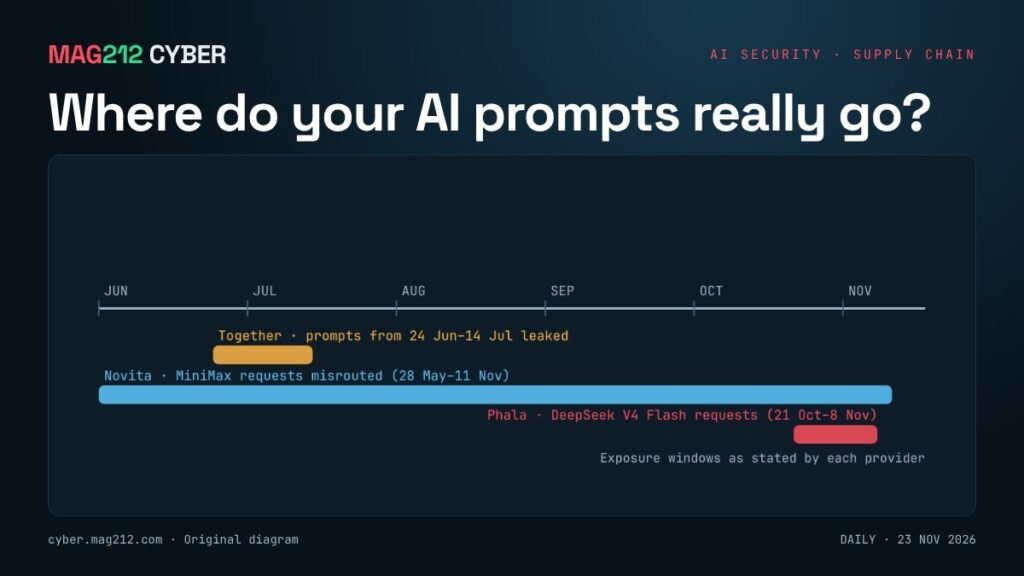
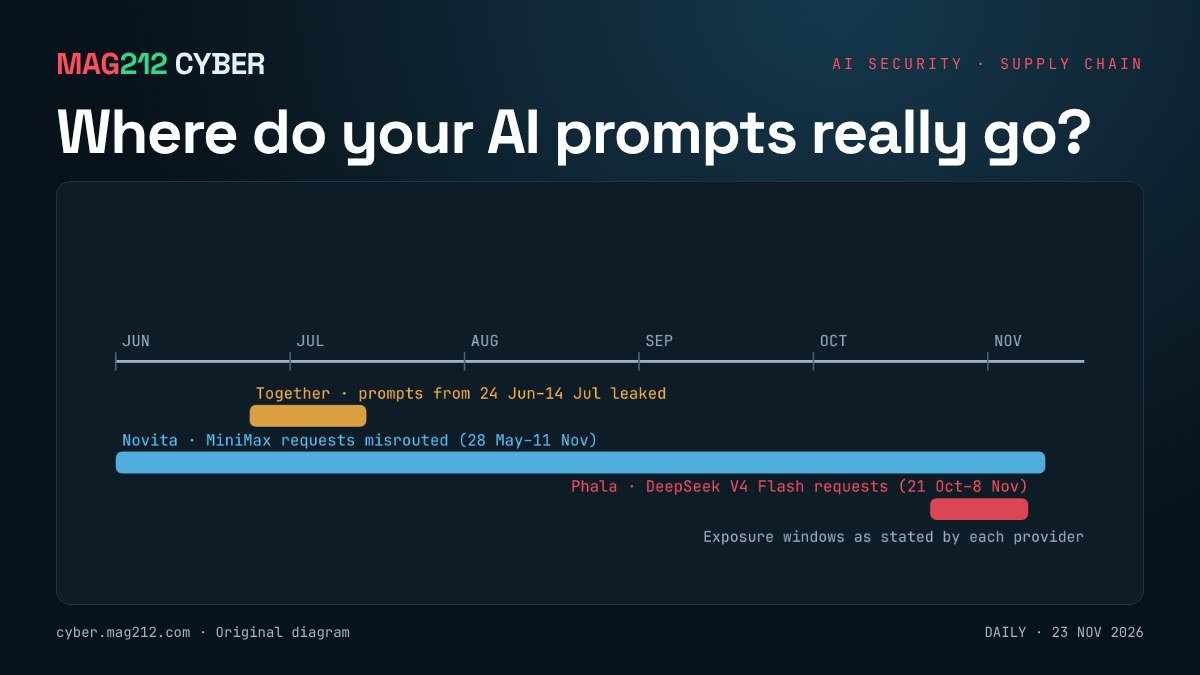
Novita says a routing configuration error sent some MiniMax requests to MiniMax’s official API, instead of its own servers, from 28 May to 11 November 2026. Novita Atlas Cloud said on 23 November that its MiniMax M3 and M2.7 requests were also forwarded to MiniMax’s API, where a third party opened private links from prompts. Atlas says it did not store the prompts and has pulled its models from OpenRouter while it retests. Atlas Cloud
The lesson: privacy settings such as “no training” or ZDR bind the company you send them to. Dragos warns they may not follow your data to the next hop. Dragos
Lesson 2: Some of this was a classic break-in
Phala’s preliminary report (10 November) describes an intrusion. An attacker chained an old internet-facing service with management interfaces that trusted local connections without authenticating the caller. A new GPU server was also serving production traffic before it had been fully hardened. Requests to DeepSeek V4 Flash 0731 routed to Phala between 21 October and 8 November are treated as exposed. Phala
The lesson: AI infrastructure fails the same way any infrastructure does: legacy services, implicit trust and new servers launched before they are hardened.
Lesson 3: An AI coding agent leaked the key
Together AI’s CEO wrote on 21 November that an AI coding agent committed a credential while working on a public GitHub repository. The credential opened a private Hugging Face repository holding stored prompt samples from June and July. Together’s scanner caught it and the commit was reverted, but an unauthorized party had already downloaded the samples and tested credentials it found inside them. Five of those were Dragos canaries. Together AI
Together’s fixes are worth copying: short-lived or keyless credentials, secret checks on every pull request, ZDR on by default for new accounts, and new development rules for AI coding agents.
The lesson: an agent with commit rights can publish a secret faster than a human reviewer. Put secret scanning in front of the push, not after it.
Lesson 4: Data you stopped thinking about is still data
Together’s leak came from prompt samples kept for software testing. Data you keep for debugging, evaluation or testing is still customer data, so give it the same access control and retention limits as production. (MAG212 analysis)
Lesson 5: Canary tokens work
Without the seeded keys and links, none of these providers’ notices would exist in this form. Phala says only canaries sent on 21 and 22 October were misused, which let it date the exposure precisely. Phala Dragos recommends seeding canary credentials in agent context and treating any use as an incident. Dragos
What is still unknown
- OpenRouter has not named the three providers it removed. SecurityWeek notes it did not say whether they are among those with public notices. SecurityWeek
- MiniMax has made no direct public statement in the sources we checked.
- No provider has published a total count of affected customers.
Your secret-hygiene checklist
- Never paste live secrets into prompts. Use placeholders, and filter secrets out of prompts automatically before they leave your network.
- If you used an affected model in its window, rotate. Phala, Novita and Atlas Cloud all tell users to treat secrets sent to those models as exposed and to revoke them. Phala, Novita, Atlas Cloud
- Pin your upstream provider when you use a router, or go direct to the model maker for sensitive work. Dragos
- Turn on ZDR where offered, and remember it only binds the first hop.
- Scan commits made by AI agents before they reach a public repository, and give agents short-lived, narrowly scoped credentials.
- Plant canaries in agent context and alert on any use.
Key takeaways
- An AI request is a supply chain. Know every hop.
- Both intrusions and quiet forwarding exposed prompts this year.
- A coding agent can leak a key in one commit; scan before the push.
- Rotate anything that ever sat in a prompt sent to an affected model.
Related on MAG212 CYBER
- MAG212 CYBER Daily, 23 November 2026: One upload, one shell (full issue and PDF)
- How a file upload becomes a shell (Ghostscript Upload2Shell)
- No malware needed: Webworm’s VPN spy bridge
- CISA’s KEV list explained
- Subscribe free to MAG212 CYBER
Sources
- Dragos: www.dragos.com
- OpenRouter: openrouter.ai
- Novita: novita.ai
- Atlas Cloud: www.atlascloud.ai
- Phala: phala.com
- Together AI: www.together.ai
- SecurityWeek: www.securityweek.com
Written and edited by El Mostafa Ouchen for MAG212 CYBER. Facts checked against the sources above as of 23 November 2026, 7:00 AM PT.