
N-able N-central After HF2: Able2Shell, 4EverAble2Shell and the Legacy API Question
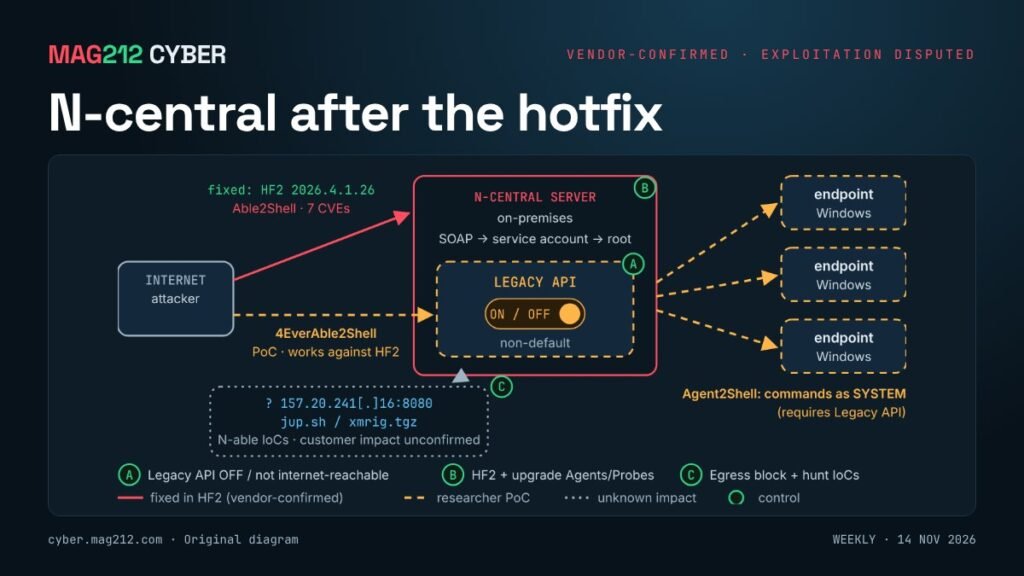
From the MAG212 CYBER Weekly, 14 November 2026. Status labels: confirmed by vendor, reported by researchers, or unverified. Every command below is copied from official documentation and was not tested by MAG212; run it only on systems you are authorised to administer.
Status: Vulnerabilities confirmed by vendor: HF2 fixes seven CVEs, and N-able acknowledges that 4EverAble2Shell and Agent2Shell depend on the Legacy API [10]. Exploitation status is in conflict:
- N-able reported scanning activity but “no evidence that any customer environment had been successfully exploited”, and Huntress has seen no exploitation in partner environments [10].
- watchTowr saw exploitation attempts on honeypots [9].
- N-able’s own 13 November IoCs include XMRig-delivery infrastructure [10].
- The earlier draft’s claim of “live exploitation” (Huntback: 21 mining identities, 19 on HF2) is unverified, because the source could not be located.
What happened
About 04:14 UTC on 9 November (the evening of 8 November in the Americas), a researcher published proof-of-concept code for 33 alleged N-central vulnerabilities (“Able2Shell”) without notifying the vendor. N-able took hosted N-central offline in the Americas, Europe and APAC and told on-premises customers to shut down. Censys counted 1,728 internet-reachable hosts that day [9]. At 5:30 PM ET on 10 November, N-central 2026.4 HF2 (build 2026.4.1.26) fixed seven CVEs [10]:
- CVE-2026-125883: XXE
- CVE-2026-125878: OGNL injection
- CVE-2026-125879: LPE to root via syslog-ng configuration
- CVE-2026-125880: stored XSS
- CVE-2026-125881: SSRF
- CVE-2026-125882: RCE via upload path traversal
- CVE-2026-91000: insecure IPC leading to LPE
At 1:10 AM ET on 12 November, the researcher released two more chains [10]:
- “4EverAble2Shell”: unauthenticated RCE to root on the N-central server, working against HF2.
- “Agent2Shell”: more than 10 issues in server-to-Agent/Probe communication, including two chains for unauthenticated command execution as SYSTEM on managed Windows endpoints.
At 6:30 AM ET, N-able said both require the non-default Legacy API to be enabled and exposed, and that hosted N-central is not vulnerable to 4EverAble2Shell [10]. N-able published IoCs at 10:25 AM ET on 13 November [10].
Who is affected
- 4EverAble2Shell: on-premises N-central servers with the Legacy API enabled and reachable from the internet, including HF2 build 2026.4.1.26.
- The seven HF2 CVEs: all builds before HF2.
- Agent2Shell: managed Windows endpoints, where the Legacy API is enabled.
No CVE IDs exist yet for 4EverAble2Shell or Agent2Shell, and MAG212 found no HF3 [10].
Why this matters
An RMM server holds standing administrative access to every managed customer. Even with exploitation disputed, the combination of public PoCs, a fix that does not cover the newest chains and a non-default setting that decides exposure means MSPs must verify configuration, not just install a hotfix. Configuration drift, not missing patches, is the real risk here. (MAG212 analysis)
How the attack works
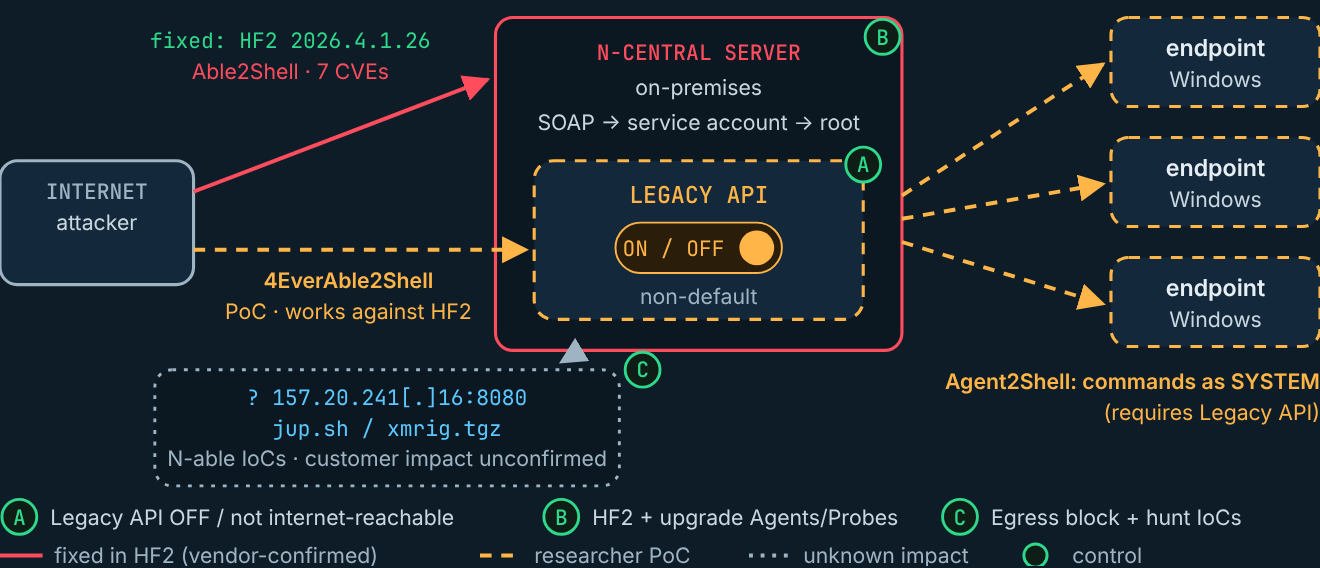
These are researcher-described paths from published PoCs:
- Unauthenticated SOAP request to the N-central server.
- Code execution as the service account.
- Escalation to root (one HF2 CVE covers LPE via syslog-ng config).
- Possible abuse of the RMM channel to push commands to managed endpoints as SYSTEM (Agent2Shell).
N-able’s IoCs show a miner-delivery path (jup.sh, xmrig.tgz) on attacker infrastructure. Whether customer servers actually ran it is not established in the sources MAG212 could reach.
What defenders should look for
N-able IoCs, 13 Nov, defanged [10]:
- URLs:
hxxp://157.20.241[.]16:8080/jup.sh,/xvgz,/xmrig.tgz,/ob/cronhit?h=jup_start_<rig>&persist=<method>,/ob/fcheck - Outbound connections:
157.20.241[.]16(ports 8080 and 19202–19418),139.99.69[.]109:10128,79.76.51[.]56:39100
Huntress static-analysis indicators (not observed in the wild) [10]:
- Server requests and files:
- POSTs to
/dms/services/ServerUIcontainingjline.internal.TerminalLineSettingsorGenericAgentXMPPMessageExchangewith SessionID −1 - POSTs to
/dms2/services2/ServerMMS2containingRemoteExecutionTaskSubmitwith sessionID −1 /var/opt/n-central/flag/flag_default.jsonas a symlink to/opt/nable/var/ncsai/scripts/ServerChild.sh/var/opt/n-central/tmp/serverchild-<12hex>.{bak,sh,out}- ZIPs under
/download/scheduled_tasks/output_files/containingCodeDropMeta.xml
- POSTs to
- Windows endpoints:
powershell.exe -NoProfile -NonInteractive -EncodedCommandrunning as SYSTEM, spawned by the N-able Agentwsp.exeorservice.cfgwritten toWindows Software Probe\bintaskkill /f /im wsp.exerun from a.cmdfile in%TEMP%
False positives. RMM platforms legitimately run encoded PowerShell as SYSTEM, so match it against your scheduled automation before escalating. A single SOAP request can be a scanner probe.
Unverified (from the earlier draft only): /tmp/.xvd, /var/tmp/.xvd, xvd.service.
How to investigate
Follow Huntress’s guidance [10]:
- Review activity from 11 November onward for unexpected admin accounts, scripts, scheduled tasks and remote sessions.
- Record the build, Legacy API status and the firewall/ACL history for the exposure window.
- Group managed endpoints by customer and tenant, and review any script pushes that change tickets do not explain.
Contain and remediate (in order)
- Confirm the Legacy API is disabled, using N-able’s KB procedure. If it must stay enabled, do not expose it to the internet, and do not rely on IP allowlisting alone [10].
- Apply HF2.
- Upgrade Agents and Probes as well as servers, because HF2 changes how they communicate [10].
- Block and hunt the IoC addresses.
- If you find compromise, rebuild the server from trusted media and rotate RMM, integration and customer credentials from a clean control plane.
Verify recovery
N-able warned that a patched build may not change the version number [9], so confirm patch state with N-able rather than by version string. Test from an external vantage point that the Legacy API path is unreachable. Confirm Agents and Probes check in, then run a harmless approved job on one canary endpoint per tenant.
Prevention and awareness
RMM consoles are a “keys to every customer” asset. Put them behind VPN or zero-trust access, log admin actions off-box, and give each MSP technician a separate identity protected by phishing-resistant MFA.
No command panels. No official N-able doc for checking or disabling the Legacy API was verified [10].
Related on MAG212 CYBER
- MAG212 CYBER Weekly, 14 November 2026: The keys were already inside (full issue and PDF)
- Subscribe free to MAG212 CYBER
Sources
- [9] Cloud Security Alliance Labs, “CSA research note: Able2Shell N-central zero-days”, 10 Nov 2026. link
- [10] Huntress, “N-able disables cloud services following disclosure of Able2Shell exploit chains”, 9 Nov, updated through 13 Nov 2026. link
Written and edited by El Mostafa Ouchen for MAG212 CYBER. Facts checked against the sources above as of 14 November 2026, 10:05 AM PST. Diagrams are original MAG212 CYBER illustrations.