
Expedia Confirms a Breach Through a Data-Platform Supplier as n0n Claims Nearly a Billion Records
From the MAG212 CYBER Daily, 15 November 2026. Every command is copied from official documentation or the cited analysis and was not tested by MAG212; run it only on systems you are authorised to administer.
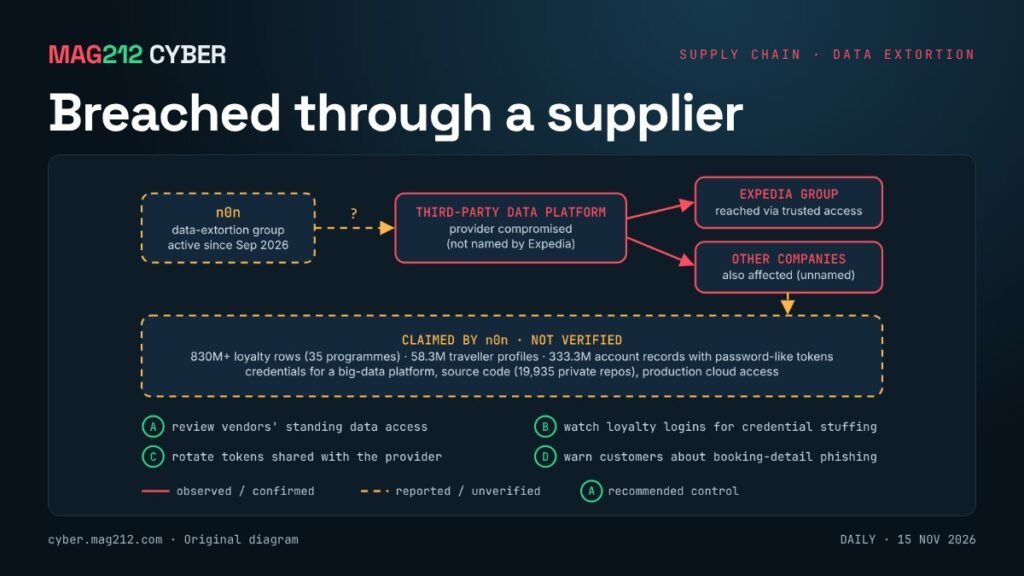
Status: Intrusion confirmed; scale unverified. Expedia says attackers compromised a third-party data platform provider and used its trusted access to reach Expedia’s systems, in an attack that affected several companies. What data was taken, the provider’s name and n0n’s figures are not confirmed. [1][2]
What happened
The data-extortion group n0n listed Expedia Group on its leak site in early November, claiming more than a terabyte of data. On Thursday 12 November Expedia acknowledged a supply-chain attack in which attackers compromised a third-party data platform provider and used it to reach Expedia’s systems. Expedia says it contained the issue when it became aware, is investigating with outside security experts, and that its platforms remain safe for travellers and partners. [1][2][3]
Expedia has not named the provider. Skift notes that Qubole, whose AWS account was abused against customers’ cloud environments between 14 and 26 October, was a former Expedia vendor. Expedia has not said whether the incidents are linked, and researchers have not named Expedia as a Qubole victim. [1]
Why this matters
Expedia's statement confirms a pattern seen repeatedly this autumn: attackers reach large companies through a supplier's trusted access to their data, not through the companies' own perimeter. Loyalty programmes turn that data into money quickly through account takeover. (MAG212 analysis)
What n0n claims (not verified)
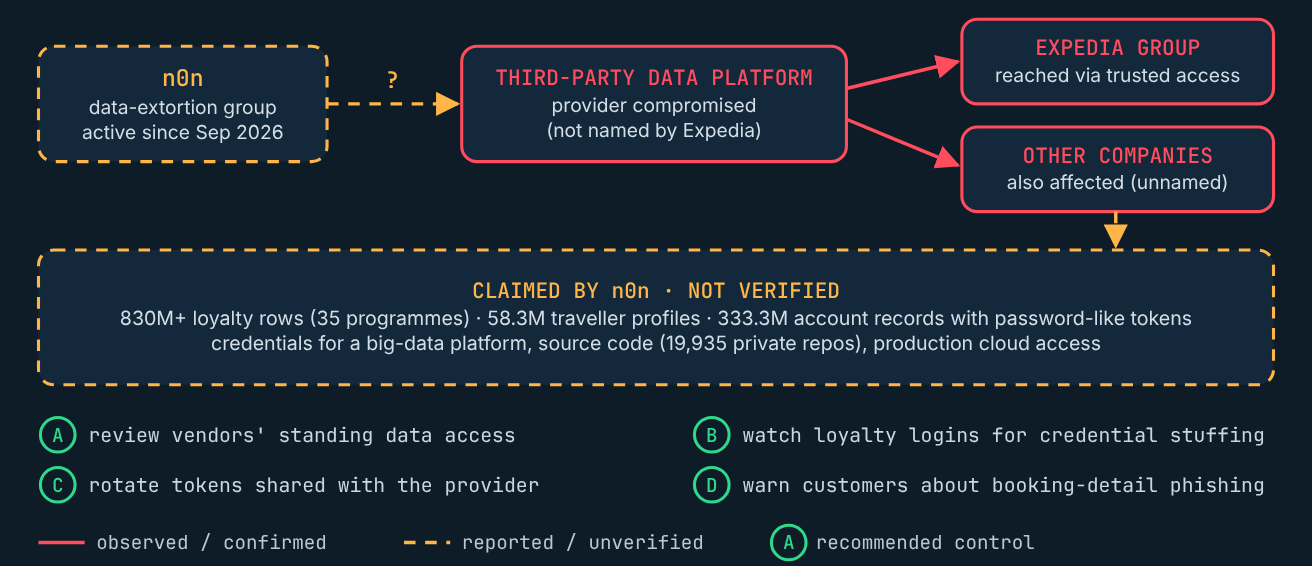
According to reporting on n0n’s leak post, the group claims: [3][2]
- more than 830 million loyalty-programme rows across 35 programmes;
- 58.3 million traveller profiles with email addresses, account dates and home airports;
- 333.3 million consumer account records pairing account IDs and emails with password-like tokens;
- live credentials for a big-data platform, access to source code in 19,935 private repositories, and production cloud access.
Expedia has not confirmed these figures, and some published files may be historical. [4][5]
Who is affected
Customers and loyalty members of Expedia Group brands, including Expedia, Hotels.com, Vrbo, Orbitz, Travelocity and Hotwire, if the claims hold, plus the unnamed companies that used the same data platform provider. [3][1]
How the attack works
No entry vector has been disclosed. SOCRadar, which found an exposed n0n server in September, says every documented n0n intrusion relied on weak or compromised credentials, and found no exploit payloads or CVE references in the operator’s files. We treat that as a hypothesis for this case, not a finding. [5]
What defenders should look for
- Credential stuffing against loyalty and travel accounts, and points drained or redeemed in unusual patterns. [4]
- Phishing that quotes real bookings, home airports or loyalty IDs.
- Vendor-held tokens, roles or keys to your data platforms that are still active after a contract has ended.
How to investigate
- Inventory every third party with standing access to your data platforms, warehouses and cloud accounts, including former vendors.
- Review cloud audit logs for role assumptions and data reads by vendor identities over the last 60 days.
- Compare published sample data, if any, with your own records to judge whether it is current or historical.
Command reference
List who can assume your AWS roles
AWS CLI v2 · requires iam:ListRoles · read-only · not tested by MAG212
aws iam list-roles \
  --query "Roles[].{Name:RoleName,Trust:AssumeRolePolicyDocument.Statement[].Principal}" \
  --output json
Flag any external AWS account ID you cannot match to a current vendor contract, especially for data platforms you no longer use. Run it in each account.
Contain and remediate (in order)
- Revoke or rotate tokens, keys and roles shared with data-platform providers, starting with vendors you no longer use.
- Force password resets and step-up verification for loyalty accounts showing anomalous logins or redemptions.
- Warn customers that you will not ask for passwords or payment by email, and that messages quoting their bookings may still be fake.
- Preserve vendor access logs before revoking access, so the investigation can establish what was read.
Verify recovery
- No external principals remain in role trust policies without a current contract.
- Credential-stuffing alerts on loyalty endpoints return to baseline.
- Rotated keys fail when tested from the old configuration.
Prevention and awareness
Data platforms aggregate everything an attacker wants. Require time-limited, least-privilege access for vendors, review it quarterly, and delete integrations when contracts end. Travellers should enable MFA on travel and loyalty accounts and open apps directly rather than following links in emails.
Related on MAG212 CYBER
- MAG212 CYBER Daily, 15 November 2026: Machine speed, human gaps (full issue and PDF)
- MAG212 CYBER Weekly, 14 November 2026
- Subscribe free to MAG212 CYBER
Sources
- [1] Skift, “Expedia confirms cyberattack through third-party vendor“, 12 Nov 2026.
- [2] Security Affairs, “Extortion group claims theft of nearly one billion Expedia traveler records“, 14 Nov 2026.
- [3] Cybernews, “Nearly a billion traveler records at risk as hackers target Expedia“, Nov 2026.
- [4] Security Boulevard, “Top 10 breaches of the week“, 14 Nov 2026.
- [5] Cyber Daily, “Cyber extortion group claims breach of Expedia“, 12 Nov 2026.
Written and edited by El Mostafa Ouchen for MAG212 CYBER. Facts checked against the sources above as of 15 November 2026, 7:45 AM PST.