
Also Today: Telegram Widgets RCE Dispute, Retadup Worm Returns, SANSAR GPU Miner and the BIS AI Remote-Access Rule
From the MAG212 CYBER Daily, 17 November 2026. Facts are sourced below; analysis is marked as MAG212’s.
Status: Facts are as reported by the cited sources; Telegram’s case is disputed and labelled. [1][2][3][4]
Telegram widgets: RCE demonstrations and a malware warning
Telegram’s new widgets, promoted by Pavel Durov on 10 November, let messages act as apps. Researchers say the feature runs the QuickJS JavaScript engine inside messages without a sandbox. [1]
- On 11 November a researcher posted a video of a bot interaction opening the Calculator app on an Android phone, and later claimed a second exploit against the Windows client. [1]
- On 13 November Kaspersky said a widget flaw may have been exploited to deliver WebRAT (also called Salat Stealer), suspecting that visiting certain channels triggered a PowerShell script. It shared no technical details or victim counts and advised users not to launch widgets until a fix is released. [1]
- Durov disputed the claims, saying a user had to start a third-party service first and that the issue had been patched server-side. Telegram said the Android issue was fixed for all users; the Windows claim is unconfirmed. [1]
What to do: avoid launching widgets from unknown channels or bots for now, keep Telegram updated, and alert on PowerShell launched by the Telegram desktop client.
Why this matters
None of these four needs a full feature, but each points to an action: avoid a new messaging feature until it is fixed, hunt for a tampered library, audit GPU job access, and review customer checks if you host compute. (MAG212 analysis)
Retadup worm returns with CoffeeLoader
The USB-spreading Windows worm disrupted by French law enforcement in 2019 is active again after its old command-and-control domains were re-registered; they have pushed SmokeLoader and, since early 2025, CoffeeLoader. [2]
- Delivery: an NSIS installer drops a tampered copy of the 7-Zip library,
7z.dll, into a temporary folder and runs it withrundll32.exe. Part of its code is replaced with self-decrypting shellcode. [2] - Persistence: the DLL is copied into a ProgramData or LocalAppData subfolder with a Run key whose name is eight hexadecimal digits; the malware injects into processes such as
dllhost.exeandWerFault.exe. [2] - Scale: Kaspersky blocked about 15,000 infections, mostly in Peru, Angola, Russia and Bolivia. [2]
What to hunt: 7z.dll outside the 7-Zip installation folder, rundll32.exe loading it, and new Run keys with eight-hex-digit names.
SANSAR hides crypto-mining from nvidia-smi
Elastic found attackers entering GPU hosts through an exposed Ray job agent, sending GPU inventory to an external server, then submitting a reverse-shell job and adding an SSH key. [3]
- A Rust orchestrator takes commands over Tor and launches XMRig or SRBMiner-MULTI.
- A modified NVML wrapper makes
nvidia-smireport 0% utilisation with random temperature (36–46°C) and power (100–200 W) values. - A kernel rootkit,
acpi_thermal_mgr.ko, is built with DKMS and reloaded at boot through an initramfs hook; a separate backdoor gets its command server address from an Ethereum smart contract. [3]
What to do: never expose Ray dashboards or job APIs to untrusted networks, audit who can submit jobs, compare GPU monitoring libraries with vendor packages, and check for unknown kernel modules.
BIS restricts remote access to US AI chips
The Commerce Department’s Bureau of Industry and Security issued a rule on 16 November, effective immediately, restricting remote access to advanced US chips and servers. Overseas data centres serving companies in countries such as China, Russia, Iran and Cuba must identify their end users, and chip sales to Indonesia, Malaysia, Singapore, Thailand and Brazil face case-by-case licensing. [4]
What to do: cloud and GPU-hosting providers should review know-your-customer and end-user screening processes with legal counsel.
Related on MAG212 CYBER
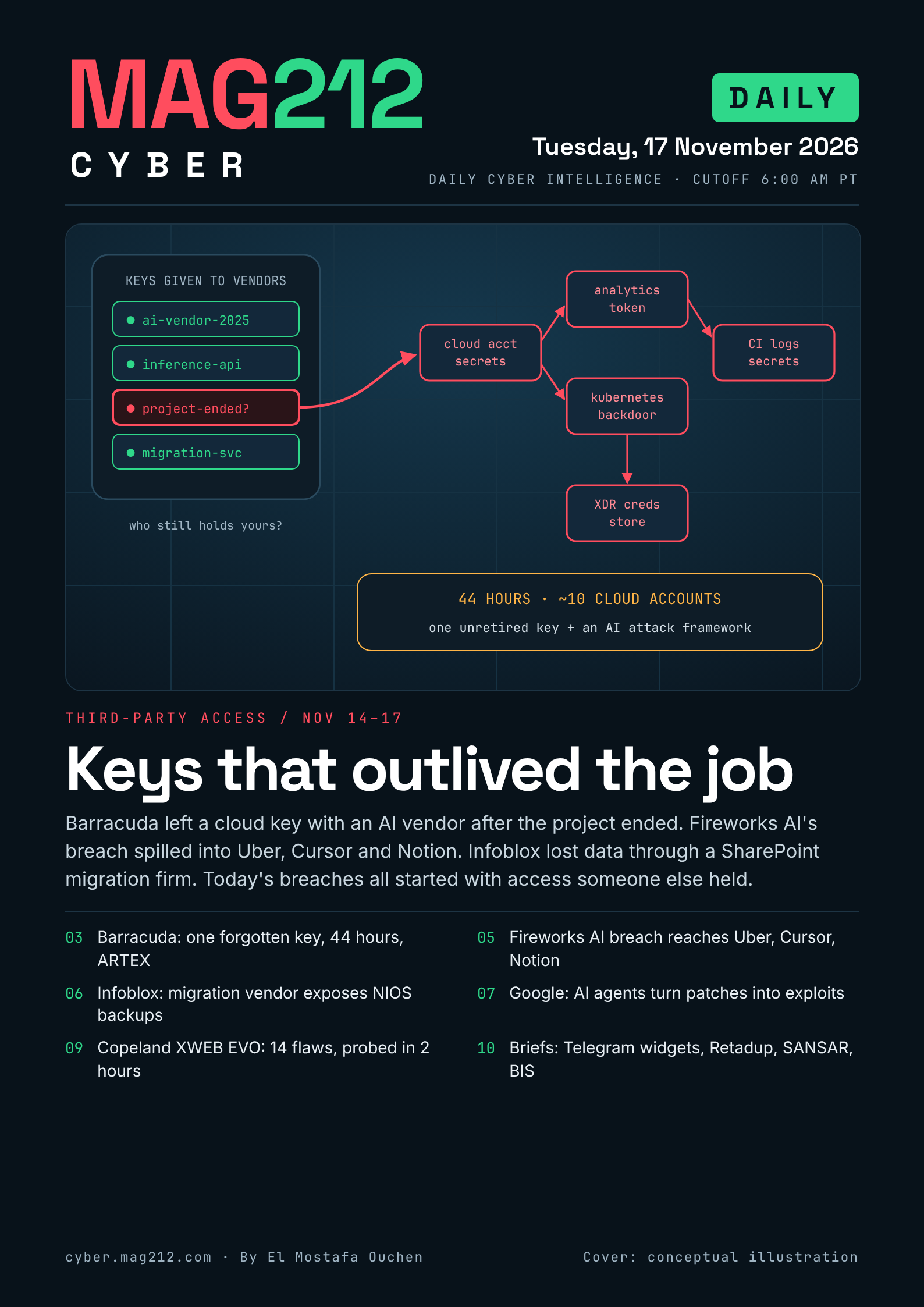
- MAG212 CYBER Daily, 17 November 2026: Keys that outlived the job (full issue and PDF)
- MAG212 CYBER Daily, 16 November 2026: The boxes nobody patches
- MAG212 CYBER Weekly, 14 November 2026
- Subscribe free to MAG212 CYBER
Sources
- [1] SecurityWeek, “Telegram widgets hit by RCE demos, malware warning days after launch“, 16 Nov 2026.
- [2] The Hacker News, “Retadup worm resurfaces 7 years after takedown to spread CoffeeLoader“, 16 Nov 2026.
- [3] The Hacker News, “SANSAR Linux cryptomining malware uses modified NVIDIA library“, 16 Nov 2026.
- [4] SecurityWeek, “Trump administration moves to block China from indirect access to American AI technology“, 16 Nov 2026.
Written and edited by El Mostafa Ouchen for MAG212 CYBER. Facts checked against the sources above as of 17 November 2026, 6:00 AM PT.