
ARTEX Agents Stole AI Keys to Pay for More Attacks: What Amazon Saw and How to Lock Down AI Gateways
From the MAG212 CYBER Daily, 16 November 2026. Every command is copied from official documentation or the cited analysis and was not tested by MAG212; run it only on systems you are authorised to administer.
Status: Vendor threat intelligence, moderate confidence. Amazon published on 13 November 2026; the findings were widely reported on 16 November. Amazon did not observe the activity live: its view comes from records the agents carried in requests to its decoys, and it cannot verify the outcomes the agents claimed. This is an update to our [15 November ARTEX coverage](https://cyber.mag212.com/fbi-artex-flash-ai-agents-autonomous-intrusions-defender-guide/). [1][4]
What happened
From 3 October to 5 November 2026, Amazon’s MadPot sensors, configured to look like popular LLM inference APIs, received requests from AI agents. Because agent frameworks send their working history with each call, the requests carried the agents’ own records of their campaigns. Amazon assesses, with moderate confidence, that the agents ran on ARTEX, an open-source agentic penetration-testing framework, and that the operators were separate Chinese-nexus groups, based on simplified-Chinese prompts, China time-zone settings and targeting and tooling patterns. [1]
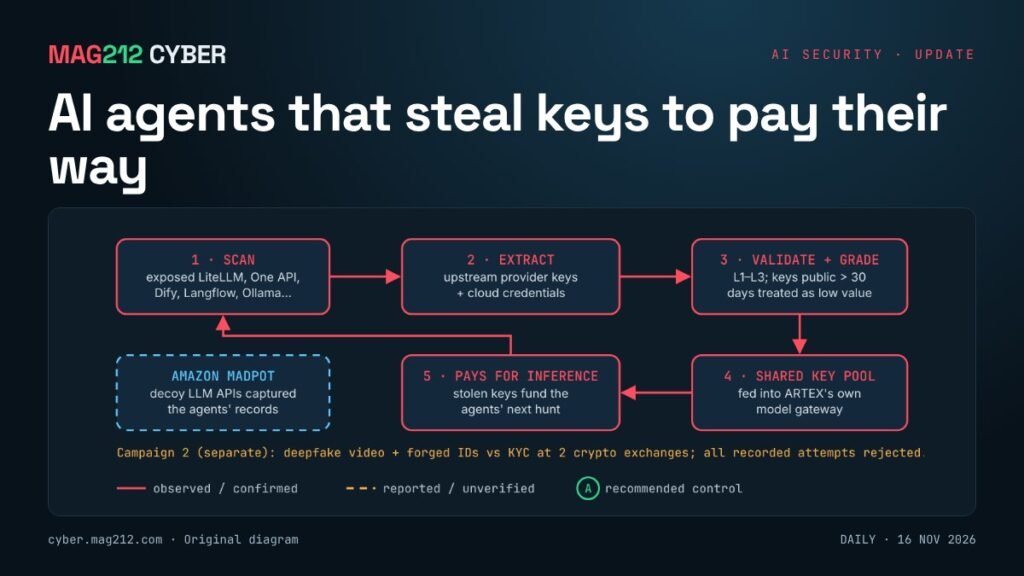
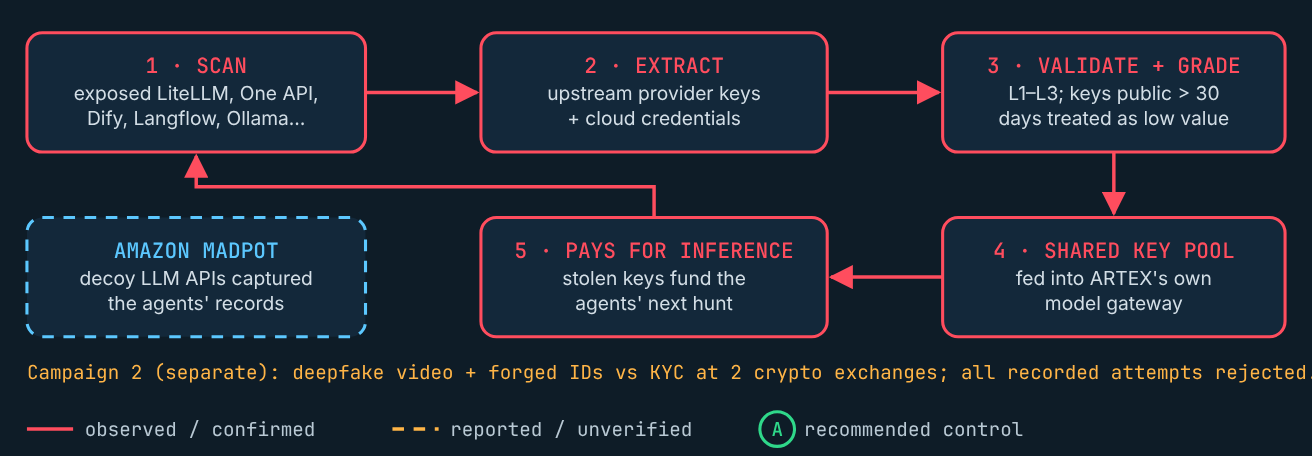
Campaign 1, AI credential theft. Agents searched for internet-exposed AI applications, extracted the upstream provider keys and cloud credentials they held, validated them and added them to a shared pool fed into ARTEX’s own model gateway. The stolen keys paid for the inference that drove further hunting. The records grade credentials L1 to L3 and treat keys that have been public for more than 30 days as low value. [1]
Campaign 2, identity-check bypass. Agents used real-time deepfake video and forged ID photos against know-your-customer checks at two cryptocurrency exchanges, and forged camera metadata to make edited ID images look unaltered. The liveness-check vendor’s server rejected every recorded deepfake attempt. [1]
Amazon stresses that none of the techniques was new. The agents succeeded where basic hygiene was missing: default or hardcoded credentials, exposed secrets, unauthenticated endpoints and unpatched software. [1]
Who is affected
- LLM gateways and proxies: One API, New API, Veloera, Sub2API and LiteLLM. [1][3]
- AI application builders: Dify, FastGPT, Langflow, RAGFlow, Open WebUI, LobeChat and Ollama. [3]
- Gateways are favoured because a single weak management console can expose many downstream provider accounts. [3]
- Known vulnerabilities named in reporting include Langflow CVE-2025-3248, fixed in 1.3.0. [3][6]
Why this matters
Yesterday's story was the FBI's warning that ARTEX speeds up intrusions. Amazon's data shows a simple business model behind some of it: steal AI keys, spend them on more AI-driven scanning, repeat. Every exposed AI gateway is both a target and, once breached, a source of funding for the attacker. (MAG212 analysis)
How the attack works
- Scan: agents look for the web interfaces and APIs of the products above.
- Access: default admin credentials, missing authentication or a known flaw give access to the configuration.
- Extract: stored upstream provider keys and cloud credentials are copied.
- Validate and grade: keys are tested against providers and graded L1–L3.
- Pool and spend: working keys go into a shared pool behind ARTEX’s model gateway and pay for the next round of scanning. [1]
Indicators of compromise
| IPv4 | Campaign | Seen |
|---|---|---|
| 104.28.225[.]223 | 1 | 17–19 Oct |
| 31.22.91[.]156 | 1 | 14–19 Oct |
| 150.136.38[.]110 | 1 | 31 Oct |
| 128.242.115[.]131 | 1 | 31 Oct |
| 216.176.239[.]231 | 1 | 2 Nov |
| 212.107.28[.]51 | 2 | 14 Oct |
| 103.142.140[.]158 | 2 | 17 Oct |
| 104.28.251[.]98 and .99 | 2 | 18 Oct |
| 104.28.219[.]97 | 2 | 18 Oct |
| 125.103.213[.]41 | 2 | 18–19 Oct |
Some addresses sit in shared hosting or proxy ranges; check context before blocking. [1]
What defenders should look for
- Unexpected spend or usage spikes on AI provider accounts, especially from new regions or at odd hours.
- New or unknown keys, users or models configured in an AI gateway.
- Requests to gateway admin endpoints from the IPs above or from unfamiliar networks.
- Provider keys found in code repositories, container images or public artifacts.
How to investigate
Check whether your AI services answer without authentication. Run these from outside your network against hosts you own (read-only; not tested by MAG212):
curl -s -m 5 http://<PUBLIC_IP>:11434/api/tags
curl -s -o /dev/null -w '%{http_code}\n' https://<LITELLM_HOST>/v1/models
Ollama has no built-in authentication, so a JSON model list from the first command means anyone can use it. A LiteLLM proxy configured with a master key should return 401 to the second command; 200 means no key is required. [5][7]
Then review the gateway’s admin and audit logs for logins and key exports, and each AI provider’s usage dashboard for the period from early October.
How to contain and remediate
- Put every AI gateway and builder behind authentication and off the public internet. [1]
- Change default admin credentials and master keys. Rotate every provider key the tool stored, not only the ones you suspect.
- Patch known flaws, for example Langflow 1.3.0 or later for CVE-2025-3248. [6]
- Set spend alerts and quotas with each AI provider. [1]
- Keep secrets out of code and public artifacts; scan repositories and images.
How to verify recovery
- The external checks above fail or return 401.
- Old provider keys are revoked and fail; new keys are in use only from known systems.
- Provider usage returns to expected levels.
Prevention and awareness
- Developers: treat a self-hosted AI gateway like a payment system; it holds credentials worth money.
- Security teams: add AI gateways and builders to external attack-surface scans.
- Decision-makers: assume exposed secrets will be found within days and fund the basics first, as Amazon advises. [1]
Related on MAG212 CYBER
- MAG212 CYBER Daily, 16 November 2026: The boxes nobody patches (full issue and PDF)
- MAG212 CYBER Daily, 15 November 2026: Machine speed, human gaps
- MAG212 CYBER Weekly, 14 November 2026
- Subscribe free to MAG212 CYBER
Sources
- [1] AWS Security Blog, “Amazon Threat Intelligence observes threat actors running cybercrime campaigns with ARTEX AI agents“, 13 Nov 2026.
- [3] Tbreak, “AI agents are hunting exposed LiteLLM and Dify tools for API keys“, 16 Nov 2026.
- [4] MAG212 CYBER, “FBI ARTEX FLASH: AI agents and autonomous intrusions, a defender's guide“, 15 Nov 2026.
- [5] Ollama, “API reference (GET /api/tags)“, docs 2026.
- [6] NVD, “CVE-2025-3248 (Langflow, fixed in 1.3.0)“, record 2026.
- [7] LiteLLM, “Proxy: virtual keys and master key“, docs 2026.
Written and edited by El Mostafa Ouchen for MAG212 CYBER. Facts checked against the sources above as of 16 November 2026, 6:00 AM PT.