
From Log4Shell in vCenter to a Code-Signing Server: Lessons From Kaspersky’s BO Team Investigation
From the MAG212 CYBER Daily, 16 November 2026. Every command is copied from official documentation or the cited analysis and was not tested by MAG212; run it only on systems you are authorised to administer.
Status: Investigation report. Kaspersky ICS CERT published its findings on 5 November 2026; The Hacker News reported them on 16 November. The intrusion was detected in June 2025. Kaspersky assesses BO Team (also tracked as Black Owl, Hoody Hyena and Lifting Zmiy) as Ukrainian in origin; that is its assessment, not independently confirmed. No malicious software release has been confirmed. [1][2]
What happened
An unnamed Russian software developer with customers in Russia contacted Kaspersky’s ICS CERT in June 2025 about suspicious activity. The investigation found a months-long compromise of its development infrastructure and of the server it used to sign commercial software builds. [1][2]
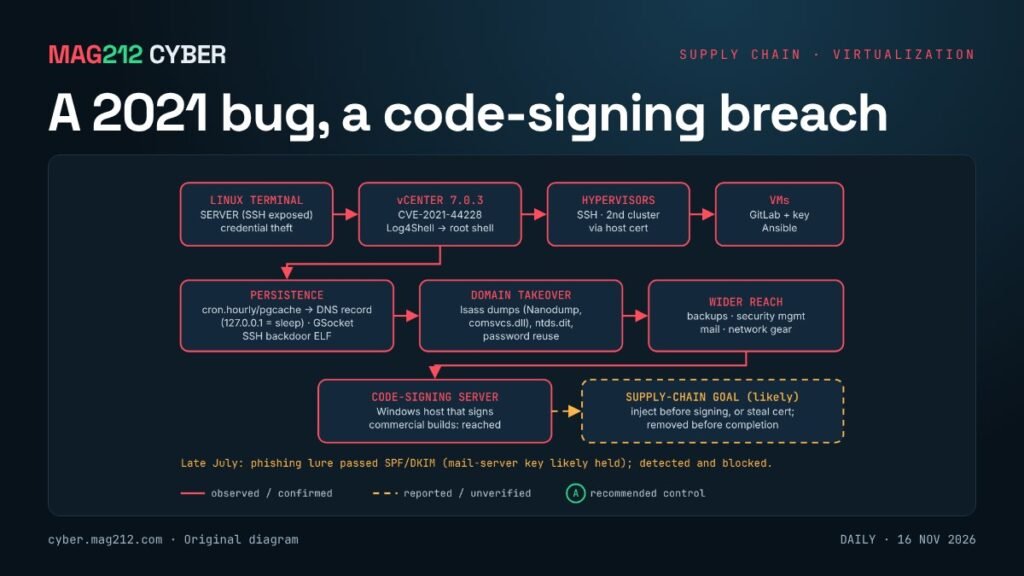
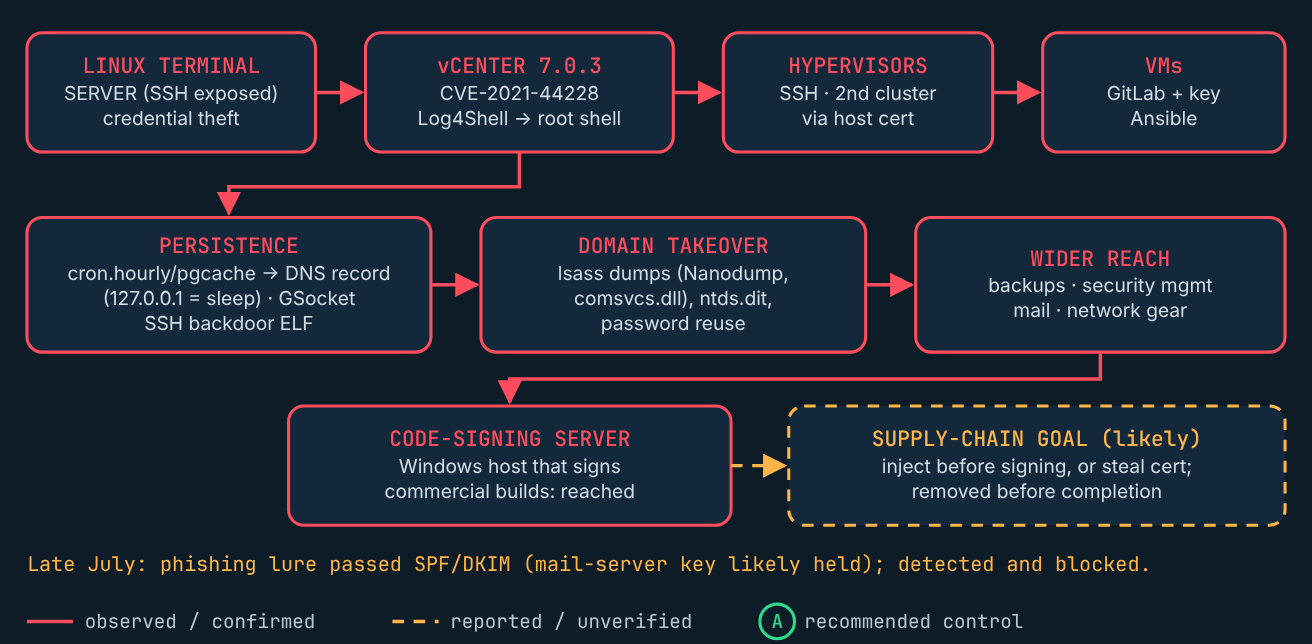
After failed attempts to log in to the vCenter web interface from a Linux terminal server whose SSH service was exposed, the intruders found a vCenter Server 7.0.3 still vulnerable to CVE-2021-44228 (Log4Shell) and obtained a root command line. From there they connected to the hypervisor over SSH, reached a second virtualization cluster using a hypervisor certificate, and accessed virtual machines including GitLab (with its source repositories and private key) and the Ansible orchestration system. Harvested administrator credentials, Kerberos tickets and password reuse across domains gave them the domain controller. [2]
Kaspersky says a Windows server used to sign the company’s commercial builds was of particular interest. The attackers could have tried to inject code into builds before signing, or steal the signing certificate to sign malware later. Kaspersky concluded the likely goal was a supply-chain attack, but the attackers were removed before completing it. [1][2]
After detection, in late July, the attackers sent phishing emails with a “disconnected mail server” lure that passed SPF and DKIM checks, suggesting they held a mail server’s private key. Kaspersky says the campaign was detected and prevented. [2]
Who is affected
- Any vCenter Server 7.0 below 7.0 Update 3c (build 19234570) that never received the Log4j fix or the VMware workaround. Fixes for 6.7 and 6.5 are 6.7 U3q and 6.5 U3s. [3]
- Software publishers whose signing hosts share a domain and trust zone with build and IT systems.
- The victim’s customers: Kaspersky reports no confirmed malicious signed release.
Why this matters
Log4Shell was patched in vCenter at the end of 2021, yet an unpatched management appliance still opened the door in 2025. Virtualization managers are often outside endpoint monitoring, and code-signing servers often sit in the same trust zone as ordinary IT. Together they turn one old bug into a potential supply-chain attack. (MAG212 analysis)
How the attack works
- Initial access: an exposed SSH service on a Linux terminal server.
- Exploitation: Log4Shell on vCenter 7.0.3, giving a root shell on the appliance.
- Lateral movement: SSH to hypervisors; a host certificate to a second cluster; access to VMs including GitLab and Ansible.
- Persistence: a shell script named
pgcachein/etc/cron.hourly/, disguised as a PostgreSQL component, fetches a second stage from a free nofrillsdns[.]com subdomain. While the command server is offline the DNS record points to 127.0.0.1; changing the record activates the payload, which downloads the GSocket remote-access utility. An SSH backdoor ELF was also deployed, and/usr/bin/nxnode-loginwas modified to write captured credentials to/dev/shm/pulse-shm-3088612174. - Credential theft: lsass memory dumps via
comsvcs.dlland Nanodump, a registry dump to decryptntds.dit, and brute force of a terminal-server administrator password after about 2,500 failed attempts. - Objective: the code-signing server, plus backup and security-management servers, mail infrastructure and network equipment. Event logs were deleted after a security product blocked activity. [2]
Indicators of compromise
| Type | Indicator |
|---|---|
| IPs | 193.3.23[.]236, 80.76.42[.]139 |
| Domains | nofrillsdns[.]com subdomains lo1yaizaeghaevarooD1ahtaichootae and lo1yaizaeghaevarood1ahtaichootaz; proxy-sale[.]com |
| Files | /etc/cron.hourly/pgcache; /usr/bin/nxnode-login (modified); /dev/shm/pulse-shm-3088612174 |
| Tools | GSocket, Nanodump, comsvcs.dll, Cobalt Strike, Mythic |
These relate to 2025 activity; infrastructure may have changed. [1][2]
How to investigate
On the vCenter Server Appliance, in the bash shell as root (read-only; not tested by MAG212):
vpxd -v
ls -la /etc/cron.hourly/
ls -la /dev/shm/ | grep -i pulse-shm
grep -rIl 'nofrillsdns' /etc /var/spool/cron 2>/dev/null
vpxd -v prints the vCenter build; 7.0 U3c is build 19234570. Because pgcache imitates a PostgreSQL component, compare any finding with a known-good appliance before drawing conclusions. Run the same file checks on other Linux hosts, including terminal servers where nxnode-login might have been altered. [2][3]
Search DNS, proxy and firewall logs for the published indicators, replacing the placeholders with your log paths (read-only):
zgrep -iE 'nofrillsdns|proxy-sale' <DNS_OR_PROXY_LOG>*
zgrep -E '193\.3\.23\.236|80\.76\.42\.139' <FIREWALL_LOG>*
Retention limits how far back this can see. Also look for unexpected hourly cron jobs or systemd timers on appliances, outbound DNS to free dynamic-DNS services from servers, GSocket relay traffic, lsass access via comsvcs.dll, and event-log clearing.
How to contain and remediate
- Upgrade vCenter to a supported release; for the 7.0 line that means at least 7.0 U3c, which ships Log4j 2.17. VMware’s KB workaround is a temporary measure only. [3]
- Remove vCenter, ESXi SSH and terminal servers from internet reach; require MFA through a jump host.
- If artefacts are found, preserve disk and memory images, then rebuild affected hosts rather than cleaning them.
- Reset domain, hypervisor, GitLab and service credentials, and stop password reuse across domains.
- If the mail server was in scope, rotate its DKIM keys.
Protecting code signing (MAG212 analysis)
- Keep signing keys in a hardware security module or a managed signing service, not on a domain-joined server.
- Sign only from the CI pipeline, with approvals and a log of every signature.
- Compare released binaries against reproducible builds or a second independent build before shipping.
- If a key may have been exposed: revoke it, re-issue, re-sign releases and tell customers.
How to verify recovery
vpxd -vshows a fixed build; no unknown cron jobs or/dev/shmartefacts.- No DNS or network traffic to the indicators.
- Every signature in the last year maps to a CI job and an approved release.
Prevention and awareness
- Administrators: scan management appliances (vCenter, backup consoles, hypervisors) for known vulnerabilities as often as servers.
- Engineering leaders: treat the signing key as the crown jewel of the software supply chain.
- Decision-makers: ask your software vendors how they protect their signing keys and build pipelines.
Related on MAG212 CYBER
- MAG212 CYBER Daily, 16 November 2026: The boxes nobody patches (full issue and PDF)
- MAG212 CYBER Daily, 15 November 2026: Machine speed, human gaps
- MAG212 CYBER Weekly, 14 November 2026
- Subscribe free to MAG212 CYBER
Sources
- [1] Kaspersky ICS CERT, “Supply chain attack: BO Team in a software developer's infrastructure“, 5 Nov 2026.
- [2] The Hacker News, “BO Team exploits Log4Shell in VMware vCenter, compromises Russian firm's code-signing server“, 16 Nov 2026.
- [3] Broadcom (VMware) KB 318925, “Workaround instructions to address CVE-2021-44228 and CVE-2021-45046 in vCenter Server“, KB 2026.
Written and edited by El Mostafa Ouchen for MAG212 CYBER. Facts checked against the sources above as of 16 November 2026, 6:00 AM PT.