
Copeland XWEB EVO Refrigeration Controllers: 14 Root Flaws, Two Exploited Within Hours, Five Never to Be Fixed
From the MAG212 CYBER Daily, 17 November 2026. Every command is copied from official documentation or the cited analysis and was not tested by MAG212; run it only on systems you are authorised to administer.
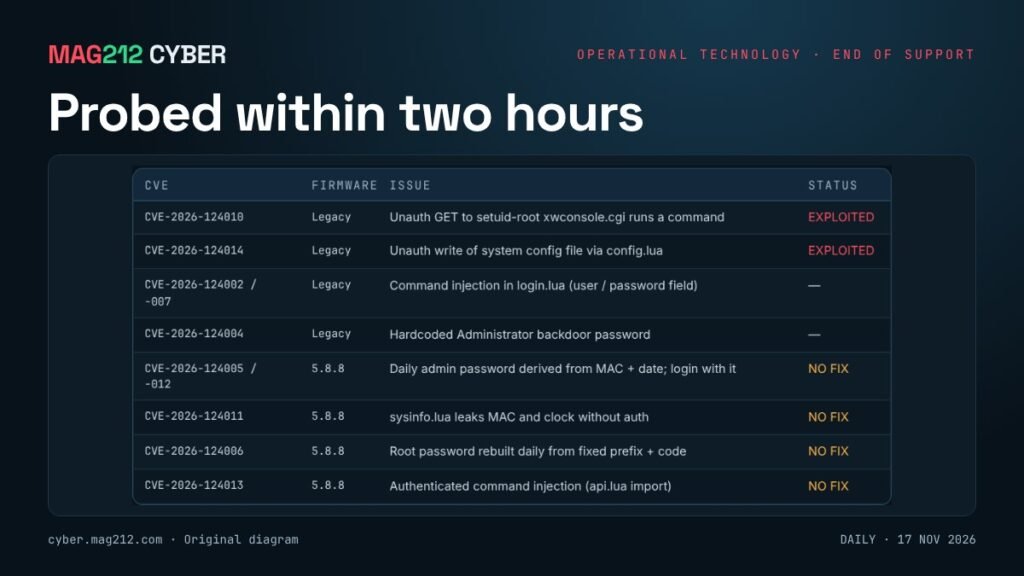
Status: Researcher disclosure with observed exploitation attempts. VulnCheck published on 13 November 2026 after CVE records went live on 12 November; it added two CVEs to its own KEV list after seeing attempts on its canaries. Copeland ended software support for XWEB EVO on 16 March 2026. [1][2][3]
What happened
VulnCheck researcher Valentin Lobstein disclosed 14 vulnerabilities in XWEB EVO, a Dixell supervisory system now sold under the Copeland name and used to manage refrigeration in supermarkets and cold stores. Each flaw yielded root on test systems. [1][2]
The CVE records went live on 12 November at 20:18 UTC. VulnCheck’s canaries recorded the first attempt to exploit CVE-2026-124014 at 22:00 UTC, about an hour and 40 minutes later, with no public proof of concept. A second CVE was probed from early on 13 November. [1]
Why this matters
This follows the Danfoss disclosure we covered on 16 November and the October attacks on French supermarkets. Refrigeration controllers are now an active target, and XWEB EVO adds a hard problem: the vendor has ended support, so isolation and replacement are the only fixes. (MAG212 analysis)
The vulnerabilities
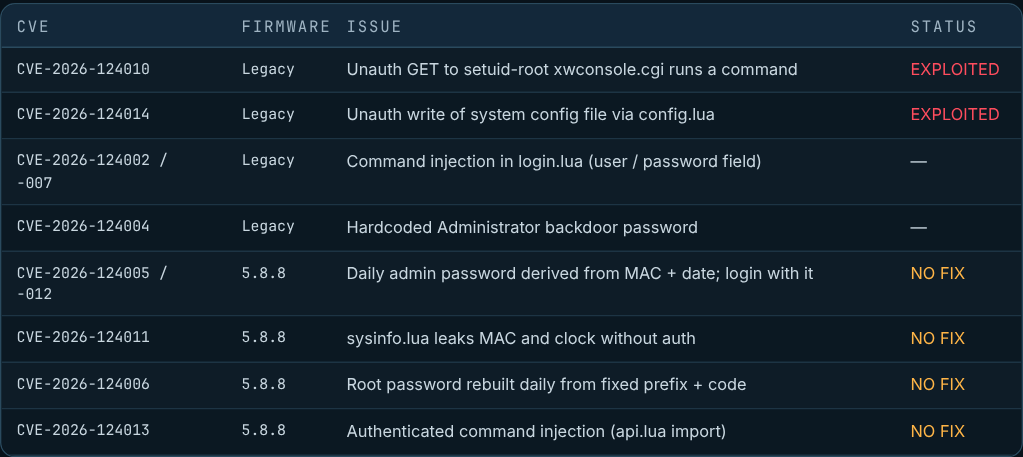
| CVE | Firmware | Issue | Status |
|---|---|---|---|
| CVE-2026-124010 | Legacy | Unauthenticated GET to setuid-root xwconsole.cgi runs a command as root | Exploited |
| CVE-2026-124014 | Legacy | Unauthenticated write of the system configuration file via config.lua | Exploited |
| CVE-2026-124002, -124007 | Legacy | Command injection in login.lua via the username or password field | Not observed |
| CVE-2026-124004 | Legacy | Hardcoded Administrator backdoor password | Not observed |
| CVE-2026-124003 | Legacy | Setuid-root Lua interpreter turns injections into root | Not observed |
| CVE-2026-124008, -124009, -124015 | Legacy | Authenticated injection in devices.lua and backup.lua; session-bypass password reset | Not observed |
| CVE-2026-124005, -124012 | 5.8.8 | Daily admin password derived from MAC and date; login with it alone | No fix |
| CVE-2026-124011 | 5.8.8 | sysinfo.lua discloses MAC and clock without authentication | No fix |
| CVE-2026-124006 | 5.8.8 | Root password rebuilt daily from a fixed prefix plus the daily code | No fix |
| CVE-2026-124013 | 5.8.8 | Authenticated command injection in api.lua import | No fix |
Legacy means pre-2021 Lua-era builds (VulnCheck tested 5.2.3); 5.8.8 is the current firmware. Source: VulnCheck. [1]
Who is affected
- Owners of Dixell/Copeland XWEB EVO controllers, especially those reachable from the internet. Onyphe data cited by VulnCheck shows about 1,960 public XWEB EVO hosts, against 108 for XWEB Pro; Shodan shows about 1,663. [1][2]
- CERT-FR named Copeland and Dixell XWEB controllers among the products affected in October’s attacks on about 700 French supermarkets, though VulnCheck does not link the new scanning to that campaign. [2]
How the attack works
- Older firmware: an unauthenticated request to
xwconsole.cgiruns a command as root, or a request toconfig.luaoverwrites the system configuration. [1] - Current firmware: an unauthenticated page reveals the device’s MAC address and clock. The daily administrator password is computed from those two values, so an attacker can derive it offline, log in, enable SSH and log in as root, because the root password uses the same daily code. [1][2]
Exploitation observed
- CVE-2026-124014: 125 hits between 22:00 UTC on 12 November and 06:16 UTC on 13 November, 87 in the first hour, all from 202.61.138.117 (a Tokyo-geolocated VPS). [1]
- CVE-2026-124010: four probes from 177.4.12.11 (Hong Kong) between 03:41 and 04:09 UTC on 13 November, each running only
id. [1]
VulnCheck describes both sources as opportunistic scanners, not the October campaign. A probe is an attempt, not proof of compromise. [1]
How to investigate
If your proxy, firewall or web logs capture HTTP paths to the controllers (read-only; not tested by MAG212):
zgrep -E 'POST [^ ]*config\.lua|GET [^ ]*xwconsole\.cgi' <PROXY_OR_FW_LOG>*
zgrep -E '202\.61\.138\.117|177\.4\.12\.11' <FIREWALL_LOG>*
Also check whether SSH is enabled on any XWEB EVO device and review user accounts, setpoints and defrost schedules.
How to contain and remediate
- Block all internet access to XWEB EVO devices; allow remote access only over a VPN. [1]
- If you find matching requests, treat the controller as compromised: change credentials, disable SSH and restore a known-good configuration.
- Check setpoints, defrost schedules, users and alarm routing with your refrigeration engineer, as for the Danfoss controllers we covered on 16 November. [4]
- Plan replacement. Copeland’s end-of-support bulletin recommends moving to XWEB Pro; there will be no fixes for EVO. [3]
How to verify recovery
- The device does not answer from the internet when tested from outside.
- SSH is disabled; no unknown users; settings match design values.
Prevention and awareness
- Facilities managers: maintain a list of refrigeration and building controllers and their support status.
- Decision-makers: budget for replacing end-of-support controllers; network isolation buys time, not safety.
- Store staff: report unusual defrosts and temperature alarms quickly.
Related on MAG212 CYBER
- MAG212 CYBER Daily, 17 November 2026: Keys that outlived the job (full issue and PDF)
- MAG212 CYBER Daily, 16 November 2026: The boxes nobody patches
- MAG212 CYBER Weekly, 14 November 2026
- Subscribe free to MAG212 CYBER
Sources
- [1] VulnCheck, “Copeland XWEB EVO: unauthenticated root (14 CVEs)“, 13 Nov 2026.
- [2] SecurityWeek, “Hackers probe newly disclosed flaws in Copeland refrigeration controllers“, 16 Nov 2026.
- [3] Copeland, “XWEB EVO end-of-software-support product bulletin (PDF)“, Mar 2026.
- [4] MAG212 CYBER, “Danfoss AK-SM800A: six unpatched pre-login flaws“, 16 Nov 2026.
Written and edited by El Mostafa Ouchen for MAG212 CYBER. Facts checked against the sources above as of 17 November 2026, 6:00 AM PT.