
Opinion: Is AI Making Us Worse at Cybersecurity?
From the MAG212 CYBER Daily, 15 November 2026. This is MAG212 analysis; facts are sourced below.
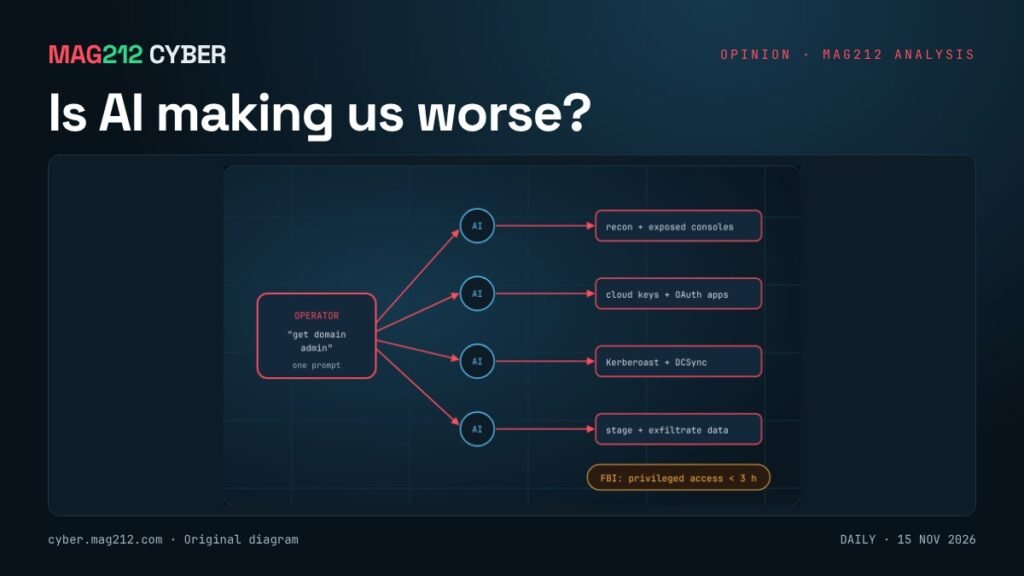
SecurityWeek asked the question in a 14 November headline. The FBI’s alert on ARTEX, published the day before, answers half of it: attackers are clearly getting faster. The other half is about defenders.
The attacker half
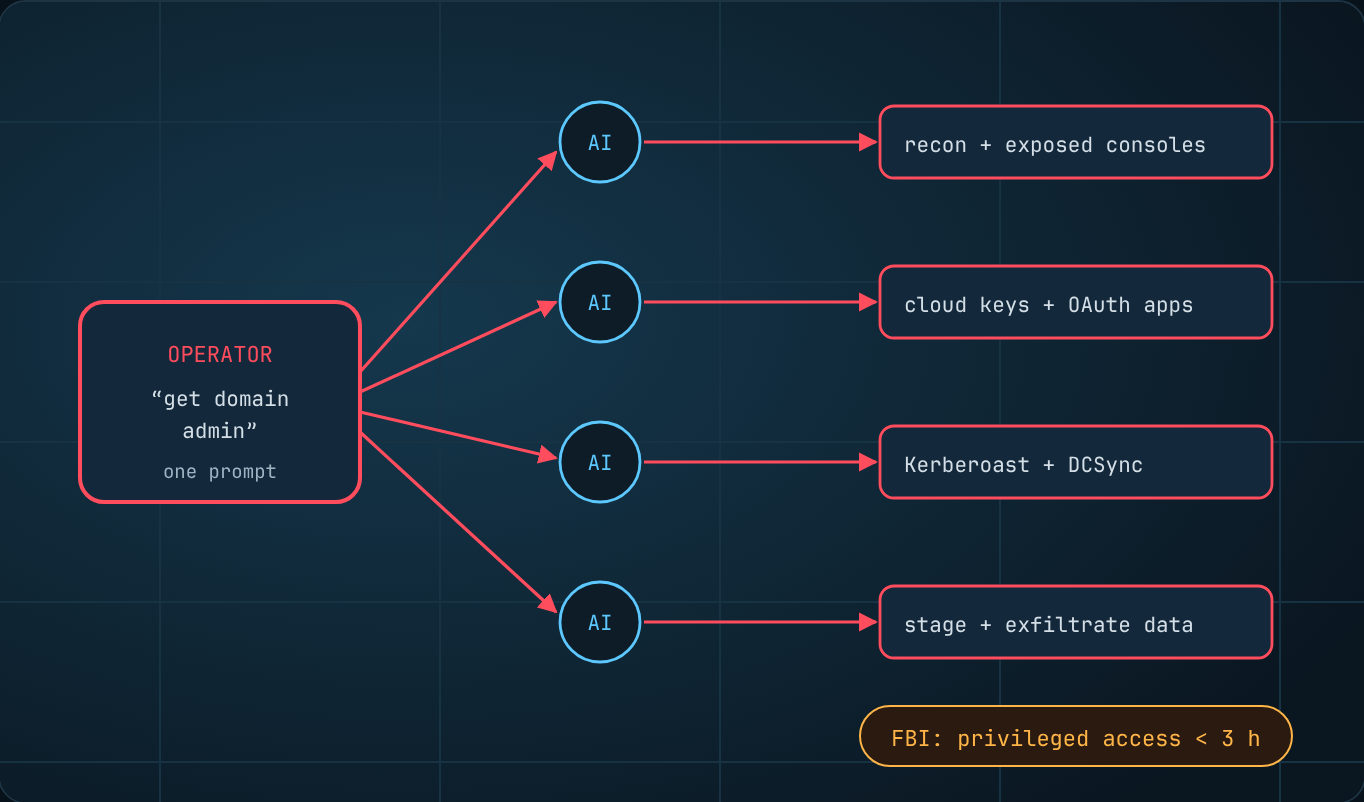
ARTEX is an open-source framework that turns a plain-language goal into commands run by AI agents. The FBI says threat actors have used it since at least August 2026 against ten sectors, and that some intrusions went from initial targeting to privileged access in under three hours. Crucially, ARTEX brings no new exploits. Its agents chain ordinary techniques such as Kerberoasting, OAuth credential additions, web shells and cloud metadata queries, in parallel and at machine speed. [1]
The defender half
ISC2’s research into AI and security roles suggests the risk is not that AI replaces analysts, but that it changes the job. As reported by ITPro and SecureWorld: [2][3]
- 65% of professionals who use AI say they spend time deciding when to trust or act on its recommendations.
- 62% say AI has not reduced the need for foundational cybersecurity skills; 26% say it has.
- Nearly half report lower stress, but 32% say AI has made stress worse, often because of reviewing and correcting output.
Our view
AI makes teams worse when it replaces understanding, and better when it removes toil. The ARTEX campaigns are a good test. The signal that catches an AI-driven intruder is often mundane: a new secret on a service principal, an unexpected Kudu API call, a web shell in a forgotten portal. An analyst who can read an Entra audit log will spot those faster than a tool they cannot explain.
That does not argue against AI in the SOC. Triage, summarisation, enrichment and drafting are exactly the repetitive work that burns analysts out, and attackers are already automating their side. It argues for keeping humans in the loop where judgement matters, and for keeping people skilled enough to judge.
What we would do on Monday
- Use AI to triage and summarise, but keep a human sign-off on containment actions such as disabling accounts or isolating servers.
- Train junior analysts on raw logs and raw packets, not only on AI summaries.
- Measure how often AI output is wrong in your own environment, and share the numbers internally.
- Hunt the basics that ARTEX relies on: credential additions to apps, exposed admin endpoints and server egress to LLM APIs.
A note on sources
We could not retrieve the text of SecurityWeek’s column for this piece, so we cite only its headline. The survey figures come from ISC2 research as reported by ITPro and SecureWorld.
Related on MAG212 CYBER
- MAG212 CYBER Daily, 15 November 2026: Machine speed, human gaps (full issue and PDF)
- MAG212 CYBER Weekly, 14 November 2026
- Subscribe free to MAG212 CYBER
Sources
- [1] FBI / IC3, “FLASH-20261113-001: Threat Overview of ARTEX Autonomous Penetration Testing Framework“, 13 Nov 2026.
- [2] ITPro, “Cyber professionals are flocking to AI tools, but they're getting tired of fixing mistakes (ISC2)“, 2026 2026.
- [3] SecureWorld, “Why AI is actually increasing the cognitive load on cyber teams (ISC2)“, 2026 2026.
Written and edited by El Mostafa Ouchen for MAG212 CYBER. Facts checked against the sources above as of 15 November 2026, 7:45 AM PST.