
MAG212 CYBER Daily, 11 November 2026: Barracuda exploited, Outlook zero-day, Xen Orchestra takeover, Fortinet criticals
Happy Veterans Day, and thank you to everyone who has served.
MAG212 CYBER · Daily Cyber Intelligence · Wednesday, November 11, 2026 · Research cutoff 06:00 PT. Today the way in is the admin console. An exploited Barracuda flaw chain gives root on six appliance lines, and CISA gave agencies until November 13 to fix it and look for compromise. Microsoft’s only exploited bug among about 1,094 CVEs this month is an Outlook hash leak. A Xen Orchestra authentication bypass hands over whole XCP-ng pools. Management planes that answer from the internet are being found and used.
What needs attention today
| # | Action | How |
|---|---|---|
| 1 | Barracuda: lock down admin UIs, patch, and triage before 13 Nov | Restrict admin interfaces to trusted networks, confirm each product’s patch ID (ESG BNSF-40425/-40430, ADC/WAF BNADC-16586, BMA BNMA-32468, WCC BNWF-60060, WSG BNYF-24789) and review config-import/restore history on exposed devices. |
| 2 | Xen Orchestra: isolate, upgrade to 6.9.2 / 6.10.1, run Vates’ host checks | Block the eight published IPs and the onion C2. Any IOC hit means rotating every secret and reinstalling. |
| 3 | Microsoft and Chrome: Office fix, Exchange and DCs first, Chrome 157 | Ship the November Office update (CVE-2026-124194); put Exchange servers and DCs in the first ring (CVE-2026-116928, -119958); force Chrome 157.0.8103.50/.51. |
What’s inside
- Barracuda ESG and five more appliance lines: exploited chain to root. KEV due Nov 13; forensic triage, not just patching.
- Patch Tuesday: an exploited Outlook NTLMv2 hash leak (CVE-2026-124194) among about 1,094 CVEs, plus two zero-click 9.8s.
- Xen Orchestra (VSA-2026-062): an empty-object cookie bypass leads to root on XCP-ng hosts. Vendor IOCs and host checks are included.
- Chrome zero-day, BroadWorks and Openwave complete the KEV batch, all due Nov 24.
- Fortinet’s ten criticals: FortiMail, FGFM, OSPF and FortiAuthenticator. Some branches must migrate.
- CopperDragon’s Sparrow toolkit links three espionage campaigns, including a fake “certificate fix” lure.
- NEAR AI and Fireworks AI breached: SGLang RCE and LLMjacking.
- Vanderbilt tells its campus to shut down devices as the BYOD gang claims the attack.
- Defender’s Action Desk, awareness lesson and source register (78 sources).
Read the full stories
- Barracuda’s Exploited Flaw Chain Gives Attackers Root on Six Appliance Lines; CISA Sets a 13 November Deadline
- November 2026 Patch Tuesday: An Exploited Outlook Hash Leak Leads About 1,094 Microsoft Fixes
- Xen Orchestra Auth Bypass (VSA-2026-062) Is Exploited: An Empty-Object Cookie Hands Over XCP-ng Hosts
- Chrome Zero-Day, Cisco BroadWorks and Openwave Join CISA KEV With a 24 November Deadline
- Fortinet’s Ten Critical Advisories: Upgrade FortiMail, FortiManager and FortiOS, or Migrate Where No Fix Exists
- CopperDragon’s “Sparrow” Toolkit Ties Three China-Nexus Espionage Campaigns Together
- AI Inference Platforms Breached: NEAR AI Hit Through an SGLang RCE, Fireworks AI by an LLMjacking Crew
- Vanderbilt Tells Its Campus to Shut Down Devices as the BYOD Gang Claims the Attack
Updates on earlier coverage
- Qubole (covered November 10): more than a dozen organisations were hit between October 14 and 26, and S3 data was taken. Yesterday’s actions stand.
- France / IRGC fridge sabotage: the EU sanctions push is still only a pledge.
Read the full edition
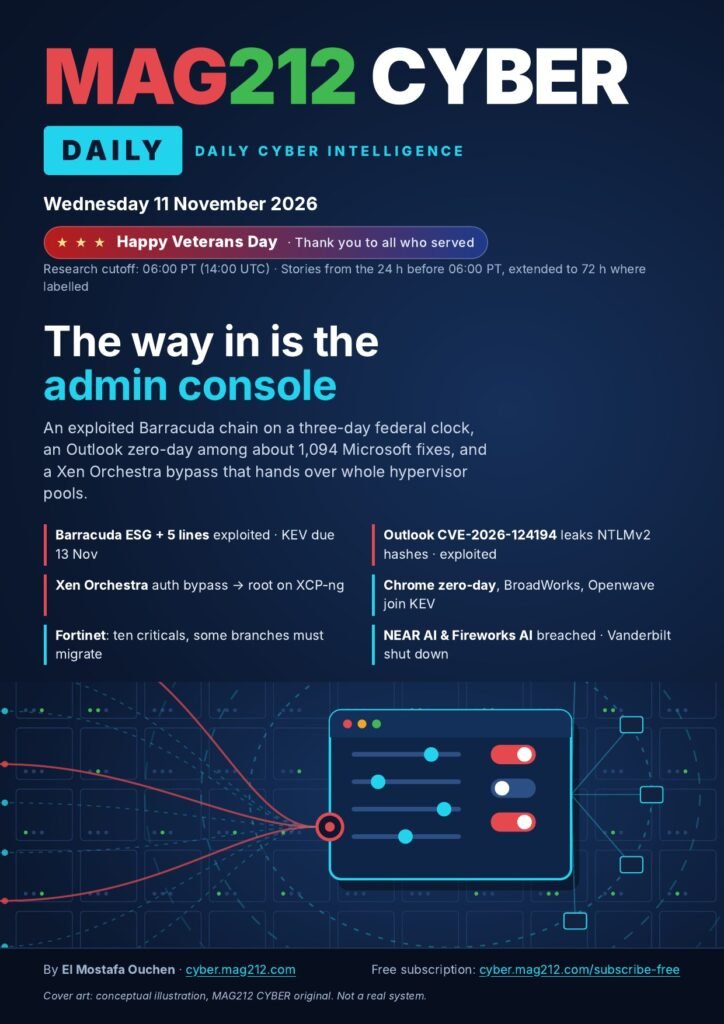
The way in is the admin console
An exploited Barracuda chain on a three-day federal clock, an Outlook zero-day among about 1,094 Microsoft fixes, and a Xen Orchestra bypass that hands over whole hypervisor pools.
- Barracuda ESG + 5 lines exploited · KEV due 13 Nov
- Outlook CVE-2026-124194 leaks NTLMv2 hashes · exploited
- Xen Orchestra auth bypass → root on XCP-ng
- Chrome zero-day, BroadWorks, Openwave join KEV
- Fortinet: ten criticals, some branches must migrate
- NEAR AI & Fireworks AI breached · Vanderbilt shut down
Executive briefing
MAG212 analysis In the past 24 hours the confirmed or credible ways in were a Barracuda admin UI, a Xen Orchestra console, FortiManager’s FGFM port and an exposed AI inference server. CISA gave agencies until 13 November to fix the Barracuda pair and told them to look for compromise, not just patch. Microsoft’s only exploited bug this month is a “Moderate” Outlook flaw. The common lesson: management planes that answer from the internet are being found and used.
The three actions that matter most today
Barracuda: lock down admin UIs, patch, triage before 13 Nov
Restrict admin interfaces to trusted networks, confirm each product’s patch ID (ESG BNSF-40425/-40430, ADC/WAF BNADC-16586, BMA BNMA-32468, WCC BNWF-60060, WSG BNYF-24789) and review config-import/restore history on exposed devices. Barracuda CISA KEV
Xen Orchestra: isolate, upgrade to 6.9.2 / 6.10.1, run Vates’ host checks
Block the eight published IPs and the onion C2. Any IOC hit means rotating every secret and reinstalling. Vates
Microsoft and Chrome: Office fix, Exchange and DCs first, Chrome 157
Ship the November Office update (CVE-2026-124194); Exchange servers and DCs in the first ring (CVE-2026-116928, -119958); force Chrome 157.0.8103.50/.51. MSRC ZDI The Hacker News
Story board
| # | Story | Date label | Exploited? | Who should care |
|---|---|---|---|---|
| 1 | Barracuda ESG and appliance chain | KEV 10 Nov, due 13 Nov | Yes | MSPs, SMB and school IT |
| 2 | Patch Tuesday: Outlook zero-day | 10 Nov · KEV due 24 Nov | Yes | Everyone; Exchange and AD first |
| 3 | Xen Orchestra VSA-2026-062 | 10 Nov | Yes | MSPs, hosting, schools on XCP-ng |
| 4 | KEV: Chrome, BroadWorks, Openwave | KEV 10 Nov, due 24 Nov | Yes | Endpoint fleets, telecom/UC |
| 5 | Fortinet’s ten critical advisories | 10 Nov (patched 21–22 Oct) | No | Network engineers, MSPs |
| 6 | CopperDragon / Sparrow toolkit | 10 Nov | Yes | Telecom, government, MSPs |
| 7 | NEAR AI and Fireworks AI | 9 Nov [72h] | Yes | AI/ML teams, AI buyers |
| 8 | Vanderbilt shutdown, BYOD claim | 9 Nov [72h] | Incident | School, university, healthcare IT |
Labels: Confirmed primary source · Reported secondary outlet · Claimed attacker or unverified · MAG212 analysis our judgement · Unknown not established.
Small links like this cite sources. Diagrams are MAG212 originals; commands were not tested by us. KEV data: CISA GitHub mirror, catalog 2026.11.10 (cisa.gov and NVD CVSS not checked). Not opened: Mandiant MNDT pages, Cisco’s BroadWorks advisory, Google’s Chrome note, Notion’s advisory, Vanderbilt’s status page.
In this issue
- 01Barracuda’s exploited chain gives root on six appliance linesKEV due 13 Nov · forensic triage4
- 02Microsoft fixes an exploited Outlook hash leakAbout 1,094 CVEs · two zero-click 9.8s5
- 03Xen Orchestra’s empty-object cookie hands over XCP-ng hostsVendor IOCs and host checks7
- 04Chrome, BroadWorks and Openwave complete the KEV batchAll due 24 Nov8
- 05Fortinet’s ten criticals: upgrade, or migrateFortiMail · FGFM · OSPF · FortiAuthenticator9
- 06CopperDragon’s Sparrow toolkit links three espionage campaignsFake “certificate fix” lure11
- 07AI inference platforms breached: NEAR AI and Fireworks AISGLang RCE · LLMjacking12
- 08Vanderbilt tells its campus to shut down devicesBYOD gang claims the attack13
- ◆Defender’s Action DeskChecklist · KEV deadlines · pending items13
- ◆Awareness lesson and briefly noted“A real certificate error never asks you to install a fix”15
- ◆Source register78 sources, with whether we opened them16
↻ Updates to yesterday’s stories
- Qubole: new detail. Reported More than a dozen organisations were hit (yesterday: “multiple”). The campaign ran 14–26 October from a rented OVH server and Mullvad VPN, used TruffleHog to validate credentials and took S3 data, sometimes whole buckets. Wiz found a remotely bootable data-harvesting ISO but no evidence it was deployed; a separate 8–11 October wave tested customer-owned AWS keys. No actor named. Sentra’s write-up is now out beside Wiz’s; both carry IOCs. Yesterday’s actions stand: audit vendor-trusting IAM roles, review CloudTrail from 1 October. [72h] SecurityWeek Sentra Wiz
- France / IRGC fridge sabotage: still a pledge. AP repeats Barrot’s 9 November promise to seek sanctions “at the European level” and the Paris prosecutor’s pursuit of arrest warrants. Unknown No EU sanctions decision or G7 cyber statement found. Siasat/AP
- Outlook zero-day, 10 Nov KEV additions and Fortinet were only noted in yesterday’s afternoon update; they now get full treatment in stories 2, 4 and 5. No new material found for sshole, SonicWall, Plex2Shell, Frontline or bee-js.
Barracuda’s exploited flaw chain gives attackers root on six appliance lines
What happened
Confirmed Barracuda’s advisory covers an authorization bypass in Email Security Gateway only (CVE-2026-116606, CVSS 9.3) and a command injection in ESG, Load Balancer ADC, Message Archiver, WAF Control Center, WAF and Web Security Gateway (CVE-2026-111560, CVSS 8.6). Chained, they give root. On 9 November at 21:00 EST Barracuda added that it had seen exploitation “affecting a small number of organizations”. Barracuda CISA added both to KEV on 10 November, due 13 November, with forensic triage “Yes”, ransomware use “Unknown” and references to Mandiant disclosures MNDT-2026-0041/-0042. CISA KEV
Reported Previdian saw 17 attempts against CVE-2026-116606 from 15 IP addresses in three countries between 9 and 11 November; the IPs weren’t published and the actors are unidentified. No ransomware link has been reported. SecurityWeek Previdian
Who is affected and how it works
| Product | CVE(s) | Patch ID | Product | CVE(s) | Patch ID |
|---|---|---|---|---|---|
| ESG 9.4.017 and later | both | BNSF-40425 | WAF Control Center | 111560 | BNWF-60060 |
| ESG below 9.4.017 | both | BNSF-40430 | Web Application Firewall | 111560 | BNADC-16586 |
| Load Balancer ADC | 111560 | BNADC-16586 | Web Security Gateway | 111560 | BNYF-24789 |
| Message Archiver | 111560 | BNMA-32468 | Version thresholds given for ESG only Unknown fixed firmware for the others | ||
Source: Barracuda advisory.
Confirmed On 5 November Barracuda changed CVE-2026-116606’s “Authentication Required” field to “No (Administrative UI Access Required)”: no credentials, but the admin UI must be reachable. Barracuda KEV says the bypass lets an attacker invoke config-import and restore a crafted backup, and the injection runs root commands “when the crafted timezone value is subsequently processed”. CISA KEV MAG212 analysis That points to a crafted backup that sets a malicious timezone value. Unknown Tooling, actors, start date and the Mandiant pages’ contents.
What to look for
MAG212 analysis With no published IOCs: config-import or backup-restore events you didn’t start, unexpected timezone changes, and admin-UI connections from outside your management networks.
Investigate, contain and remediate (in order)
- Restrict the admin UI now to trusted networks; this is Barracuda’s workaround. Barracuda
- Confirm the latest firmware and the patch ID on every device. Devices several versions behind may need more than one update; apply manually if auto-patching didn’t run. Barracuda Campus
- Triage before you trust a patched box. MAG212 analysis Treat any appliance with an internet-reachable admin UI since 2 November as possibly compromised: preserve logs, review config history, involve Barracuda support or your IR provider.
- MAG212 analysis If compromise is suspected, rotate LDAP bind, SMTP relay and admin credentials, and consider rebuilding rather than cleaning.
Verify recovery: the patch ID shows as applied on every device; the admin UI doesn’t answer from an external vantage point; config history re-reviewed after patching. Lesson MAG212 analysis: MSPs should inventory admin-UI exposure across every client appliance this week.
Microsoft fixes an exploited Outlook hash leak among about 1,094 CVEs
What happened
Confirmed Of 1,342 entries in Microsoft’s November data, 1,094 were first published on 10 November: 1,093 assigned by Microsoft and one by VulDB. By MAG212’s count of that data, 63 Microsoft-assigned CVEs are Critical. Exactly one is marked exploited and none publicly disclosed. MSRC Reported SecurityWeek also counts 1,094; ZDI says “about 1,090” and calls the count “a bit confusing”. SecurityWeek notes 165 republished third-party CVEs (none from Chrome) and that this is the last month of updates for Windows 11 23H2 Enterprise and Education. ZDI counts 30 wormable CVEs by its own definition. SecurityWeek ZDI
The Outlook zero-day: who is affected and how it works
Confirmed CVE-2026-124194 is a spoofing flaw (missing warning before an unsafe action) in Microsoft 365 Apps for Enterprise and Office LTSC 2021/2024, rated “Exploitation Detected”, customer action required. A user must open a crafted message file; Outlook then connects to an attacker-controlled location without the usual warning and discloses the user’s NTLMv2 hash. The Preview Pane is not an attack vector. Credited to “nono” and Benoît Sevens. MSRC KEV: due 24 November, forensic triage “No”. CISA KEV Reported ZDI says the hash could be used “to authenticate as the user”. ZDI Unknown Who exploited it, against whom, the delivery method and IOCs.
The criticals to patch next (per ZDI; none reported exploited)
| CVE | Component | CVSS | Why it matters |
|---|---|---|---|
| CVE-2026-116928 | Windows Search RCE, reached through Exchange | 9.8 | Crafted attachment triggers when the server indexes it; no user action |
| CVE-2026-119958 | Windows LDAP RCE | 9.8 | No interaction; especially damaging on domain controllers |
| CVE-2026-119952 | Windows Schannel RCE | 8.1 | “Exploitation More Likely” despite high complexity |
| CVE-2026-112967 | Xbox Live Networking Service RCE | 9.8 | Unauthenticated heap overflow; ZDI sees real-world use as unlikely |
| CVE-2026-95962 | Windows Virtual Filtering Platform RCE | n/a | Use-after-free from a crafted packet, no auth, race condition |
| CVE-2026-119990 | Azure OpenAI elevation of privilege | 9.8 | Revised to no customer action needed |
Source: ZDI. CVSS for CVE-2026-95962 was not captured.
Look for, contain and remediate (in order)
- Deploy the November Office updates to Microsoft 365 Apps and Office LTSC 2021/2024. MSRC
- Patch Exchange servers and domain controllers first for CVE-2026-116928 and CVE-2026-119958. ZDI MAG212 analysis Zero-click and unauthenticated, so expect exploit development.
- MAG212 analysis Block outbound SMB/NTLM (TCP 445) to the internet and consider NTLM restrictions; review firewall logs for workstations, particularly Outlook, reaching internet hosts on 445.
- MAG212 analysis Reset passwords for anyone who reports opening an odd message file and review their sign-ins.
- Plan Windows 11 23H2 Enterprise/Education migrations. SecurityWeek
Verify recovery: patch reporting shows the November Office build on all Outlook clients and the November update on Exchange and DCs; outbound TCP 445 to the internet is blocked from inside. Lesson MAG212 analysis: this month’s only exploited bug is “Moderate”. Exploitation status should outrank CVSS, which is what KEV encodes.
Xen Orchestra’s empty-object cookie hands attackers root on XCP-ng hosts
What happened
Confirmed Vates rates VSA-2026-062, “Empty-object login token”, Critical and says it is being actively exploited by an actor operating initially from 91.211.251.112:8001 and an onion address. There is no CVE yet. Vates Reported Credited to Filip Magic and Christoffer Olsen (TDC NET Security); THN adds that VirusTotal flags that IP as a RedLine Stealer C2. A crafted cookie, authenticationToken=j:%7B%7D, is parsed into an empty object that the token provider accepts, giving XO admin, then code execution on pools and root on hosts. The Hacker News Unknown Start date and victim count.
Who is affected
| Install type | Affected | Fixed (vendor) |
|---|---|---|
| Xen Orchestra, stable channel | before 6.9.2 | XO 6.9.2 (xo-server 5.211.2) |
| Xen Orchestra, latest channel | before 6.10.1 | XO 6.10.1 (xo-server 5.213.1) |
| Xen Orchestra Appliance (XOA) | yes | update to the versions above |
| From-sources builds | yes | latest master (PR #10748) |
Source: Vates. Conflict: THN gives 6.9.1 / 6.10.0 with the same xo-server versions; we use the vendor’s figures.
What to look for (vendor IOCs)
| Type | Indicator (all from Vates VSA-2026-062) |
|---|---|
| Request pattern | authenticationToken=j:%7B%7D or j:{} |
| Host artifacts | a VM named pivot2; VMs with hvm_serial: file |
| Files | /etc/cron.d/zz-ustar2, /etc/cron.d/zz-ustar, /.ustar5, /.ustar6 |
| IPs to block | 91.211.251.112 193.148.56.72 37.221.208.216 45.66.35.11 64.65.0.120 64.65.62.160 89.47.51.90 92.60.37.247 |
| Onion C2 | ustar3rqxgnskzgnwkgpofgtvxevm6cx3lxdbwt4mndtveqyaohid.onion:3333 |
Vendor caveat: successful exploitation leaves no log entry, and finding no IOCs does not prove a host is clean. Vates
# VMs whose platform settings include a file-backed serial port (IOC: hvm_serial: file)
xe vm-list params=name-label,platform | grep -B1 'hvm_serial: file'
# Search current and rotated xensource logs for file-backed serial configuration
zgrep -- '-serial file:' /var/log/xensource.log*
# Preload hijack and the published persistence files
ls -la /etc/ld.so.preload /.ustar* /etc/cron.d/zz-ustar*
Contain and remediate (in order, per Vates)
- Take XO off the internet onto a dedicated management network; block the IPs and onion address.
- Upgrade to XO 6.9.2 or 6.10.1 (xo-server 5.211.2 / 5.213.1); from-sources builds to latest master.
- Optional interim WAF or reverse-proxy rule for the token patterns; Vates warns regex rules can be bypassed.
- Run the host checks above on every host.
- If compromised: rotate all secrets (proxy, backup remotes, root, pool secret, users, OTP, mail) and fully reinstall. Vates
Verify recovery: confirm the XO version, that the interface is unreachable from untrusted networks, re-run the checks, and confirm rotated secrets are in use. MAG212 analysis With no logs, reinstalling is the only high-confidence recovery for a host with any hit. Virtualisation control planes belong on an isolated network, especially for MSPs and schools that chose XCP-ng to save cost.
Chrome zero-day, Cisco BroadWorks and Openwave complete the 10 November KEV batch
Chrome CVE-2026-125350: exploited XML use-after-free
Reported Google is “aware that an exploit for CVE-2026-125350 exists in the wild”. Reported anonymously on 6 November, it is the eighth exploited Chrome zero-day of 2026, fixed in Chrome 157.0.8103.50/.51 (Windows, macOS) and 157.0.8103.50 (Linux). The Hacker News SecurityWeek Confirmed KEV notes it affects other Chromium browsers such as Edge and Opera. CISA KEV Unknown Attack details, targets, IOCs, and whether Edge has shipped a fix; Google’s release note was not opened. Do MAG212 analysis push 157.0.8103.50/.51 and force a browser restart, then track Edge and Opera. Verify the version in your endpoint inventory.
Cisco BroadWorks CVE-2026-20320: exploited XXE
Confirmed An XML external entity flaw that “could allow an unauthenticated, remote attacker to read sensitive configuration information”; due 24 November. CISA KEV Unknown Fixed releases, CVSS and IOCs; read Cisco’s advisory (not opened) before acting. MAG212 analysis Configuration can hold credentials, so plan rotation alongside the patch.
Openwave Webtop Media Transcoder CVE-2026-111793
Confirmed “Incorrect resource transfer between spheres” in Openwave Messaging Webtop Media Transcoder; due 24 November, referencing the vendor’s GitHub advisory and JVN. CISA KEV Openwave Unknown Versions and exploitation details. Narrow audience: telecom and messaging providers.
MAG212 analysis Where we recorded the flag, every three-day KEV deadline this week carries forensic triage “Yes” and every 14-day one “No”: the short clock appears to signal suspected compromise, not just urgency.
Fortinet’s ten critical advisories: upgrade where you can, migrate where you can’t
What happened
Confirmed The FortiGuard PSIRT index grew from 324 to 370 advisories on 10 November. Every advisory page our researchers fetched says “Known Exploited: No” and offers no workaround, so upgrading is the only fix. FortiGuard Fortinet RSS Reported The fixes came from Fortinet’s AI-assisted testing programme; watchTowr’s Yordan Ganchev expects them to be “rapidly reverse-engineered, reproduced, and exploited” and advises restricting exposed management interfaces. Cybernews
| Advisory | Product · CVE | Flaw (Fortinet summary) | CVSS | Fixed |
|---|---|---|---|---|
| FG-IR-26-199 | FortiMail · CVE-2026-126147 | Unauth path traversal → code execution | 9.8 | 8.0.2 · 7.6.7 · 7.4.9 · 7.2 migrate · Cloud remediated |
| FG-IR-26-200 | FortiMail · CVE-2026-126148 | Unauth command injection via HA join-request packets | 9.8 | 8.0.2 · 7.6.7 · 7.4/7.2 not affected |
| FG-IR-26-216 | FortiMail · CVE-2026-126164 | Unauth SQL injection → code execution* | 9.4 | as -199; 7.2 migrate |
| -207 / -208 | FortiMail IBE | Unauth IBE session / recipient account takeover | 9.1 | not retrieved |
| FG-IR-26-275 | FortiManager & FortiAnalyzer FGFM · CVE-2026-126261 | Unauth code execution by anyone who can reach the FGFM port | 9.0 | 8.0.1 · 7.6.8 · 7.4/7.2 migrate |
| FG-IR-26-267 | FortiOS, FortiSASE OSPF · CVE-2026-126253 | OSPF auth bypass; adjacent attacker may broadcast LSAs; PoC exists (E:P) | 9.3 | 8.0.2 · 7.6.8 · 7.4.13 · 7.2.14; FortiSASE 26.3.2 (no action), 26.2–25.1 migrate |
| FG-IR-26-244 | FortiManager/FAZ (+Cloud) · CVE-2026-126229 | Authenticated admin reaches other VDOMs | 9.1 | not retrieved |
| FG-IR-26-271 | FortiAuthenticator | Hard-coded password; credential bypass “in certain circumstances” | 9.0 | check the advisory |
| FG-IR-26-265 | FortiAuthenticator | Incorrect authorization; authentication bypass | 9.1 | check the advisory |
*FG-IR-26-216’s Impact field says “Denial of service” while its summary describes code execution; treat it as the worse case. FortiAuthenticator advisories confirmed in Fortinet’s RSS feed; MAG212 has not retrieved their affected or fixed versions. Earlier social-post figures for FortiManager are superseded by FG-IR-26-275.
Contain and remediate (in order)
- MAG212 analysis Start with FortiManager/FortiAnalyzer reachable on FGFM from untrusted networks and internet-facing FortiMail: unauthenticated code execution, the class watchTowr expects to be weaponised.
- Schedule migrations now for FortiMail 7.2 and FortiManager/FortiAnalyzer 7.4/7.2, which have no in-branch fix. FG-IR-26-199 FG-IR-26-275
- Upgrade FortiOS for the OSPF flaw. MAG212 analysis Meanwhile, OSPF authentication and passive interfaces on user segments reduce adjacency exposure (general hardening, not Fortinet guidance).
- Read FG-IR-26-271 and -265 for FortiAuthenticator versions and patch; it sits in front of VPN and admin MFA.
- Restrict all management interfaces to trusted networks. Cybernews
Look for and verify: MAG212 analysis no IOCs exist; watch FGFM and FortiMail HA traffic from unexpected sources and OSPF neighbour changes you didn’t make. Confirm firmware per device and, from outside, that FGFM and FortiMail admin/HA ports don’t answer.
CopperDragon’s “Sparrow” toolkit ties three China-nexus espionage campaigns together
What happened
Confirmed After a year-long investigation, Check Point Research linked three clusters, SilentDelivery, OceanGate and DarkWire, through a shared framework it calls Sparrow, which it suggests is supplied by a developer it names CopperDragon. Targets: telecom providers, government, military, research and critical infrastructure in 21 countries. CPR warns a telecom compromise could expose call records, subscriber locations, SMS and possibly lawful-intercept systems. Check Point Check Point Research
How each cluster gets in
- SilentDelivery (Europe/Asia, 2026): obfuscated JavaScript on legitimate sites fingerprints visitors and shows a fake Chrome certificate warning offering a “Certificate Fix”, a trojanized MSI that drops a backdoor. Also LNK files disguised as PDFs sent to Indonesian organisations. The Hacker News
- OceanGate (2025–26, India focus): a “vulnerable internet-facing Linux server”, with no product or CVE named, then RDP brute force to an admin account; Linux backdoors with an optional rootkit, Windows keylogger and credential stealers. The Hacker News
- DarkWire (mid-2025, Latin American telecom and government): DLL sideloading, DNS tunnelling over MX queries, C2 often in the victim’s own country. The Hacker News ESET documented related Sparrow activity in Latin America in September. CSA
Attribution: assessed, not proven
Reported CopperDragon is “assessed” to supply FamousSparrow, Earth Estries, Tropic Trooper, UAT-9244 and UAT-8302; FamousSparrow’s relationship to Salt Typhoon “remains unclear”. The Hacker News Confirmed CPR’s own caveat: shared malware or C2 “does not necessarily mean” the same actor, and it gives no formal confidence level. Check Point Unknown No government corroboration found. We say “shared toolkit links three campaigns”, not “one group”.
What to look for, and what to do
CPR publishes domains, IP addresses and file hashes, plus host artifacts: a Run-key persistence value, a local account added to Administrators with remote token filtering disabled, custom firewall rules, distinctive C2 HTTP paths and a renamed LSASS dump. We don’t reprint the values: copy them verbatim from the Check Point Research report into your tooling. Check Point’s guidance, in order: Check Point
- Sweep DNS, proxy and EDR telemetry for CPR’s domains, IPs and hashes; hunt the host artifacts.
- Treat any “certificate fix” or update utility as suspicious. MAG212 analysis Block unsigned MSIs from browser download folders.
- Monitor for malicious DLL loading, credential dumping, keylogging and new persistence.
- Restrict and monitor RDP, SMB and SSH, especially brute force on internet-facing hosts.
- Inspect DNS, including tunnelling over MX, and unusual outbound traffic; inventory and patch internet-facing Linux servers.
Verify: MAG212 analysis after removal, the rogue account and firewall rules are gone and token-filtering policy is back to baseline; rotate credentials on any host with credential-dumping artifacts.
AI inference platforms breached: NEAR AI via an SGLang RCE, Fireworks AI scope widens
NEAR AI: an exploited SGLang flaw, and a TEE that didn’t help
Confirmed On 8 November an attacker exploited an RCE in SGLang, “the open-source inference engine running on our servers”, reached NEAR AI infrastructure and an internal system behind the deprecated Private Chat service. Exposed: names and emails of about 100 users (some with plan and balance data), chat history, settings and logs of 18 agents on a legacy deployment outside the TEE, and two Cloud customers’ API keys (now revoked) that sat in logs. No sign stored Private Chat conversations were accessed, but the attacker “could also have observed user requests”, including confidential-mode ones. NEAR AI revoked sessions and admin credentials, took Private Chat offline, patched every inference server, rotated credentials and notified users. NEAR AI Reported The TEE “does not protect against a vulnerability in the software running inside the environment”. Brave’s Leo uses a NEAR AI-run TEE; NEAR hasn’t said whether the server handled Brave traffic. The Hacker News
Unknown No CVE, endpoint, SGLang version or IOCs, and no SGLang advisory tied to the incident. CERT/CC listed six unpatched SGLang flaws in July, but nothing links NEAR AI’s breach to any of them. SGLang operators (CERT/CC): keep SGLang off untrusted networks, segment it, set SGLANG_USE_PICKLE_IPC=false (a configuration change; restart the process, MAG212 analysis) and disable unused endpoints. CERT/CC MAG212 analysis Also require API keys and keep secrets out of inference-host logs.
Fireworks AI: an LLMjacking crew came in through a third-party cloud provider
Confirmed An unnamed cloud provider hosting Fireworks R&D machines had an incident on 23 October; on 24 October the attacker reached development machines and ran an unauthorized workload, detected the same day. Accessed: resource metadata, billing and shipping addresses, invoices, balances, secrets for a limited set of accounts and some incomplete model weights and datasets. Not affected: Inference, Training SDK and Nexus; card numbers aren’t stored. Fireworks attributes it to an unnamed, financially motivated group reselling tokens through illicit gateways (LLMjacking), engaged Unit 42 and told law enforcement. Fireworks Reported Affected accounts are a “limited number”, all notified. The Record reports Notion was notified on 2 November, disconnected, disabled its Insights feature and stopped serving open-weight models via Fireworks. The Record We do not report that Notion AI chats were exposed: a THN headline says so, but neither its article body nor Fireworks’ bulletin does, and we haven’t read Notion’s advisory. The Hacker News
Fireworks customers MAG212 analysis, from the bulletin: rotate secrets stored in Fireworks and all API keys; look for keys you didn’t create and odd usage or billing; treat uploaded datasets and fine-tunes as possibly exposed; alert on LLM usage spikes. Lesson: treat AI vendors as holders of your secrets, with scoped, rotatable keys on your third-party risk register.
Vanderbilt tells its campus to shut down devices as the BYOD gang claims the attack
Confirmed Vanderbilt has an active incident that may affect devices, systems and cloud services, and told users to “SHUT DOWN YOUR DEVICE IMMEDIATELY” and leave university Wi-Fi. It has about 14,000 students and more than 6,000 staff. WSMV The Record Reported Officials called it a “likely” ransomware attack; classes proceeded though some were cancelled; users reported ransom notes and files renamed with a .byod extension (Nashville Scene via Gizmodo, not officially confirmed). Gizmodo Claimed BYOD says it holds data on more than 1 million people including SSNs, plus the domain controller and research data. Vanderbilt didn’t respond to Gizmodo. Gizmodo
Reported BYOD’s first victim appeared on 29 September; it has also claimed Michigan State and UNM Health Sciences Center, which confirmed a “cybersecurity event” on 26 October. Its UNM machine count is unverified, as is a 9 November claim against the Texas Health and Human Services Commission. The Record The Register Unknown Vector, official ransomware confirmation, restoration status and whether data was taken. No IOCs.
For school and university IT MAG212 analysis: (1) confirm tested offline or immutable backups of domain controllers and identity systems; (2) rehearse a campus-wide “shut down devices” message on a channel that works without email; (3) review privileged and domain-admin activity; (4) watch Vanderbilt’s status page for a vector disclosure.
Defender’s Action Desk
Prioritised from today’s stories. MAG212 analysis for the ordering; sources are in each article.
- NowBarracuda: admin UI to trusted networks only; confirm patch IDs; review config-import/restore history; triage exposed boxes before 13 Nov. → 01
- NowXen Orchestra: isolate; XO 6.9.2 / 6.10.1; block 8 IPs + onion; run 3 host checks; any hit → rotate and reinstall. → 03
- NowOutlook and Chrome: November Office update; Chrome 157.0.8103.50/.51 with forced restart. → 02 → 04
- TodayExchange and DCs: first ring for CVE-2026-116928 and CVE-2026-119958; block outbound TCP 445. → 02
- TodayFortinet: close FGFM and FortiMail exposure; book FortiMail 7.2 and FortiManager/FAZ 7.4/7.2 migrations. → 05
- TodayN-able on-prem N-central: keep offline until the hotfix is verified (Briefly noted).
- This weekAI vendors: rotate Fireworks keys and secrets; keep SGLang off untrusted networks. → 07
- This weekHunting: load CPR’s CopperDragon IOCs; brief staff on fake “certificate fixes”. → 06
- This weekGit: update to 2.56.1 or your branch’s fix; no recursive clones of untrusted repos (Briefly noted).
KEV deadlines (federal due dates; a priority signal for everyone)
| CVE | Product | Added | Due | Triage |
|---|---|---|---|---|
| CVE-2026-48356 · -111497 | Adobe Commerce · Google Brotli | 27 Oct | 10 Nov (passed) | — |
| CVE-2026-41709 | Broadcom VMware ESX | 28 Oct | 11 Nov (today) | — |
| CVE-2026-123158 · -116779 · -102895 · -123218 | OpenSSH · FreeSWITCH · GPUStack · IBM Aspera Faspex | 9 Nov | 12 Nov | Yes |
| CVE-2026-116606 · -111560 | Barracuda | 10 Nov | 13 Nov | Yes |
| CVE-2026-118527 | Ivanti Connect Secure | 30 Oct | 13 Nov | — |
| CVE-2026-19868 | SonicWall SonicOS SSLVPN | 6 Nov | 20 Nov | — |
| CVE-2026-124194 · -125350 · -20320 · -111793 | Outlook · Chromium · Cisco BroadWorks · Openwave | 10 Nov | 24 Nov | No |
Bold: new in catalog 2026.11.10. “—” = flag not recorded in our notes. Ransomware use “Unknown” for every 10 Nov addition. Source: CISA KEV.
⏳ Pending at the cutoff: check before you act
- Barracuda IOCs: Mandiant’s MNDT-2026-0041/-0042 pages, referenced by KEV, were not opened; no IOCs have been published. CISA KEV
- Git for Windows: no 2.56.1-based release as of 19:09 UTC on 10 Nov. The Hacker News
- N-able N-central hotfix: expected around midday 10 Nov; not confirmed. Check the N-able status page.
- KEV 11 Nov additions: none in the GitHub mirror at research time; cisa.gov not checked.
- Also open: FortiAuthenticator FG-IR-26-271/-265 and FG-IR-26-207/-208/-244 version tables; Cisco BroadWorks fixed releases; Edge/Opera status for CVE-2026-125350; Vanderbilt status updates.
Awareness lesson: “A real certificate error never asks you to install a fix”
For employees, teachers and students
CopperDragon’s watering holes show a convincing fake Chrome certificate warning and offer a “Certificate Fix” download that is really espionage malware. The Hacker News
- Browsers never ask you to download software to fix a security warning.
- Close the tab and report it to IT.
- Don’t open unexpected message-file attachments: opening one was enough to leak a password hash in this month’s exploited Outlook flaw. MSRC
For leaders and owners
“If a management console can be reached from the internet, it is on someone’s target list.” MAG212 analysis
Ask IT or your MSP for one page listing every management interface (appliances, hypervisors, RMM, AI/ML servers), whether it is internet-reachable, and who owns it.
Set a 30-day target of zero internet-exposed management planes.
Briefly noted
- N-able N-central offline [72h]. Reported N-able took hosted N-central offline after a researcher posted more than 30 alleged zero-days with PoC code on 8 Nov (ISMG counts 33); N-able reports no evidence of exploitation and told on-prem customers to stay offline until patched. No CVEs yet. SecurityWeek GovInfoSecurity
- Git CVE-2026-111760 (10 Nov). Confirmed A malicious repo can swap a submodule’s
.gitfile for a symlink to hooks, running code on recursive clone. Fixed in Git 2.56.1, 2.55.1, 2.54.1, 2.53.1, 2.52.1, 2.51.3 and 2.50.2 and GHES 3.19.15/3.20.11/3.21.9/3.22.4; five more CVEs fixed. Not exploited. GitHub MAG212 analysis CI runners and AI coding agents cloning with--recursiveare most at risk. - Adobe (10 Nov). Reported About 110 flaws in nine products, none exploited; six Connect flaws score 10.0 and four AEM flaws 9.9. SecurityWeek
- SAP (10 Nov). Reported 42 notes (43 per Onapsis), nine critical, including ICM2SHELL and unauthenticated SAP Gateway RCE “ProxyGate”; not exploited. SecurityWeek
- ICS Patch Tuesday (11 Nov). Reported Siemens: 9 advisories, 10 flaws, two on Node2Shell exposure; Schneider, VDE CERT and Johnson Controls also published. SecurityWeek
Source register
Every source in the research brief; titles link to the source. “No” means not opened, and claims from it rest on the secondary sources listed. Links checked for form; not re-fetched at publication. Corrections: cyber.mag212.com.
- 1 CISA KEV catalog (GitHub mirror, v2026.11.10) 10 Nov 2026 · Primary (government) · Opened: Yes
- 2 Barracuda Trust Center: pre-auth authorization bypass and command injection 2 Nov, updated 9 Nov 2026 · Primary (vendor) · Opened: Yes
- 3 Barracuda Campus: manual patch steps n/a · Vendor documentation · Opened: Linked from advisory
- 4 SecurityWeek: Recently patched Barracuda vulnerabilities exploited 11 Nov 2026 · Secondary · Opened: Yes
- 5 Previdian: CVE-2026-116606 Nov 2026 · Researcher · Opened: Cited via SecurityWeek
- 6 BleepingComputer: Barracuda warns of critical flaws 3 Nov, updated 6 Nov 2026 · Secondary (background) · Opened: Yes
- 7 MSRC: CVE-2026-124194 10 Nov 2026 · Primary (vendor) · Opened: Yes (coordinator)
- 8 MSRC: November 2026 release notes / CVRF 10 Nov 2026 · Primary (vendor) · Opened: Yes (coordinator)
- 9 SecurityWeek: Exploited Outlook zero-day among 1,094 flaws 10 Nov 2026 · Secondary · Opened: Yes
- 10 ZDI: The November 2026 security update review 10 Nov 2026 · Researcher · Opened: Yes (table truncated)
- 11 Vates VSA-2026-062: Empty-object login token 10 Nov 2026 · Primary (vendor) · Opened: Yes
- 12 The Hacker News: Hackers exploit critical Xen Orchestra flaw 10–11 Nov 2026 · Secondary · Opened: Yes
- 13 The Hacker News: Google issues Chrome security update 10 Nov 2026 · Secondary · Opened: Yes
- 14 SecurityWeek: Chrome update patches exploited XML zero-day 10 Nov 2026 · Secondary · Opened: Yes
- 15 Google Chrome Releases: stable channel update 10 Nov 2026 · Primary (vendor) · Opened: No
- 16 Cisco advisory cisco-sa-bworks-xxe-uwUd7CEt Nov 2026 · Primary (vendor) · Opened: No
- 17 Openwave advisory CAN-2026-2032674 Nov 2026 · Primary (vendor) · Opened: No (KEV reference)
- 18 FortiGuard PSIRT index 10 Nov 2026 · Primary (vendor) · Opened: Yes
- 19 Fortinet PSIRT RSS feed 10 Nov 2026 · Primary (vendor) · Opened: Yes (coordinator)
- 20 FG-IR-26-199 (FortiMail) 10 Nov 2026 · Primary (vendor) · Opened: Yes
- 21 FG-IR-26-200 (FortiMail) 10 Nov 2026 · Primary (vendor) · Opened: Yes
- 22 FG-IR-26-216 (FortiMail) 10 Nov 2026 · Primary (vendor) · Opened: Yes
- 23 FG-IR-26-207 / -208 (FortiMail IBE) [2] 10 Nov 2026 · Primary (vendor) · Opened: RSS summary only
- 24 FG-IR-26-275 (FortiManager/FortiAnalyzer FGFM) 10 Nov 2026 · Primary (vendor) · Opened: Yes
- 25 FG-IR-26-267 (FortiOS/FortiSASE OSPF) 10 Nov 2026 · Primary (vendor) · Opened: Yes
- 26 FG-IR-26-244 (FortiManager/FortiAnalyzer dmserver) 10 Nov 2026 · Primary (vendor) · Opened: RSS/index only
- 27 FG-IR-26-271 / -265 (FortiAuthenticator) [2] 10 Nov 2026 · Primary (vendor) · Opened: RSS summary only
- 28 Cybernews: Fortinet critical flaws, November disclosure Oct–Nov 2026 · Secondary (background) · Opened: Yes (yesterday)
- 29 Check Point Blog: CopperDragon 10 Nov 2026 · Primary (researcher) · Opened: Yes
- 30 Check Point Research: full CopperDragon report 10 Nov 2026 · Primary (researcher) · Opened: Yes (via summarising tool)
- 31 The Hacker News: Three China-nexus espionage campaigns linked through Sparrow 10 Nov 2026 · Secondary · Opened: Yes
- 32 CSA research note: FamousSparrow SparroWocky Sep 2026 · Secondary (background) · Opened: Yes
- 33 NEAR AI: Security incident report (SGLang) 9 Nov 2026 · Primary (company) · Opened: Yes
- 34 NEAR AI on X: follow-up Nov 2026 · Primary (company) · Opened: Cited via THN
- 35 The Hacker News: SGLang RCE exploit breaches NEAR AI 10 Nov 2026 · Secondary · Opened: Yes
- 36 Brave blog: browser AI E2EE 15 Oct 2026 · Background · Opened: Cited via THN
- 37 CERT/CC VU#281278 (SGLang) 30 Jul 2026 · Government CERT (background) · Opened: Yes
- 38 OSV: CVE-2026-15976 Modified 28 Oct 2026 · Database (background) · Opened: Yes
- 39 The Hacker News: SGLang CVE-2026-5760 Apr 2026 · Secondary (background) · Opened: Search result
- 40 Fireworks AI: October 2026 security incident update 9 Nov 2026 · Primary (company) · Opened: Yes
- 41 Fireworks AI: October 2026 security incident (original) Oct 2026 · Primary (company) · Opened: Cited via THN/The Record
- 42 The Hacker News: Fireworks AI breach widens 10 Nov 2026 · Secondary · Opened: Yes
- 43 The Record: Fireworks says hackers stole data in October attacks 10 Nov 2026 · Secondary · Opened: Yes
- 44 Notion advisory: third-party AI vendor incident Nov 2026 · Primary (company) · Opened: No
- 45 WSMV: Vanderbilt urges community to shut down devices 9 Nov 2026 · Secondary (local news) · Opened: Yes
- 46 The Record: Vanderbilt cyberattack ransomware alert 9–10 Nov 2026 · Secondary · Opened: Yes
- 47 Gizmodo: Attackers claim data on over 1 million Vanderbilt students and staff 9 Nov, modified 10 Nov 2026 · Secondary · Opened: Yes
- 48 ransomware.live: BYOD listing for Vanderbilt Nov 2026 · Tertiary (leak-site tracker) · Opened: Cited via Gizmodo
- 49 Vanderbilt status page incident Nov 2026 · Primary (university) · Opened: No
- 50 The Register: UNM HSC / BYOD 27 Oct 2026 · Secondary (background) · Opened: Yes
- 51 SecurityWeek: Over a dozen organizations hit in Qubole supply-chain attack 10 Nov 2026 (13:27 UTC) · Secondary · Opened: Yes
- 52 Sentra: Inside the Qubole supply-chain attack Nov 2026 · Primary (researcher) · Opened: Cited via SecurityWeek
- 53 Wiz: Qubole cross-account access abused in the wild ~9 Nov 2026 · Primary (researcher) · Opened: Cited via SecurityWeek
- 54 Siasat/AP: France blames Iran, seeks European sanctions 10 Nov 2026 · Secondary (wire) · Opened: Yes
- 55 SecurityWeek/AP: France blames Iran for refrigerator cyberattack 10 Nov 2026 · Secondary (wire) · Opened: Yes (yesterday)
- 56 SecurityWeek: N-able takes N-central offline 10 Nov 2026 · Secondary · Opened: Yes
- 57 GovInfoSecurity: N-able takes platform offline after 33 zero-days 10 Nov 2026 · Secondary · Opened: Yes
- 58 Oracle-Security GitHub: N-Central 0-days 8 Nov 2026 · Researcher · Opened: Cited via SecurityWeek
- 59 N-able status page Live · Primary (vendor) · Opened: No
- 60 GitHub blog: Git security vulnerabilities announced 10 Nov 2026 · Primary (vendor) · Opened: Yes
- 61 Git mailing list announcement 10 Nov 2026 · Primary (project) · Opened: Cited via GitHub
- 62 The Hacker News: Git patches flaw that lets malicious repos run code 10 Nov 2026 · Secondary · Opened: Yes
- 63 SecurityWeek: Adobe patches 110 vulnerabilities across 9 products 10 Nov 2026 · Secondary · Opened: Yes
- 64 SecurityWeek: SAP patches critical ICM2SHELL, ProxyGate 10 Nov 2026 · Secondary · Opened: Yes
- 65 SecurityWeek: ICS Patch Tuesday, Siemens flags Node2Shell exposure 11 Nov 2026 · Secondary · Opened: Yes
- 66 BleepingComputer: CISA warns of Node2Shell exploitation Nov 2026 · Secondary (background) · Opened: Search result
- 67 SecurityWeek: CISA warns of Node2Shell exploitation Nov 2026 · Secondary (background) · Opened: Search result
- 68 GCN: CISA Node.js deadline Nov 2026 · Secondary (background) · Opened: Search result
- 69 CISA GovDelivery: ICSA-26-307-01 3 Nov 2026 · Primary (government, background) · Opened: Yes
- 70 SecurityWeek: IBM Aspera Faspex, SignalWire FreeSwitch exploited Nov 2026 · Secondary · Opened: Yes
- 71 BleepingComputer: SonicWall SSL-VPN MFA bypass 6 Nov 2026 · Secondary (background) · Opened: Yes
- 72 BleepingComputer: French bank heist via service provider 7 Nov 2026 · Secondary (held, out of window) · Opened: Yes
- 73 Europol: investment-scam servers seized 3–4 Nov 2026 · Primary (government, held) · Opened: Yes
- 74 The Hacker News: Xen hypervisor flaws 10–11 Nov 2026 · Secondary · Opened: Headline only
- 75 The Hacker News: Microsoft Paint RCE fix 10–11 Nov 2026 · Secondary · Opened: Headline only
- 76 SecurityWeek: Bluetooth, AirPlay pairing flaws patched across Apple platforms 11 Nov 2026 · Secondary · Opened: Headline only
- 77 BleepingComputer homepage (Iris Ohyama item) 10–11 Nov 2026 · Secondary · Opened: Listing only
- 78 The Hacker News homepage 11 Nov 2026 · Secondary · Opened: Listing
Get tomorrow’s briefing before your first coffee
Verified stories, the three actions that matter, and clear labels for what’s confirmed, reported and still unknown. Free.
Subscribe free →Editor: El Mostafa Ouchen · cyber.mag212.com · Issue MAG212_CYBER_Daily_2026-11-11
Flip through the edition
Get MAG212 CYBER in your inbox every day. Subscribe free. By El Mostafa Ouchen.