
MAG212 CYBER Daily · 13 November 2026: Check Point Gateway to ESXi Wiper, N-central Zero-Day, NetScaler and Microsoft 365
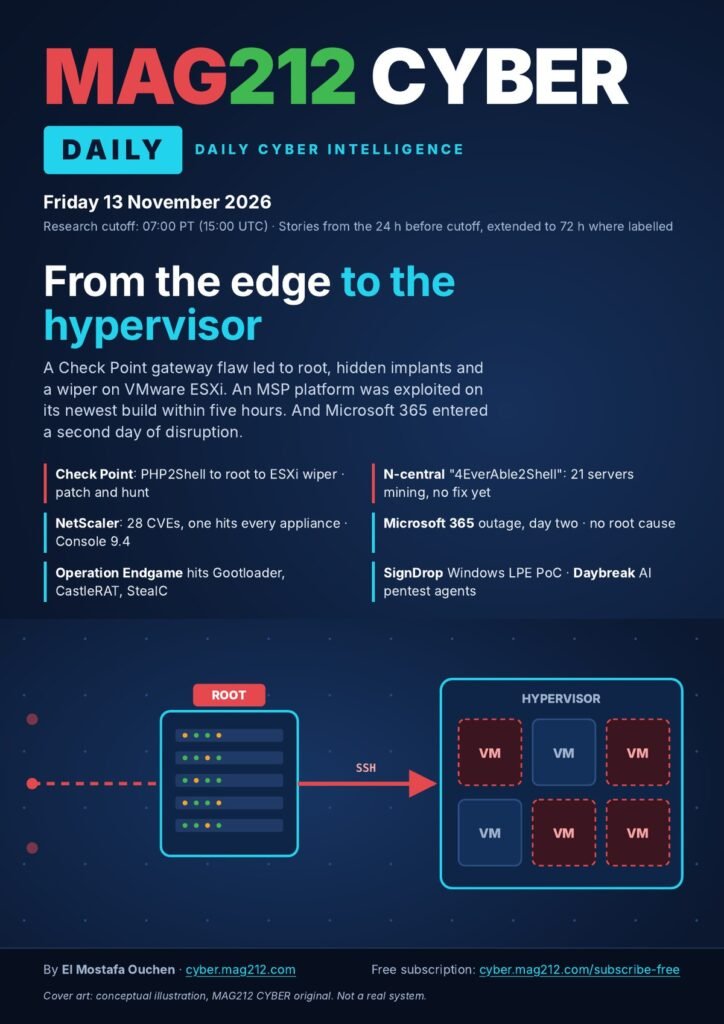
MAG212 CYBER · Daily Cyber Intelligence · Friday, November 13, 2026 · Research cutoff 07:00 PT. From the edge to the hypervisor. Check Point detailed intrusions that went from an unpatched VPN portal to root on the firewall, a hidden implant and a wiper on VMware ESXi. N-able’s N-central was exploited on its newest build within hours of a public exploit, with no fix yet. Citrix shipped 28 NetScaler fixes, and Microsoft 365 entered a second day of disruption.
What needs attention today
| # | Action | How |
|---|---|---|
| 1 | Check Point: apply the November Jumbo Hotfix and hunt | Internet-facing Mobile Access gateways first. Look for upload_progress_pwn session files, zz*.tpl templates and a CPconfigdaemon process; check ESXi for SSH logins from gateways. Any hit means rebuild. |
| 2 | N-central: keep servers offline or Legacy API off, and check for miners | No fix yet; Hotfix 2 is vulnerable. Look for xvd.service and /tmp/.xvd; treat a hit as full compromise. |
| 3 | NetScaler: upgrade every ADC and Gateway, then Console | 14.1-73.57 or 13.1-64.39 (FIPS 14.1-73.58 / 13.1-37.293), Gateway and AAA first; Console 14.1-74.34, management networks only. |
Read the full stories
- Check Point gateways: PHP2Shell and CVE-2026-123039 to root, a stealth implant and an ESXi wiper.
- N-central 4EverAble2Shell: 21 servers mining within hours; no fix.
- Citrix NetScaler: 28 CVEs, one in every appliance, plus a 9.4 Console bypass.
- Microsoft 365, day two: still degraded, network change rolled back, no root cause.
- Operation Endgame: Gootloader, CastleRAT and StealC disrupted; 6M+ credentials.
- SignDrop: a public Windows exploit reaches SYSTEM through Microsoft Defender; no patch.
- AI pentest agents: OpenAI Daybreak launches the same week attackers used AntiFox.
- Defender’s Action Desk, awareness lesson and source register (38 sources).
Updates on earlier coverage
- Barracuda: the KEV deadline for CVE-2026-116606 and CVE-2026-111560 is today, November 13.
- KEV gaps: Check Point’s exploited CVE-2026-123039 and the Apache Axis CVE-2026-90436 used against N-central are not yet in KEV; don’t wait for it.
- ScreenConnect / SCKit (covered November 12): no new verified details; yesterday’s actions stand.
- eMudhra: Microsoft starts removing eMudhra roots on Monday, November 16.
Read the full edition
From the edge to the hypervisor
A Check Point gateway flaw led to root, hidden implants and a wiper on VMware ESXi. An MSP platform was exploited on its newest build within five hours. And Microsoft 365 entered a second day of disruption.
- Check Point: PHP2Shell to root to ESXi wiper · patch and hunt
- N-central “4EverAble2Shell”: 21 servers mining, no fix yet
- NetScaler: 28 CVEs, one hits every appliance · Console 9.4
- Microsoft 365 outage, day two · no root cause
- Operation Endgame hits Gootloader, CastleRAT, StealC
- SignDrop Windows LPE PoC · Daybreak AI pentest agents
Executive briefing
MAG212 analysis Today’s theme is what sits behind the edge. Check Point showed how one unpatched VPN portal became root on a firewall, a hidden implant, and finally a wiper on the hypervisor behind it. N-central, the platform many MSPs use to run their customers, was exploited on its newest build within hours of a public exploit. Citrix shipped 28 NetScaler fixes, and Microsoft 365 is still not fully back. The common lesson: management planes are the target, so isolate them, log them off-box and patch them first.
The three actions that matter most today
Check Point: apply the November Jumbo Hotfix and hunt
Prioritise internet-facing Mobile Access gateways. Look for upload_progress_pwn session files, zz*.tpl templates and a CPconfigdaemon process, and check ESXi for SSH logins from gateways. If you find one, treat it as a rebuild. Check Point CPR
N-central: keep Legacy API off and check for miners
There’s no fix yet for 4EverAble2Shell, and Hotfix 2 doesn’t stop it. Keep on-prem servers offline until N-able says otherwise; if one is online, confirm Legacy API is disabled, look for xvd.service and /tmp/.xvd, and treat a hit as full server compromise. BleepingComputer
Story board
| # | Story | Date label | Exploited? | Who should care |
|---|---|---|---|---|
| 1 | Check Point gateways to ESXi wiper | 12 Nov | Yes | Firewall, VPN and virtualisation teams |
| 2 | N-central 4EverAble2Shell zero-day | 12–13 Nov | Yes | MSPs and their customers |
| 3 | NetScaler ADC, Gateway and Console | 12–13 Nov | Not reported | Remote access and app delivery owners |
| 4 | Microsoft 365 outage, day two | 12–13 Nov | No attack seen | Every Microsoft 365 tenant |
| 5 | Operation Endgame | 12 Nov | Victims | Identity teams, WordPress owners |
| 6 | SignDrop Windows privilege escalation | 13 Nov | PoC only | Windows and endpoint teams |
| 7 | AI pentest agents on both sides | 12–13 Nov | n/a | AppSec leaders, CISOs |
Labels: Confirmed primary source · Reported secondary outlet · Claimed attacker or unverified · MAG212 analysis our judgement · Unknown not established.
In this issue
- 01From a VPN portal to an ESXi wiperCheck Point PHP2Shell, CVE-2026-123039, TSGA implant4
- 02N-central’s newest build exploited within hours4EverAble2Shell · 21 servers mining · no fix6
- 0328 NetScaler flaws, one in every applianceADC/Gateway 14.1-73.57 · Console 14.1-74.347
- 04Microsoft 365 outage enters day twoEX1550543 · network rollback · no root cause9
- 05Operation Endgame hits three malware networksGootloader · CastleRAT · StealC · 6M+ credentials10
- 06SignDrop: a Windows path to SYSTEM via DefenderPublic PoC · no CVE or fix yet11
- 07AI pentest agents, owned by defenders and attackersOpenAI Daybreak vs AntiFox12
- ◆Defender’s Action DeskChecklist · KEV deadlines · pending items13
- ◆Awareness lesson and briefly noted“Need a contract template? Go to the source”14
- ◆Source register38 sources, with whether we opened them15
↻ Updates to earlier coverage
- Barracuda: KEV deadline is today. Confirmed CVE-2026-116606 and CVE-2026-111560 are due 13 November. CISA’s catalog is still at version 2026.11.10, with no additions on 11–13 November. CISA KEV
- Gaps in KEV. Confirmed The PHP2Shell CVEs have been listed since 26 October. Check Point’s exploited CVE-2026-123039 and the Apache Axis CVE-2026-90436 used against N-central are not listed yet, so don’t wait for KEV to act on them. CISA KEV
- ScreenConnect / SCKit (covered 12 Nov): Unknown We found no new verified details since yesterday. ConnectWise’s advisory index still had no November entry. Yesterday’s sweep and response steps stand. MAG212, 12 Nov
- eMudhra: Microsoft starts removing eMudhra roots Monday 16 November. Replace emSign/eMudhra certificates now.
From a VPN portal to an ESXi wiper: inside the Check Point gateway intrusions
What happened
Confirmed Check Point says attackers exploited PHP2Shell, a PHP flaw that also affects its Security Gateways, through the Mobile Access portal. They then used a Gaia privilege-escalation flaw, CVE-2026-123039, to get root and persistence. Activity ran from 30 October to 4 November, a week after fixes shipped on 23 October. Only “a couple of dozen unpatched systems, in a single region” were compromised. In many cases the attacker got a foothold in the network; in a limited number the activity was destructive and ideologically motivated. Check Point notified affected customers and helped remediate. Check Point advisory
Confirmed Check Point Research describes two waves. The first, on 30 October, targeted Israeli organisations and included destructive activity against some. The second, on 2 November, hit organisations in several countries and sectors with no sign of destruction. Check Point Research
Who is affected
| CVE | What | Affected | Exploited |
|---|---|---|---|
| CVE-2026-109618 / -109619 | PHP2Shell: unauthenticated RCE via firewall web interfaces (9.2) | Security Gateways with Mobile Access Portal, R80 to R82.20; Spark R81.10.x, R82.00.x, R77.20.x, R80.20.x | Yes |
| CVE-2026-123039 | Local privilege escalation in the Gaia DynamicCLI service (7.8) | Gaia R81.20, R82, R82.10, R82.20 | Yes |
| CVE-2026-107484 | Gaia Portal privilege escalation by an authenticated user (7.3) | Gaia WebUI R80 to R82.20 | No |
| CVE-2026-120490 | Management-to-gateway access via NAT rule (3.8) | R81.20, R82 | No |
Source: Check Point advisory (SK references sk1000302, sk1000362, sk1000291, sk1000364). The November Jumbo Hotfix also includes the Node2Shell/Brotli fix CVE-2026-111497.
How the attack works
Confirmed In the intrusion Check Point investigated, the attacker:
- Exploited the portal, leaving PHP session files with
upload_progress_pwnunder/opt/CPcvpn-R81.20/tmp/and causing hundreds of Apache/PHP worker crashes. - Escalated from the portal’s service account to root through DynamicCLI.
- Wrote PHP web shells as
zz*.tpllogin-page templates, using the keyzz2026, with uploads saved to/tmp/.up.tpl. - Launched the TSGA implant from
/tmp/CPconfigdaemon, which relaunches asslot_CPconfigdaemon. TSGA drops TSProxy to/lib/libcpfwcommon.soand injects it into appliance processes to hide attacker connections. It can also steal configuration, persist in backups and snapshots, and tamper with firewall logs. - Scanned the internal network with the gogo scanner, then used SSH as
vpxuserto reach a VMware ESXi host and run thedestroy_v6wiper, which leftDREAM_ANNEXATION.txtnotes rejecting ransom.
Check Point Research Unknown How the attacker obtained a working ESXi credential. Reported TSGA and TSProxy are modified variants of PhiliKit, a backdoor seen in Ivanti VPN attacks that ESET associated with China-nexus UNC5221. Check Point says the evidence doesn’t support a confident attribution: the actor may have run the whole campaign, acted as an access broker, or staged a false flag.
# Gaia: installed Jumbo Hotfix take
cpinfo -y all 2>/dev/null | grep -i -A2 'HOTFIX'
# Portal exploitation marker and template web shells
grep -l 'upload_progress_pwn' /opt/CPcvpn-*/tmp/sess_* 2>/dev/null
find / -xdev \( -name 'zz*.tpl' -o -name 'challenge_render.tpl' -o -name '*CPconfigdaemon' \
  -o -name 'libcpfwcommon.so' \) 2>/dev/null
ls -la /tmp/.bd.log /tmp/.up.tpl /tmp/.p_sock 2>/dev/null
netstat -tlnp 2>/dev/null | grep ':11072'
# ESXi: SSH logins as vpxuser (run on each host)
grep -i 'vpxuser' /var/log/auth.log | grep -i 'sshd'
Investigate, contain and remediate (in order)
- Preserve evidence off the box first: remote syslog, SmartConsole logs, upstream NetFlow and vCenter/ESXi auth logs. TSGA can tamper with local firewall logs, so gaps after a logging-daemon crash are themselves a signal.
- Block
130.94.19[.]204and.168, and restrict traffic from gateways to hypervisor management networks. - Install the November Jumbo Hotfix on all management servers and gateways, internet-facing Mobile Access first (for example R81.20 Take 174, R82.10 Take 52). R81.20 R82.10
- MAG212 analysis If any indicator matches, rebuild rather than clean. TSGA persists in backups and snapshots, so check backups before restoring. Then rotate VPN, admin and
vpxuser/vCenter credentials.
Verify recovery: the take is confirmed on both cluster members; there’s no listener on 11072; ESXi shows no SSH from gateways; and policy install, VPN login and failover work. Prevention MAG212 analysis: a firewall should never be able to SSH to your hypervisors. Put ESXi management behind its own boundary, disable ESXi SSH when it’s not in use, and keep firewall logs somewhere the firewall can’t edit.
N-central’s newest build exploited within hours of a public exploit
What happened
Reported Researcher Sean Bales published more than 30 N-central zero-days with exploits on 8 November. N-able took hosted N-central offline on 9 November and shipped 2026.4 Hotfix 2 (build 2026.4.1.26) on 10 November, fixing seven CVEs. On 12 November Bales released two more exploits, 4EverAble2Shell and Agent2Shell, tested against that same Hotfix 2 build. SecurityWeek BleepingComputer
Reported Previdian saw probing at about 08:30 UTC on 12 November. Huntback saw the full chain from 09:16 UTC, and by 12:50 UTC counted 21 compromised N-central servers running an XMRig miner. Huntback describes all 21 as hosted N-central servers; nineteen were on Hotfix 2, spread across the US, Canada, South Africa, the UK, Germany, France and Sweden. SecurityWeek, citing Lupovis and Huntback, puts the first successful compromises about five hours after the exploit was published. BleepingComputer SecurityWeek
Who is affected and how it works
Reported N-central servers with the Legacy API enabled; Legacy API is off by default. Unknown How the compromised servers came to have it enabled. The chain uses an Apache Axis flaw, CVE-2026-90436, to run commands as the nable service account. It then abuses the privileged setLDFileOwner helper and a symbolic link to make a root-owned script writable, edits that script, and runs it as root through serverControl. The payload fetched a script from 157.20.241[.]16 and installed a miner set to use about half the CPU cores. BleepingComputer MAG212 analysis Cryptomining is the least of it: root on an RMM server means control of every endpoint it manages. Agent2Shell, if it works as claimed, targets those endpoints directly.
Reported N-able’s 12 November advisory says it is “restricting certain N-central features and integrations”. It has disabled the Intune integration, applied protections to hosted environments, and urges on-premises customers to confirm Legacy API access is disabled and to keep upgrading agents and probes. At that point it said it had seen no compromise using the new flaws; researchers have since reported compromises. BleepingComputer N-able status
# Huntback indicators: miner service, staging folders, mining process
systemctl list-units --all --no-pager | grep -i 'xvd'
ls -la /tmp/.xvd /var/tmp/.xvd 2>/dev/null
ps aux | grep -Ei 'xmrig|xvd' | grep -v grep
# Exploit requests in your web access log (path varies by build)
grep -E '/dms/services/ServerUI' <N-CENTRAL-WEB-ACCESS-LOG> | grep -i 'TerminalLineSettings'
# Connections to the reported payload host
ss -tnp | grep '157.20.241.16'
<N-CENTRAL-WEB-ACCESS-LOG> with your appliance’s web log path. Expected clean result: no output from any command. Any hit means full root compromise: take the server off the network and rebuild. Commands not tested by MAG212 CYBER. Indicators from Huntback and Previdian via BleepingComputer.Contain and remediate (in order)
- Follow N-able’s offline guidance. Reported After the 8 November dump, N-able advised on-premises customers to keep servers offline until it confirms they can safely return, and Huntress repeats that advice. Huntress If yours is back online, confirm Legacy API is disabled and that the server isn’t reachable from the internet.
- Run the checks above. On a hit, isolate the server, preserve disk and logs, rebuild from a known-good install, and rotate every credential and integration secret the server held.
- MAG212 analysis Check managed endpoints for unexpected scripts or agent tasks pushed since 8 November, and for new remote-access tools.
- Watch N-able’s status page for the fix, then apply it immediately, along with the Hotfix 2 agent and probe upgrades.
Verify recovery: Legacy API is off, there’s no xvd service or miner, CPU use is normal, and the server runs the fixed build once N-able releases it. Prevention MAG212 analysis: this is the second RMM platform in two days. Treat RMM servers as tier zero: no internet exposure without a VPN or allow-list, MFA everywhere, and logs shipped somewhere the server can’t reach.
28 NetScaler flaws, one in every appliance, plus a separate Console bypass
What happened
Confirmed Citrix bulletin CTX697305 lists 28 CVEs in NetScaler ADC and Gateway, almost all memory-safety bugs that Citrix says “can lead to unpredictable or erroneous behavior or Denial of Service”. The one that matters to everyone is CVE-2026-120868 (CVSS 4.0: 9.3), in core packet processing: all deployments are affected, “including those deployed with the default configuration”. The highest score, 9.5, goes to CVE-2026-107412, a set of memory overflows on appliances configured as a Gateway (SSL VPN, ICA Proxy, CVPN, RDP Proxy) or AAA virtual server. Separately, CTX697320 fixes CVE-2026-120869 (9.4), an unauthenticated bypass in NetScaler Console. CTX697305 CTX697320
Confirmed Neither bulletin reports exploitation. Credits include JPMorgan Chase’s XOR team, CapitalOne and watchTowr, and Citrix says it found several issues itself with AI-assisted code analysis. Secure Private Access hybrid deployments that use NetScaler instances also need the upgrade; Citrix-managed cloud services are patched by Citrix. Citrix MAG212 analysis NetScaler bugs have been weaponised quickly in past years, and watchTowr often publishes technical detail after a patch, so don’t treat “not exploited” as “not urgent”.
Who is affected
Confirmed NetScaler ADC and Gateway 14.1 before 14.1-73.57, 13.1 before 13.1-64.39, 14.1-FIPS before 14.1-73.58 and 13.1-FIPS/NDcPP before 13.1-37.293. Console 14.1 before 14.1-74.34. The Console flaw needs network access to the Console IP (attack vector “adjacent”). Other notable preconditions include a management-plane flaw exploitable by any untrusted host that can reach the NSIP (CVE-2026-120863), and authentication material written to /var/log/httperror.log after logouts (CVE-2026-111338). Citrix
# CLI: running build (run on every node, both HA peers)
show ns version
# shell: features that widen exposure (patterns from CTX697305)
shell
grep -E '^add (vpn|authentication) vserver' /nsconfig/ns.conf
grep -E 'http2 ENABLED|B64DECODE' /nsconfig/ns.conf
exit
Contain, remediate and verify
- Upgrade internet-facing Gateway and AAA appliances first, then everything else, then Console. Back up the configuration before each upgrade.
- Restrict NSIP and Console access to management networks (this addresses CVE-2026-120863 and CVE-2026-120869 exposure).
- MAG212 analysis Treat old
httperror.logfiles as sensitive (CVE-2026-111338): limit who can read them and consider rotating credentials if they were copied off-box.
Verify recovery: both HA peers report the fixed build, HA sync is healthy, VPN and SSO logins work, and a test from an untrusted segment can’t reach the Console. Prevention MAG212 analysis: subscribe to Citrix bulletin alerts, and keep a list of which features each appliance uses, so the next precondition check takes minutes.
Microsoft 365 outage enters day two with no root cause
What changed since yesterday
Confirmed At 14:00 UTC on Friday (6 a.m. Pacific), Microsoft’s public status page still listed Microsoft 365 business and enterprise services as degraded, with “Users may be unable to connect to multiple Microsoft 365 services”, and consumer products also degraded. Microsoft status Reported Both incidents remain open. Microsoft says features that depend on Exchange Online are impacted while the rest keep working, has found no malicious activity, and will publish a post-incident report with root cause after mitigation. SecurityWeek
Reported Overnight, Microsoft described a process on the affected servers “that sets up secure connections” becoming overwhelmed, after which the servers stop handling requests. It paused all deployments and configuration changes around 19:06 UTC Thursday, began reverting a recent network change whose timing lines up with the outage, and at 04:57 UTC scaled up virtual machines to absorb a traffic surge. Servers returned to service around midnight UTC failed again under load. Microsoft has not said the network change caused the outage. LazyAdmin SOCRadar WindowsForum
What to do now
Connect-MgGraph -Scopes 'ServiceHealth.Read.All'
Get-MgServiceAnnouncementIssue -ServiceHealthIssueId 'EX1550543' |
  Select-Object Id, Status, Classification, LastModifiedDateTime, Title
Get-MgServiceAnnouncementIssue -ServiceHealthIssueId 'MO1550821' |
  Select-Object Id, Status, LastModifiedDateTime
- Users: don’t reset passwords or reinstall Outlook. Mail sent to you is normally delivered once service returns.
- IT: freeze changes to MFA, Conditional Access and mail flow; send one status note a day; keep an out-of-band channel for urgent work.
- MAG212 analysis Security teams: Defender XDR and Purview were on the affected list, so check for alert backlogs once service returns, and warn staff about outage-themed “re-verify your account” phishing.
- Afterwards: read the post-incident report, check whether the outage qualifies for SLA service credits, and log your business impact.
Verify recovery: both incidents show as resolved, mail queues drain, and Teams calendars and SharePoint search behave normally. Our 12 Nov coverage
Operation Endgame hits three malware networks and recovers over 6 million credentials
What happened
Confirmed Europol says law enforcement and private partners actioned 235 servers and 257 domains behind three “cybercrime-as-a-service” tools. Germany’s BKA dates the action to 9–11 November. Agencies from Bulgaria, Canada, Denmark, Germany, Moldova, the Netherlands, Poland, the UK and the US took part, with Europol’s EC3 and Eurojust. Europol mentions no arrests. Europol BKA
Who is affected and how the tools work
Confirmed Gootloader spread through fake legal documents on hacked, often WordPress, sites and led on to ransomware: 14 servers and 218 domains came down and 681 infected websites were cleaned. CastleRAT, a remote-access trojan known since 2025, was linked to encrypted data and ransom payments: 120 servers and 39 domains were seized, with victim data shared for alerts. StealC, a credential stealer with a dropper, lost 102 servers, continuing a June 2026 action. Victims of stolen CastleRAT credentials will be alerted through HaveIBeenPwned, DIVD, CheckjeHack, NoMoreLeaks, Sekoia, the Shadowserver Foundation and NL-NCSC. Europol
What to look for and do
- Watch the notification channels. Check your domains with Have I Been Pwned domain search, and your Shadowserver reports if you subscribe.
- MAG212 analysis For each validated hit: isolate the device, reset passwords from a clean machine, and revoke sessions and tokens, because stealers take cookies as well as passwords. Then review MFA methods, mailbox rules and OAuth grants for the account.
- MAG212 analysis Hunt Gootloader: look for a browser download of a
.zipfollowed bywscript.exeorcscript.exerunning a.jsfile, and for new scheduled tasks soon after. - WordPress owners: Europol urges updated credentials, MFA and patching. Also verify core, plugins and themes against clean copies.
Verify recovery: old sessions are rejected, no new sign-ins from unknown locations, and the rebuilt device is clean. Prevention: see this issue’s awareness lesson on downloading templates safely.
SignDrop: a public exploit borrows Microsoft Defender’s privileges to reach SYSTEM
What happened
Reported Researcher Abdelhamid Naceri (“Nightmare Eclipse”) released SignDrop this week. It lets a local, standard user become SYSTEM by abusing how the Common Log File System (clfs.sys) creates its .cnpf authentication file. Cyderes compiled and tested the proof of concept and has seen no exploitation in the wild. SecurityWeek asked Microsoft for comment. SecurityWeek Unknown At our cutoff we found no Microsoft advisory, CVE or fixed build.
Who is affected and how it works
Reported The researcher says he tested it on Windows 11 26H2, Windows 11 26H2 Experimental and Windows Server 2025 Experimental. He claims it works on most Windows installations and that you’re “generally vulnerable” if Windows is older than 90 days; neither claim is verified. The trick: if a log’s container is empty, CLFS signs it whether or not a signature file exists. A user can point a log at a chosen path, make Defender open it through its signature-update interface, and so get a SYSTEM-owned file created where they choose. SecurityWeek MAG212 analysis This doesn’t let anyone in from outside: an attacker first needs code running as a user, from phishing or a stolen login. That’s exactly when ransomware crews want SYSTEM.
# OS build and update revision (UBR)
$cv = Get-ItemProperty 'HKLM:\SOFTWARE\Microsoft\Windows NT\CurrentVersion'
'{0} {1}.{2}' -f $cv.DisplayVersion, $cv.CurrentBuild, $cv.UBR
# Defender platform and engine versions
Get-MpComputerStatus | Select-Object AMProductVersion, AMEngineVersion, AntivirusSignatureLastUpdated
Contain, remediate and prevent
- Keep Windows and Defender platform updates current, and watch the Microsoft Security Response Center for a SignDrop advisory.
- MAG212 analysis Hunt: look for Defender processes (
MsMpEng.exe) creating files in user-writable folders, followed by a new SYSTEM-level process, service or scheduled task started from that location. - Reduce the first step: no local admin for daily use, application control on workstations, and fast isolation for any machine running unknown code.
Verify recovery: once Microsoft ships a fix, confirm the build and UBR across the fleet and re-run your hunt over the period before patching.
AI pentest agents, owned by defenders and by attackers, in the same week
What happened
Confirmed OpenAI announced two Daybreak products at its “Cyber at the Frontier” event on 12 November. Daybreak Red Team puts “a coordinated team of agents” to work testing web applications, validating findings from scanners, bug bounties and disclosure reports, and checking whether patches stop the exploit. Agents use source code and app context, and scope is enforced with “isolated environments and Guardian review”. OpenAI Reported Defense Factory traces vulnerabilities through code and drafts patches as GitHub pull requests that engineers review; nothing deploys automatically. It imports findings from Wiz, Snyk and Endor Labs. Red Team is in early access; Defense Factory is a preview ChatGPT plugin. SecurityWeek OpenAI
Why it matters
MAG212 analysis One day earlier we reported AntiFox, a self-hosted agentic pentest platform that attackers used to move from an IIS web shell to a stolen AWS secret, making hundreds of API calls in about 30 minutes. MAG212, 12 Nov The technique is the same on both sides; what differs is scope, consent and review. Defenders who adopt these tools should insist on written scope, isolated test environments, logs of every agent action and human review of every patch. They should also expect attackers to test their apps at agent speed: watch for bursts of enumeration and AccessDenied errors, and fix what scanners already flag.
- Before buying: ask how scope is enforced, where code and findings are stored, and who can see agent logs.
- Before running: point agents at staging, not production, and tell your SOC so their traffic isn’t mistaken for an attack.
- After: treat AI-drafted patches like any pull request: review, test, then merge.
Defender’s Action Desk
Prioritised from today’s stories. MAG212 analysis for the ordering; sources are in each article.
- NowCheck Point: November Jumbo Hotfix on gateways and management, Mobile Access first; run the gateway and ESXi hunt. → 01
- NowN-central: Legacy API off; check for
xvd.serviceand miners; rebuild on a hit. → 02 - NowBarracuda (KEV due today): confirm patch IDs on every ESG and other affected appliance; restrict admin UIs.
- TodayNetScaler: plan upgrades to 14.1-73.57 / 13.1-64.39, Gateway and AAA first; Console to 14.1-74.34; lock NSIP and Console to management networks. → 03
- TodayMicrosoft 365: track EX1550543 and MO1550821; freeze identity changes; warn about outage phishing. → 04
- This weekEndgame: check HIBP domain search; revoke sessions for any confirmed stealer victim. → 05
- This weekSignDrop: inventory Windows builds and Defender versions; hunt for Defender writing to user folders. → 06
- By 16 NoveMudhra: replace emSign/eMudhra certificates before Microsoft removes the roots.
KEV deadlines (federal due dates; a priority signal for everyone)
| CVE | Product | Added | Due |
|---|---|---|---|
| CVE-2026-116606 · -111560 | Barracuda ESG and others | 10 Nov | 13 Nov (today) |
| CVE-2026-19868 | SonicWall SonicOS SSLVPN | 6 Nov | 20 Nov |
| CVE-2026-124194 · -125350 · -20320 · -111793 | Outlook · Chromium · Cisco BroadWorks · Openwave | 10 Nov | 24 Nov |
| CVE-2026-123039 · CVE-2026-90436 | Check Point Gaia · Apache Axis (N-central) | Exploited but not yet in KEV | |
Catalog 2026.11.10; no additions on 11–13 Nov at research time. Source: CISA KEV.
⏳ Pending at the cutoff: check before you act
- N-able: no fix for 4EverAble2Shell or Agent2Shell; its status page couldn’t be read directly (statements via BleepingComputer).
- Microsoft: no root cause, no SignDrop advisory. Check Point: the advisory’s SK link was still a placeholder.
- Not opened: CERT-EU and Canadian Cyber Centre Citrix advisories, the BKA release, Jumbo Hotfix pages (cited from the editor’s draft).
Awareness lesson: “Need a contract template? Go to the source”
For employees, teachers and students
Gootloader, one of the networks taken down this week, spread by posting fake legal documents on hacked websites that ranked in search results. Europol
- Get templates from your legal team, an approved library, or a publisher’s site you type in yourself.
- If a “document” arrives as a
.zipwith a script inside, don’t open it. - Already opened something odd? Tell IT now; speed matters more than blame.
For leaders and owners
“Firewalls, RMM servers and email are the keys to the building.” MAG212 analysis
Ask this week: Who can reach our hypervisor and RMM consoles? Are firewall logs stored somewhere the firewall can’t change? What do we do when Microsoft 365 is down for a day?
Write the answers down and test one.
Briefly noted
- Maersk. Reported Maersk has confirmed data theft amid a $5 million extortion attempt (headline only). SecurityWeek
- SilentAir. Reported Hackers dubbed SilentAir intercepted calls and SMS from inside mobile networks (headline only). SecurityWeek
- Node2Shell. Confirmed The Brotli decompression flaw CVE-2026-111497 (KEV since 27 October) is also fixed in Check Point’s November Jumbo Hotfix. Check Point
Source register
Every source behind this issue; titles link to the source. “No” means MAG212 didn’t open it, and claims from it rest on other sources listed. “Headline only” items are reported, not verified. Links not re-fetched at publication. Corrections: cyber.mag212.com.
- 1 Check Point Blog: Security Advisory — Active Exploitation of PHP2Shell and Local Privilege Escalation 12 Nov 2026 · Primary (vendor) · Opened: Yes
- 2 Check Point Research: PHP2Shell Exploitation on Check Point Gateway 12 Nov 2026 · Primary (researcher) · Opened: Yes
- 3 Check Point: R81.20 Jumbo Hotfix Take 174 Nov 2026 · Primary (vendor) · Opened: No (cited by editor draft)
- 4 Check Point: R82.10 Jumbo Hotfix Take 52 Nov 2026 · Primary (vendor) · Opened: No (cited by editor draft)
- 5 SecurityWeek: PHP2Shell Exploited in Destructive Check Point Gateway Attacks 12 Nov 2026 · Trade press · Opened: Headline only
- 6 BleepingComputer: New N-able 4EverAble2Shell zero-day exploited hours after PoC released 12 Nov 2026 · Trade press (quotes N-able advisory, Previdian, Huntback) · Opened: Yes
- 7 SecurityWeek: Hackers Exploit New N-central Zero-Day Hours After PoC Publication 13 Nov 2026 · Trade press · Opened: Search extract
- 8 SecurityWeek: N-able Takes N-central Offline as Researcher Drops Over 30 Zero-Days 10 Nov 2026 · Trade press · Opened: Search extract
- 9 N-able: N-central status and advisories (uptime page) 9-12 Nov 2026 · Primary (vendor) · Opened: No (script-only page; quoted via #6)
- 10 SOCRadar: 4EverAble2Shell at a glance 13 Nov 2026 · Analysis · Opened: Search extract
- 11 Citrix CTX697305: NetScaler ADC and NetScaler Gateway Security Bulletin 12 Nov 2026 (upd. 13 Nov) · Primary (vendor) · Opened: Yes
- 12 Citrix CTX697320: NetScaler Console Security Bulletin for CVE-2026-120869 12 Nov 2026 · Primary (vendor) · Opened: Yes
- 13 CERT-EU Security Advisory 2026-020 (Citrix NetScaler) 12 Nov 2026 · Government CERT · Opened: No (cited by editor draft)
- 14 Canadian Centre for Cyber Security: Citrix security advisory AV26-1150 12 Nov 2026 · Government CERT · Opened: No (cited by editor draft)
- 15 NetScaler developer docs: show ns version current · Primary (vendor docs) · Opened: No (cited by editor draft)
- 16 Microsoft service health status (status.cloud.microsoft) 13 Nov 2026 14:00 UTC · Primary (vendor) · Opened: Yes
- 17 SecurityWeek: Microsoft 365 Outage Disrupts Outlook, Exchange Online and Teams (updated) 13 Nov 2026 · Trade press · Opened: Search extract
- 18 LazyAdmin: Microsoft 365 Outage — Current Status and SLA Credits 13 Nov 2026 · Practitioner blog · Opened: Search extract
- 19 SOCRadar: Microsoft Outlook Outage — What You Need to Know 13 Nov 2026 · Analysis · Opened: Search extract
- 20 WindowsForum: Microsoft 365 Outage — Server Health Checks, Network Rollback and an Unconfirmed Root Cause 13 Nov 2026 · Community analysis · Opened: Search extract
- 21 MAG212 CYBER: Microsoft 365 Outage (12 Nov coverage) 12 Nov 2026 · Own coverage · Opened: Yes
- 22 Europol: 6.4 million victim datasets secured in international operation against malware networks 12 Nov 2026 · Primary (law enforcement) · Opened: Yes
- 23 BKA press release on Operation Endgame (Presseportal) 12 Nov 2026 · Primary (law enforcement) · Opened: No (cited by editor draft)
- 24 Have I Been Pwned (victim notification partner) current · Service · Opened: No
- 25 SecurityWeek: Nightmare Eclipse Drops Windows Zero-Day Exploit SignDrop 13 Nov 2026 · Trade press · Opened: Yes
- 26 Threadlinqs intel TL-2026-5950 (SignDrop) Nov 2026 · Threat intel · Opened: No (cited by editor draft)
- 27 OpenAI: Daybreak Red Team 12 Nov 2026 · Primary (vendor) · Opened: Yes
- 28 OpenAI: Daybreak Defense Factory 12 Nov 2026 · Primary (vendor) · Opened: No
- 29 OpenAI: Cyber at the Frontier 12 Nov 2026 · Primary (vendor) · Opened: No
- 30 SecurityWeek: OpenAI Unveils Daybreak Red Team, Defense Factory Security Tools 13 Nov 2026 · Trade press · Opened: Yes
- 31 MAG212 CYBER: AntiFox AI pentest platform in real intrusions (12 Nov) 12 Nov 2026 · Own coverage · Opened: Yes
- 32 CISA Known Exploited Vulnerabilities catalog (GitHub mirror, v2026.11.10) 10 Nov 2026 · Government · Opened: Yes
- 33 CISA KEV catalog (web) current · Government · Opened: No
- 34 MAG212 CYBER: SCKit ScreenConnect MSP campaign (12 Nov) 12 Nov 2026 · Own coverage · Opened: Yes
- 35 SecurityWeek: Maersk Confirms Data Theft Amid $5 Million Extortion Attempt Nov 2026 · Trade press · Opened: Headline only
- 36 SecurityWeek: SilentAir Hackers Intercept Calls, SMS From Inside Mobile Networks 13 Nov 2026 · Trade press · Opened: Headline only
- 37 Barracuda Trust Center advisory (KEV pair due 13 Nov) 10 Nov 2026 · Primary (vendor) · Opened: Yes (11 Nov edition)
- 38 Huntress: N-able Disables Cloud Services Following Disclosure of "Able2Shell" Exploit Chains 9–10 Nov 2026 · Security vendor · Opened: Search result 13 Nov
Get tomorrow’s briefing before your first coffee
Verified stories, the three actions that matter, and clear labels for what’s confirmed, reported and still unknown. Free.
Subscribe free →Editor: El Mostafa Ouchen · cyber.mag212.com · Issue MAG212_CYBER_Daily_2026-11-13
Flip through the edition
Get MAG212 CYBER in your inbox every day. Subscribe free. By El Mostafa Ouchen.