
Malicious Ad Code on Dutch News Sites Tried to Hack Older iPhones: What Happened and What to Do
From the MAG212 CYBER Daily, 16 November 2026. Every command is copied from official documentation or the cited analysis and was not tested by MAG212; run it only on systems you are authorised to administer.
Status: Publisher-confirmed incident; device compromise not confirmed. Publishers say an unauthorised third party altered an ad tag. Whether any phone was actually compromised or any data stolen has not been established. [1][2]
What happened
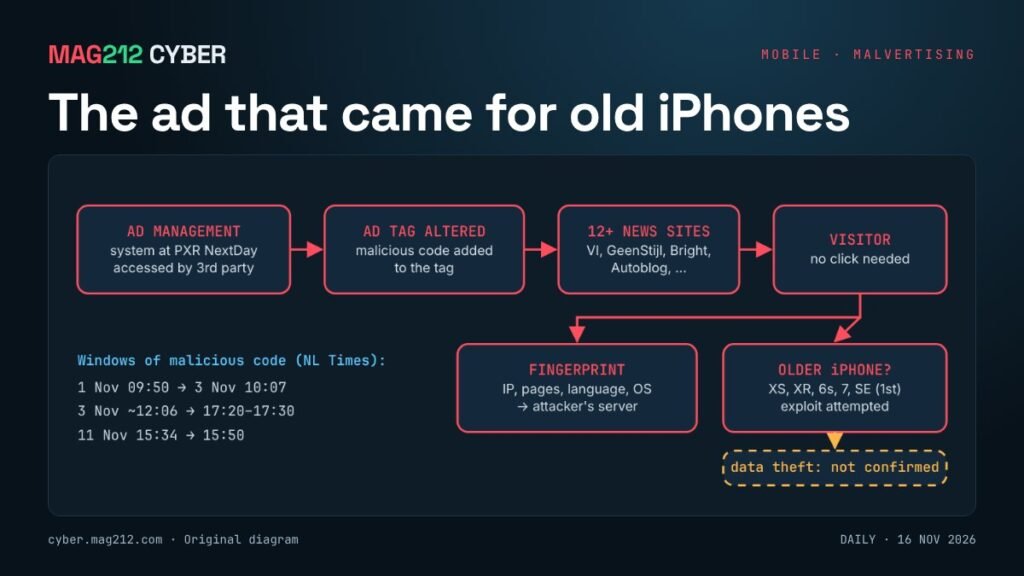
At least 12 Dutch websites have warned visitors that malicious code was distributed through their advertising. All of them use the same advertising partner, PXR NextDay, which manages ads for about 150 websites reaching roughly 12 million visitors a month. NL Times lists VI, VoetbalPrimeur, VoetbalNieuws, Bright, Scientias, Autoblog, Men’s Health, Women’s Health, Runner’s World, Bicycling, GeenStijl and Autoreview.nl; TPO counts at least 14 Dutch sites and one Belgian site. [1][3]
VI says an unauthorised third party accessed the advertising management system and inserted malicious code into an ad tag. The code has been removed and the weakness fixed, according to VI. [1]
According to the publishers, the code was active:
- from about 09:50 on 1 November until 10:07 on 3 November;
- again on 3 November between about 12:06 and 17:20–17:30 (sources differ slightly);
- and in a further unauthorised change on 11 November between 15:34 and 15:50. [1]
Who is affected
- Anyone who visited an affected site during those windows; the code collected data without any click.
- Owners of older iPhones without recent security updates. The publishers name the iPhone XS, XR, 6s, 7 and first-generation SE. Specific iOS versions have not been published. [1][2]
Why this matters
This needed no click and no app install. It reached ordinary readers of mainstream sites through the advertising supply chain, and it targeted phones that many people keep using long after they stop getting updates. (MAG212 analysis)
How the attack works
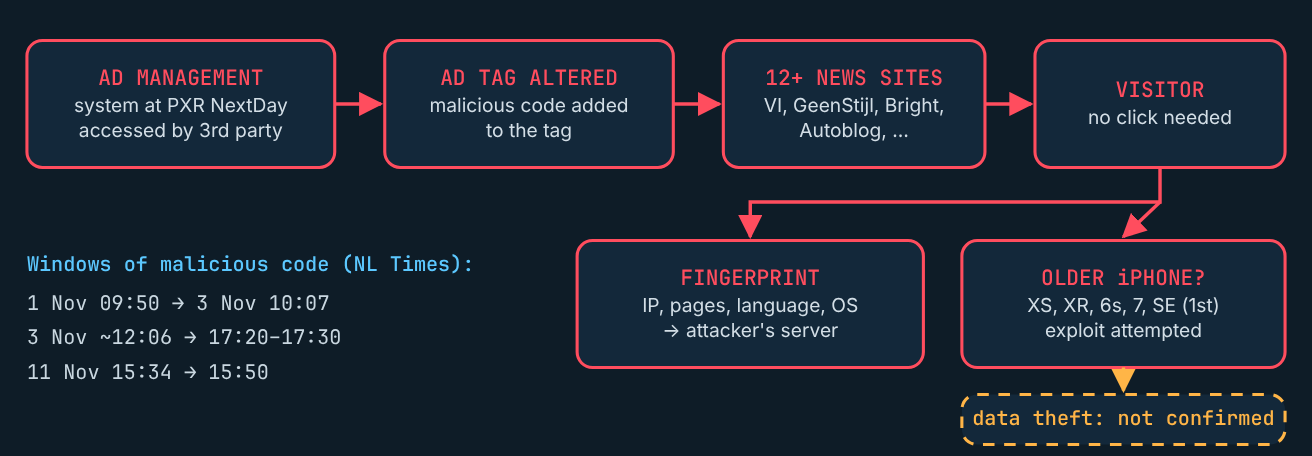
- Supply-chain entry: access to the advertising management system, then an altered ad tag.
- Delivery: the tag ran on every page that loaded ads from that partner.
- Fingerprinting: the code collected IP address, pages visited, language settings and operating-system information and sent them to a server controlled by the attackers.
- Exploitation attempt: on certain older iPhones, the code tried to exploit security vulnerabilities. If successful, that could expose stored passwords, app login credentials, messages, photos, contacts and cryptocurrency wallet keys. [1]
Unknown: which vulnerabilities and iOS versions were targeted, who is behind it, and whether any data left a phone. The reports name no CVE and no police or national CERT involvement. [1]
What users should do
If you visited one of these sites in early November on an older iPhone:
- Install the latest iOS update available for your device in Settings → General → Software Update. [1][4]
- Change passwords stored on the phone, preferably from a different trusted device.
- Turn on two-step verification and watch for unusual sign-ins.
- Be wary of phishing messages that may follow.
- If you keep a cryptocurrency wallet on the phone, move the funds to a new wallet with a new recovery phrase created on a secure device. [1]
A phone that no longer receives security updates should not hold banking, work or wallet apps. People at higher risk can turn on Apple’s Lockdown Mode. [5]
What publishers and ad teams should do (MAG212 recommendations)
- Treat ad-server and tag-manager logins as administrator access: named accounts, MFA and alerts on every tag change.
- Review change history for unexpected script sources and new domains in ad tags.
- Use a Content Security Policy where your ad stack allows it, to limit where scripts can load from and send data.
- Agree incident-notification terms with every advertising partner, including how quickly they must tell you.
How to verify recovery
- For users: the phone shows the latest available iOS, stored passwords are changed, and no unknown devices or sessions appear in key accounts.
- For publishers: ad tags match an approved baseline and no unknown script sources load on your pages.
Prevention and awareness
- Employees: keep work apps off phones that no longer receive updates; install updates the day they arrive.
- IT teams: use mobile device management to flag phones on unsupported iOS versions.
- Decision-makers: your website’s advertising partners are part of your attack surface.
Related on MAG212 CYBER
- MAG212 CYBER Daily, 16 November 2026: The boxes nobody patches (full issue and PDF)
- MAG212 CYBER Daily, 15 November 2026: Machine speed, human gaps
- MAG212 CYBER Weekly, 14 November 2026
- Subscribe free to MAG212 CYBER
Sources
- [1] NL Times, “At least 12 Dutch websites warn of malicious ad code that tried to hack old iPhones“, 15 Nov 2026.
- [2] Cybernews, “Hackers turned at least 12 Dutch websites into traps for older iPhones“, 16 Nov 2026.
- [3] TPO, “Malware via advertenties treft veertien Nederlandse websites“, 15 Nov 2026.
- [4] Apple, “Apple security releases“, page 2026.
- [5] Apple, “About Lockdown Mode“, page 2026.
Written and edited by El Mostafa Ouchen for MAG212 CYBER. Facts checked against the sources above as of 16 November 2026, 6:00 AM PT.