
Google Finds AI Agents Turning Patches Into Exploits: exploit_agent, Claude Code Config Backdoors and LLMjacking
From the MAG212 CYBER Daily, 17 November 2026. Every command is copied from official documentation or the cited analysis and was not tested by MAG212; run it only on systems you are authorised to administer.
Status: Vendor research, published 16 November 2026 by Google Threat Intelligence Group (GTIG) and Mandiant. MAG212 could not load the full report before publication; details below come from Google’s summary post and press coverage of the report, and are labelled as such. [1][2][3][4]
What happened
GTIG’s latest AI Threat Tracker says threat actors are using autonomous LLM frameworks to continuously scan software updates, work out which flaw was patched and build an attack for it, without human involvement. [1]
exploit_agent
According to coverage of the report: [3]
- Discovery: GTIG found the framework on an exposed staging server.
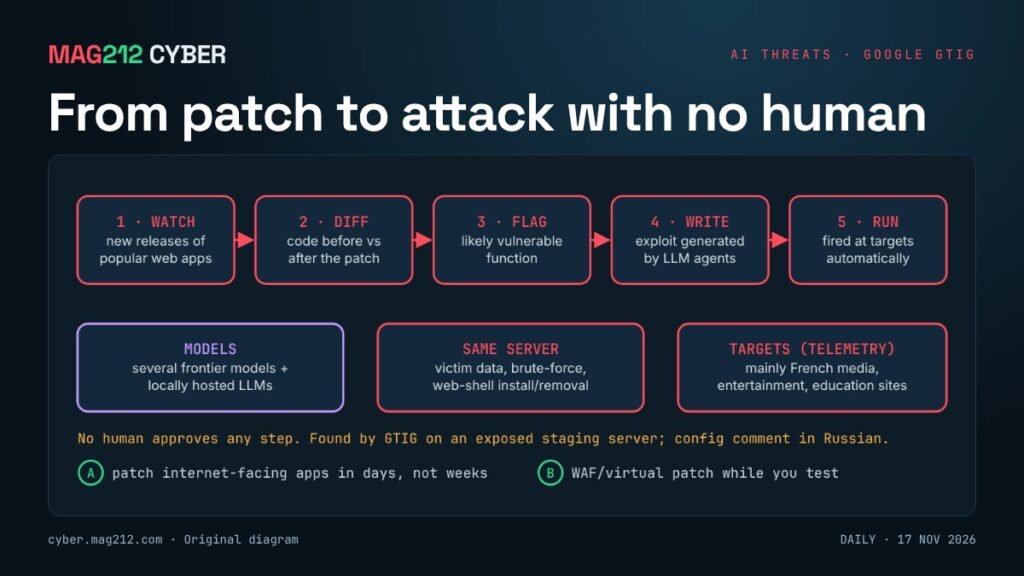
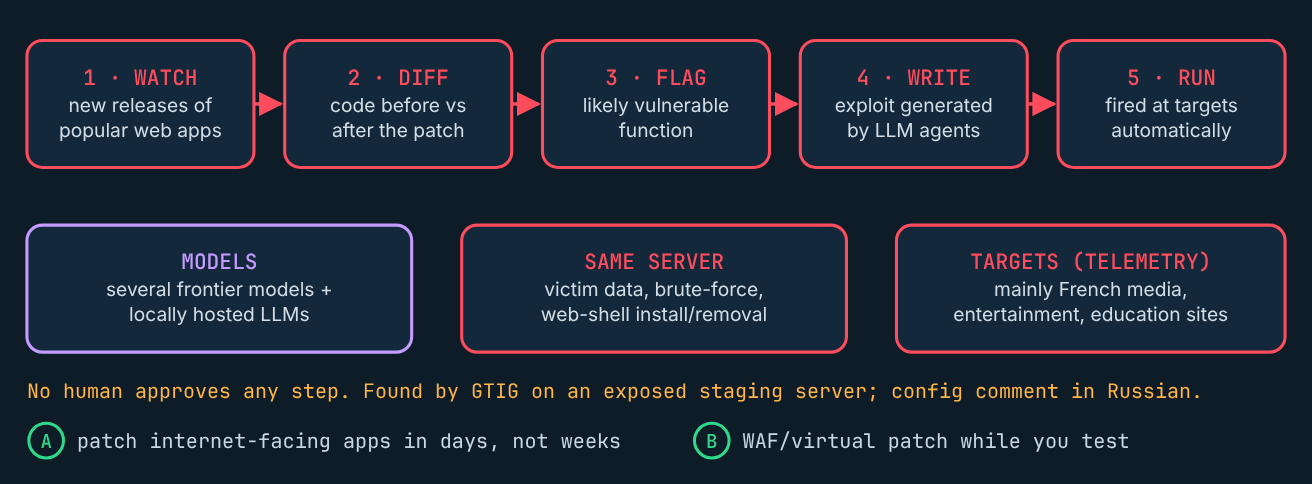
- Function: it compares popular web applications’ code before and after each patch, flags a likely vulnerability, writes an exploit and runs it automatically. GTIG describes it as the first fully autonomous patch-to-attack chain it has observed outside a lab.
- Models: it connects to several frontier models and to locally hosted language models.
- Also on the server: victim data, brute-force scripts and scripts for installing and removing web shells, including shells planted by rival attackers.
- Targets: telemetry suggests the operator mainly targeted French websites in media, entertainment and education. A comment in the configuration file, written in Russian, tells the user to enter API keys there rather than in the chat.
Why this matters
The time between a patch and a working exploit has been shrinking for years. Autonomous patch-diffing removes the human bottleneck entirely, so organisations that patch internet-facing applications in weeks are now racing machines that work in hours. (MAG212 analysis)
Why patches rather than zero-days
GTIG’s reasoning, as reported: a patch diff, release notes and any proof of concept narrow the search to a few functions, which is cheaper than finding new bugs. The report cites PaperCut NG/MF, where two flaws were exploited as zero-days in late August, researchers built working exploits within a day and a mass campaign followed four days after disclosure. [3][4]
Other frameworks
The report names ARTEX, CAIRN, CyberStrikeAI and PentAGI as autonomous multi-agent offensive frameworks. Coverage says CAIRN appeared in a breach in the US aerospace sector, a customised PentAGI platform scanned organisations in Asia from late August to early October, and HexStrike AI is being tested. GTIG notes these tools leave traces in network traffic and code. [3][4]
UNC6836: a backdoor that launches with the AI tool
Coverage of the report says UNC6836, described as a suspected North Korean group, modified .claude/settings.json files in internal code repositories so that Claude Code downloaded a backdoor called SOMBERMEME every time a developer launched it. [3]
The broader lesson: AI coding tools read project-level settings that can run commands. Claude Code documents these as hooks. Anyone who can commit to a repository can therefore make every developer who opens it run their code. [5]
LLMjacking
Attackers steal language-model API keys and cloud credentials from compromised companies and resell access through “LLM mixers” such as APIMart and JetNight. Mandiant observed more than $100,000 in fraudulent charges in a single day and estimates up to $1 million in the worst case. This matches Amazon’s findings on ARTEX agents stealing AI keys, which we covered on 16 November. [3][4][6]
Who is affected
- Organisations running popular internet-facing web applications that patch slowly.
- Development teams using AI coding tools whose configuration is stored in shared repositories.
- Anyone holding LLM provider keys in code, CI logs or configuration.
What defenders should look for
- Commits to
.claude/,.cursor/,.vscode/or similar folders by unusual authors or without review. - Hooks or tasks that fetch remote content (curl, wget, PowerShell downloads).
- Developer machines making new outbound connections right after an AI tool starts.
- Unexpected AI provider spend or new API keys.
- Bursts of exploit attempts against a web application shortly after its vendor releases a patch.
How to investigate
Run in each repository (read-only; not tested by MAG212):
git log --all --oneline -- '.claude/settings.json' '*/.claude/settings.json'
git grep -n -E '"hooks"|curl |wget |Invoke-WebRequest|bash -c' \
  -- '*.claude/settings*.json'
The first command lists every commit that touched a Claude Code project settings file; the second finds hook definitions and download commands inside them. Hooks are a legitimate feature, so a match is a lead to review, not proof of compromise. [5]
How to contain and remediate
- Patch internet-facing web applications within days of release; use a WAF rule or virtual patch while you test.
- Require code-owner review for AI tool configuration folders through CODEOWNERS or branch protection.
- Enable secret scanning across repositories, CI logs and agent traces.
- Set AI provider spend alerts and per-key quotas; rotate keys on a schedule.
- If a malicious hook is found, treat every developer machine that opened the repository as potentially compromised.
What Google did
Google says it disabled the implicated accounts and assets, is using the findings to strengthen model classifiers, released Google SecOps detection rules for ARTEX and pointed to a Mandiant hardening guide. [3]
Prevention and awareness
- Security leaders: measure patch time for internet-facing apps in days, not weeks.
- Engineering leaders: treat AI tool configuration as code that executes, because it does.
- Developers: review changes to tool settings as carefully as changes to build scripts.
Related on MAG212 CYBER
- MAG212 CYBER Daily, 17 November 2026: Keys that outlived the job (full issue and PDF)
- MAG212 CYBER Daily, 16 November 2026: The boxes nobody patches
- MAG212 CYBER Weekly, 14 November 2026
- Subscribe free to MAG212 CYBER
Sources
- [1] Google (GTIG), “The era of autonomous attacks has arrived“, 16 Nov 2026.
- [2] Google Cloud (GTIG), “Agentic threat activity crosses a significant threshold (full report; not readable at cutoff)“, 16 Nov 2026.
- [3] ITdaily, “Google sees AI agent turn patches into exploits without human intervention“, 16 Nov 2026.
- [4] The Hacker News, “Google finds hackers using AI agents to build and run exploits from software patches“, 16 Nov 2026.
- [5] Anthropic, “Claude Code settings and hooks“, docs 2026.
- [6] MAG212 CYBER, “ARTEX agents stole AI keys to pay for more attacks“, 16 Nov 2026.
Written and edited by El Mostafa Ouchen for MAG212 CYBER. Facts checked against the sources above as of 17 November 2026, 6:00 AM PT.