
When the Installer Becomes the Attack: Understanding Drupal’s Highly Critical Core Flaw
How a reachable install script can let attackers take over a site, who is affected, and what to do today if you run Drupal
From the MAG212 CYBER Daily, 25 November 2026. This article was written with AI assistance and edited by El Mostafa Ouchen. Commands, where included, are generic and were not tested by MAG212; run them only on systems you are authorised to administer.
What you will learn
- Why a CMS installer is dangerous on a live site
- What Drupal’s advisory SA-CORE-2026-017 says, and who is affected
- How to upgrade, and what to do if you cannot upgrade today
- How to check whether a site was touched
The short version
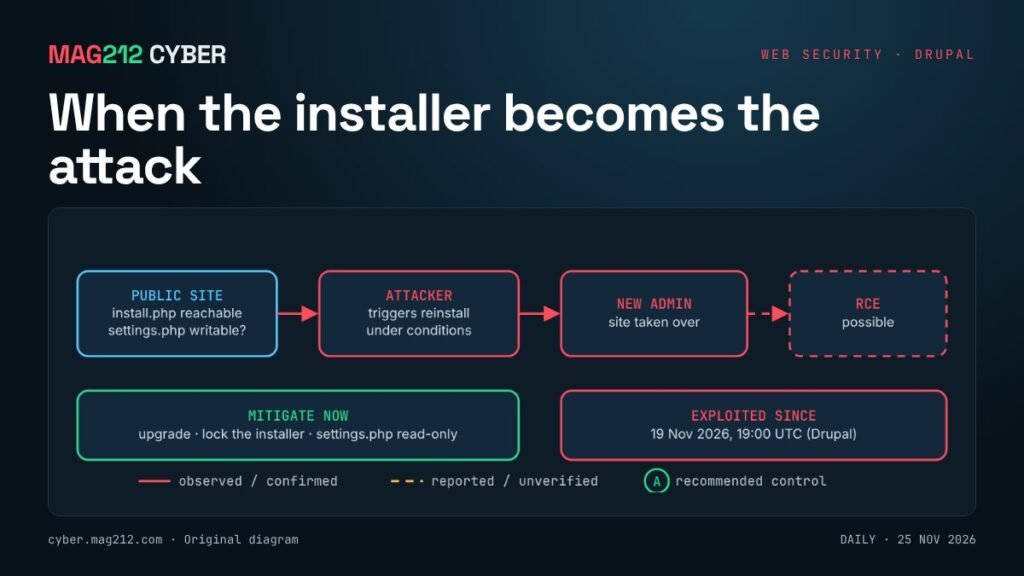
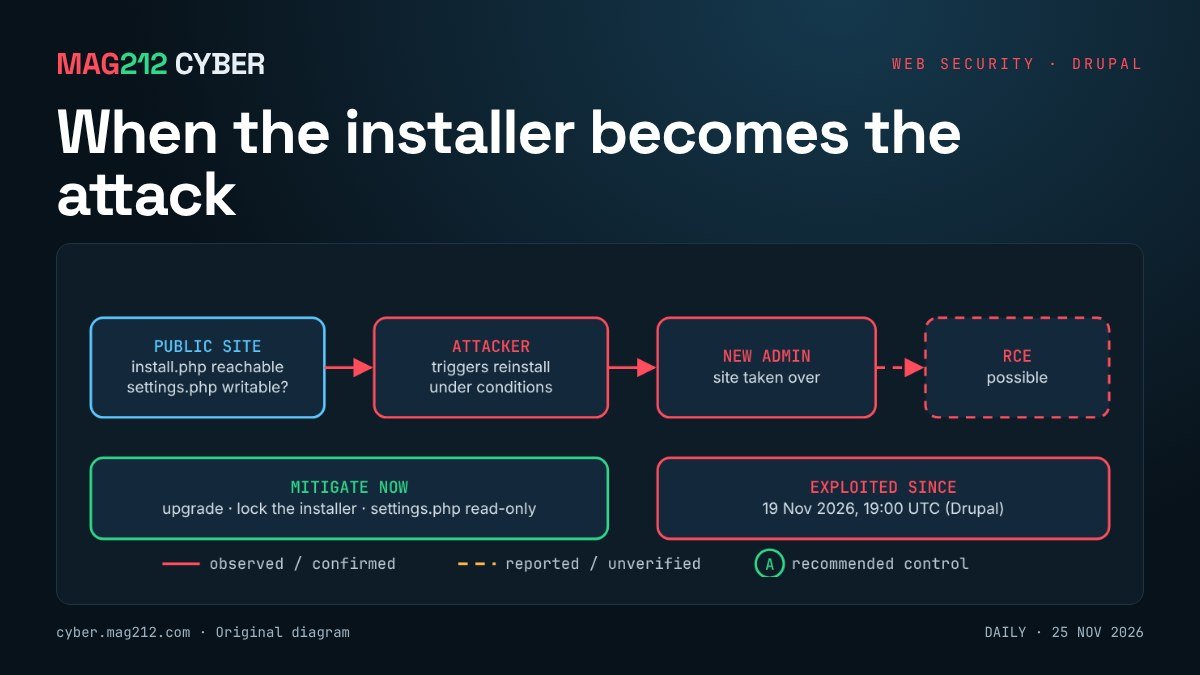
On 18 November 2026, Drupal’s security team published SA-CORE-2026-017, rated “highly critical” (20 out of 25). Under specific conditions, Drupal’s installer, install.php, can be used to try to reinstall a site, which can lead to site takeover or remote code execution. The flaw is tracked as CVE-2026-132165. Drupal SA-CORE-2026-017
Drupal says it received a report of exploitation on live sites starting 19 November 2026 at 19:00 UTC, the day after the fix. CISA added the flaw to its Known Exploited Vulnerabilities catalog on 24 November, with a deadline of 27 November for US federal agencies. Drupal SA-CORE-2026-017, CISA KEV catalog
Drupal credits Anthropic’s OSS Scanner with discovering the flaw. Drupal SA-CORE-2026-017
Lesson 1: Setup code should not stay reachable
Every CMS has a setup routine: it creates the database tables, sets the site name and creates the first admin account. On a live site, that routine should never run again. If an attacker can trigger it, they may be able to set up “their” site on top of yours, with an admin account they control.
The lesson: after installation, setup scripts are attack surface. Lock them, or remove access to them, as part of going live. (MAG212 analysis)
Lesson 2: Exploitation starts as soon as a fix is public
The gap between the advisory (18 November) and the first exploitation report (19 November) was about a day. Attackers read advisories and compare patched and unpatched code. Drupal SA-CORE-2026-017
The lesson: for “highly critical” CMS flaws, plan to patch within a day, not within the next maintenance window.
Who is affected
- Drupal 10 before 10.6.22
- Drupal 11.0.0 up to (not including) 11.3.22
- Drupal 11.4.0 up to (not including) 11.4.13
- End-of-life versions (11.2.x and below, 10.5.x and below, Drupal 8 and 9) get no fix and should be upgraded
Source: Drupal SA-CORE-2026-017
The playbook
Step 1: Upgrade
- 11.4.x: update to 11.4.13
- 11.3.x: update to 11.3.22
- 10.6.x: update to 10.6.22
Step 2: If you cannot upgrade today
- Follow Drupal’s guidance on securing the installer.
- Make
settings.phpunwritable by the web server. Drupal says this covers some, not all, attack paths. - Sites on Drupal Steward are protected against known vectors, but should still upgrade.
Source: Drupal SA-CORE-2026-017
Step 3: Check one site
From the site root, these read-only commands show the core version and whether settings.php is writable:
drush status --field=drupal-version
ls -l web/sites/default/settings.php
Paths vary by install (some sites use sites/default without web/). These commands were not tested by MAG212.
Step 4: Look for signs of a reinstall
- Requests to
install.phpin web server logs since 19 November - New or unexpected administrator accounts
- Changed site name, settings or
settings.phpcontents - Missing content or a site that suddenly looks “fresh”
If you find any of these, take the site offline, restore from a backup taken before 19 November, upgrade, and rotate database and admin credentials. (MAG212 guidance)
How to know you are done
Every site reports 10.6.22, 11.3.22 or 11.4.13 (or later); the installer is locked; and you have reviewed logs and admin accounts for activity since 19 November.
Related on MAG212 CYBER
- MAG212 CYBER Daily, 25 November 2026: Own the console, own the network (full issue and PDF)
- Own vCenter, Own Everything: A Practical Guide to VMware’s November Critical Patches
- When Attackers Own Your Firewall Manager: Lessons From the GT13 Check Point Intrusions
- “This Is the Legal Department”: How Real‑Time MFA Phishing Calls Work, and Why Passkeys Stop Them
- Subscribe free to MAG212 CYBER
Sources
- Drupal SA-CORE-2026-017: www.drupal.org
- CISA KEV catalog: raw.githubusercontent.com
Written and edited by El Mostafa Ouchen for MAG212 CYBER. Facts checked against the sources above as of 25 November 2026, 7:00 AM PT.