
Own vCenter, Own Everything: A Practical Guide to VMware’s November Critical Patches
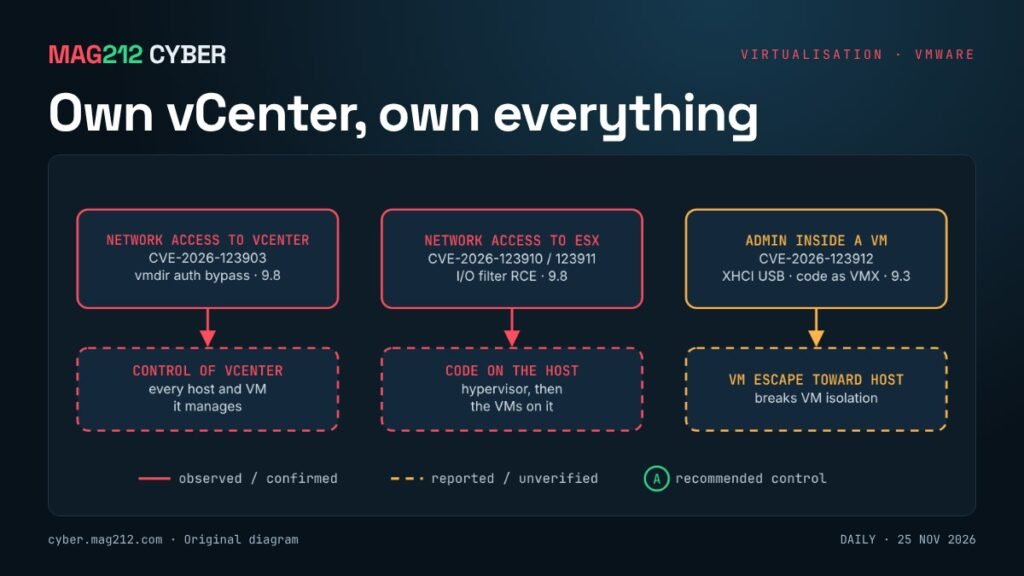
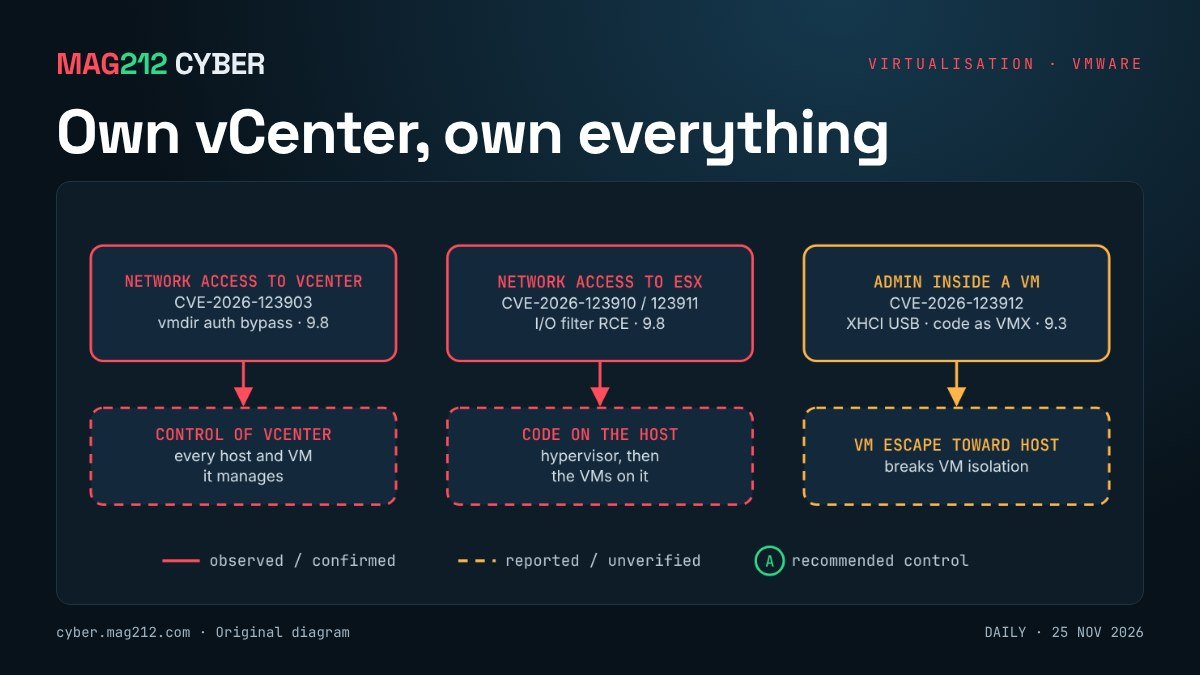
What Broadcom's latest advisory fixes, why the vCenter login bypass matters most, and a safe order for patching vCenter and ESX
From the MAG212 CYBER Daily, 25 November 2026. This article was written with AI assistance and edited by El Mostafa Ouchen. Commands, where included, are generic and were not tested by MAG212; run them only on systems you are authorised to administer.
What you will learn
- What vCenter and ESX do, and why one login bug can matter more than a dozen others
- The four critical flaws in Broadcom’s VMSA-2026-0011, in plain language
- A safe order for patching: contain, patch vCenter, then hosts
- How to confirm you are actually done
The short version
On 24 November 2026, Broadcom published security advisory VMSA-2026-0011, rated critical. It covers 23 vulnerabilities across ESX, vCenter, Workstation, Fusion, VMware Tools, Cloud Foundation, Telco Cloud and the Avi Load Balancer. Four are critical: a vCenter authentication bypass and two remote-code-execution flaws in ESX, each scored 9.8, and a USB-controller flaw scored 9.3 that can let code inside a virtual machine run as the host’s VMX process. Broadcom VMSA-2026-0011
Broadcom’s advisory does not report any exploitation of these new flaws. There are no workarounds except one knowledge-base article for two ESX 8.0 issues. Broadcom VMSA-2026-0011
Lesson 1: vCenter is a master key
ESX is the hypervisor: it runs your virtual machines. vCenter is the management console that controls many ESX hosts at once: it can start, stop, copy, snapshot and reconfigure every VM it manages.
That is why CVE-2026-123903 sits at the top of the list. It is an authentication bypass in vCenter’s directory service (vmdir), reachable over the network. An attacker who gets past vCenter’s login does not need to break into each host one by one. (MAG212 analysis)
The lesson: when you rank patches, ask “what does this system control?”, not only “what is its score?”.
Lesson 2: The same component, twice in a week
CVE-2026-123903 is not the first vmdir bypass this month. A separate vCenter bypass, CVE-2026-123890, was added to CISA’s Known Exploited Vulnerabilities (KEV) catalog on 20 November, meaning CISA has evidence it was used in real attacks. CISA KEV catalog
The new bug has not been reported as exploited. But attackers who studied the first one already know where to look. (MAG212 analysis)
The lesson: “not exploited yet” is a status, not a guarantee. Treat a second bug in an already-attacked component as urgent.
Lesson 3: Inside the VM is not outside the host
CVE-2026-123912 is an out-of-bounds write in the virtual USB (XHCI) controller. Broadcom says an attacker with admin rights inside a VM could run code as the VMX process on the host. It affects ESX, Workstation and Fusion. Broadcom VMSA-2026-0011
The lesson: if you host VMs for other teams or customers, a VM escape flaw turns “their problem” into yours.
The four critical CVEs at a glance
- CVE-2026-123903: vCenter authentication bypass in VMware Directory Service, CVSS 9.8
- CVE-2026-123910: ESX heap out-of-bounds write in the I/O filter service, CVSS 9.8
- CVE-2026-123911: ESX use-after-free in the I/O filter service, CVSS 9.8
- CVE-2026-123912: XHCI USB out-of-bounds write (ESX, Workstation, Fusion), CVSS 9.3
Source: Broadcom VMSA-2026-0011
The playbook
Step 1: Contain before you patch
- Make sure vCenter and ESX management interfaces are reachable only from an admin network or jump host.
- If vCenter is reachable from the internet, take it off now.
- Snapshot or back up the vCenter appliance before upgrading.
Step 2: Patch in the right order
- vCenter first. Fixed in 9.1.2, 9.0.2.0300 and 8.0 U3m. Cloud Foundation 5.x is fixed in 5.2.5.
- ESX hosts next, cluster by cluster, moving VMs with vMotion. Fixed builds: ESXi-9.1.2.0-25946735 (9.1), ESXi-9.0.2.0200-25953133 (9.0) and ESXi80U3m-25926933 (8.0).
- Workstation and Fusion to 26H1u1, then VMware Tools.
- Avi Load Balancer, if you run it.
Two moderate ESX 9.0 issues (CVE-2026-123914 and CVE-2026-123915) are still marked “Patch Pending”. For vCenter and ESX 7.0, Broadcom lists no fix; customers with extended support should contact Broadcom. Broadcom VMSA-2026-0011
Step 3: Check what you are running
On an ESX host, over SSH, these read-only commands print the version and build:
vmware -vl
esxcli system version get
Compare the build number with the list above. For vCenter, check the version in the appliance management interface (port 5480). These are generic commands and were not tested by MAG212.
Step 4: Look back
- Review vCenter logins and new SSO users, roles, and SSH being enabled on hosts.
- Check for unexpected VMs, snapshots or exported disks.
- Do this across your full log retention: the earlier vmdir bypass was exploited before it had a fix.
How to know you are done
Every vCenter and ESX host reports a fixed build; management interfaces are reachable only from admin networks; you have no unexplained accounts, roles or SSH changes; and ESX 9.0 hosts are tracked for the two pending fixes.
Related on MAG212 CYBER
- MAG212 CYBER Daily, 25 November 2026: Own the console, own the network (full issue and PDF)
- When Attackers Own Your Firewall Manager: Lessons From the GT13 Check Point Intrusions
- When the Installer Becomes the Attack: Understanding Drupal’s Highly Critical Core Flaw
- “This Is the Legal Department”: How Real‑Time MFA Phishing Calls Work, and Why Passkeys Stop Them
- Subscribe free to MAG212 CYBER
Sources
- Broadcom VMSA-2026-0011: support.broadcom.com
- CISA KEV catalog: raw.githubusercontent.com
Written and edited by El Mostafa Ouchen for MAG212 CYBER. Facts checked against the sources above as of 25 November 2026, 7:00 AM PT.