When Attackers Own Your Firewall Manager: Lessons From the GT13 Check Point Intrusions
GreyNoise traced an unknown actor through 24 firewall management servers. Here is what happened, what is still unknown, and how to check your own
From the MAG212 CYBER Daily, 25 November 2026. This article was written with AI assistance and edited by El Mostafa Ouchen. Commands, where included, are generic and were not tested by MAG212; run them only on systems you are authorised to administer.
What you will learn
- What a firewall management server holds, and why attackers want it
- What GreyNoise says the actor it calls GT13 did, step by step
- Why an old, already-patched bug was enough
- How to check your own management servers, and what to do if you find signs
The short version
On 23 November 2026, GreyNoise published an investigation into an actor it tracks as GT13. GreyNoise does not attribute GT13 to any known group or country. Between 2 October and 2 November 2026, the actor reached at least 22 organisations in 17 countries and stole data from 24 Check Point Security Management Servers. GreyNoise
GreyNoise says the actor used CVE-2026-16232, a SmartConsole authentication bypass that Check Point patched in July 2026, to run management tasks on the servers. GreyNoise believes the intrusion is ongoing. GreyNoise
SecurityWeek lists the affected sectors as energy, engineering, financial services, government, manufacturing, mining and transportation. Neither GreyNoise nor SecurityWeek cites a Check Point statement on the campaign, and we found none. SecurityWeek
Lesson 1: The manager is more valuable than the firewall
A firewall enforces rules. Its management server writes those rules for many firewalls, and holds the material that makes them trust each other: the firewall database, admin credentials and the Internal Certificate Authority (CA).
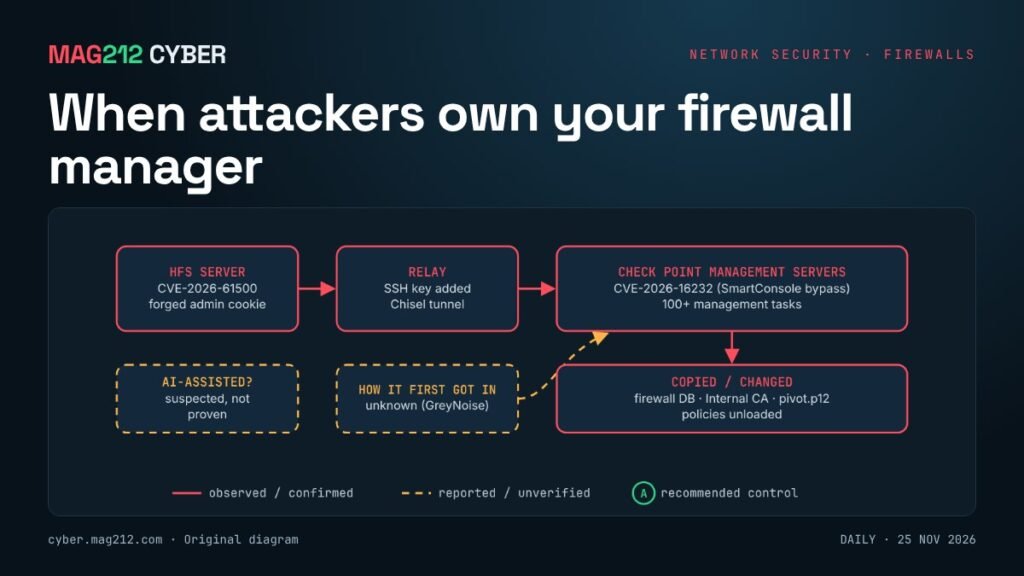
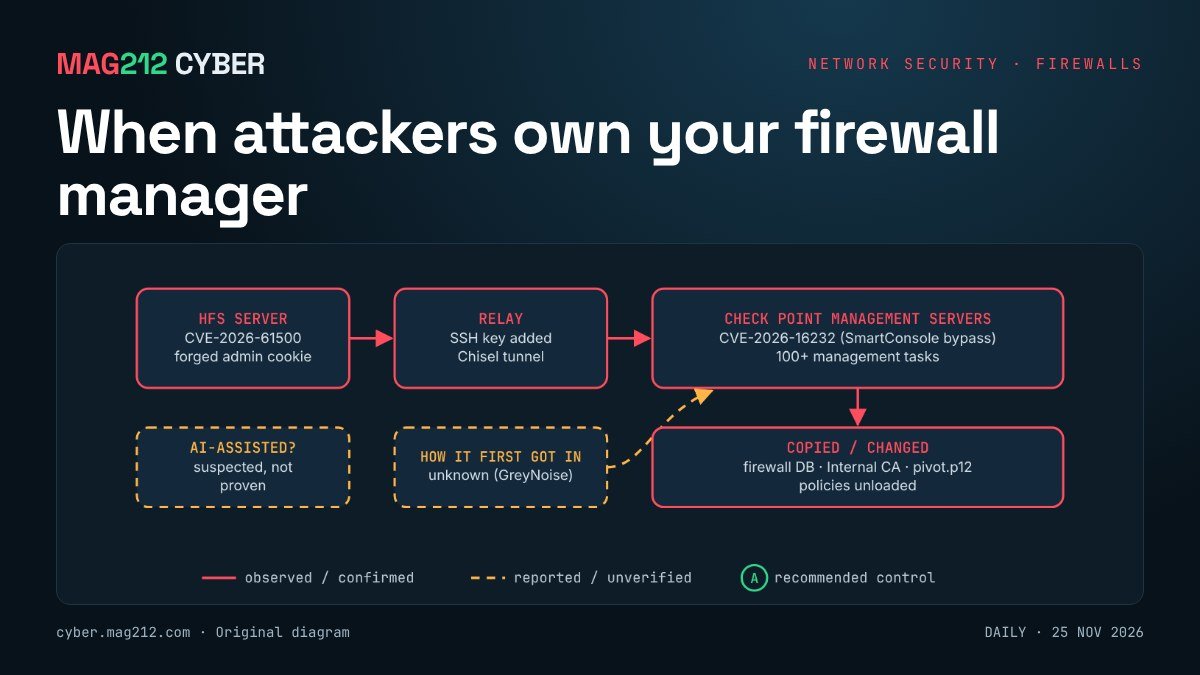
According to GreyNoise, GT13 copied firewall configurations, credentials and the Internal CA, created a certificate named pivot.p12, and unloaded security policies. GreyNoise
The lesson: treat management servers as tier-zero assets, like domain controllers. If one is compromised, every device it manages is in question. (MAG212 analysis)
Lesson 2: A July patch did not protect unpatched servers in October
CVE-2026-16232 was exploited as a zero-day and fixed in July 2026. GT13 was still able to use it months later. GreyNoise could not determine how the actor first reached the Check Point servers. Help Net Security, GreyNoise
A likely explanation, though not one GreyNoise establishes, is servers that were never patched, or were patched but not checked for earlier compromise. (MAG212 analysis)
The lesson: after a zero-day, patching is step one. Step two is confirming the system was not already compromised before you patched.
Lesson 3: How the chain unfolded
GreyNoise reconstructed this timeline (UTC):
- 2 October: a Rejetto HFS file server was exploited through CVE-2026-61500 using a forged admin session cookie.
- 5 October: an SSH key was added for the root user, turning the server into a relay.
- 20 October: tools such as Nmap and the Chisel tunnel were set up, and an exploit for CVE-2026-16232 was first used against Check Point servers.
- 21 October: credentials, the Internal CA and firewall configurations were taken.
- 26 October: a bulk certificate task was pushed to 24 servers; GreyNoise says all of them failed.
- 2 November: the last activity GreyNoise observed.
Source: GreyNoise
Lesson 4: “AI-assisted” is an assessment, not a fact
Headlines call this an AI-assisted campaign. GreyNoise says it believes the actor used large language models and agentic tooling, citing an automated cookie-forging pipeline, more than 30 helper scripts, fast self-patching and odd timeline patterns. It presents this as evidence, not proof. GreyNoise
The lesson: whether a human or an agent typed the commands, the defences are the same: patch, verify, monitor and contain.
The playbook
Step 1: Confirm the patch
Confirm the July fix for CVE-2026-16232 is installed on every Security Management Server and Multi-Domain Server.
Step 2: Hunt for the signs GreyNoise published
- Management task history showing exports of the firewall database or Internal CA, or unexpected bulk certificate tasks
- An unknown certificate named
pivot.p12, or security policies unloaded without a change ticket /etc/ld.so.preloadpointing to/usr/lib/.libproc.so- Unknown keys in
/root/.ssh/authorized_keys - Traffic to
newpayapp.comor its subdomains, or HTTP user-agents containing “research”
On a Linux-based management server, these read-only commands show the first two host artefacts:
cat /etc/ld.so.preload
cat /root/.ssh/authorized_keys
Both files may legitimately be empty or absent. These commands were not tested by MAG212; run them only on systems you administer. GreyNoise’s post has the full list of about 99 IP addresses. GreyNoise
Step 3: If you find signs
- Isolate the management server from the internet and from non-admin networks.
- Treat admin credentials and Internal CA material as exposed: rotate credentials and reissue certificates.
- Review every policy pushed since early October.
- Report to your national CERT and contact Check Point support.
Step 4: Harden for next time
- Put management interfaces on a dedicated admin network, never the internet.
- Alert on policy unloads, CA operations and new admin accounts.
- Retire forgotten file servers and other “small” internet-facing tools: in this case, one became the relay.
Related on MAG212 CYBER
- MAG212 CYBER Daily, 25 November 2026: Own the console, own the network (full issue and PDF)
- Own vCenter, Own Everything: A Practical Guide to VMware’s November Critical Patches
- When the Installer Becomes the Attack: Understanding Drupal’s Highly Critical Core Flaw
- “This Is the Legal Department”: How Real‑Time MFA Phishing Calls Work, and Why Passkeys Stop Them
- Subscribe free to MAG212 CYBER
Sources
- GreyNoise: www.greynoise.io
- SecurityWeek: www.securityweek.com
- Help Net Security: helpnetsecurity.com
Written and edited by El Mostafa Ouchen for MAG212 CYBER. Facts checked against the sources above as of 25 November 2026, 7:00 AM PT.