
Cisco Expressway CVE-2026-76466 Exploited: A Hard-Coded Cluster Credential, Four Breached Devices, and How to Fix It
From the MAG212 CYBER Daily, 20 November 2026. Every command is copied from official documentation or the cited analysis and was not tested by MAG212; run it only on systems you are authorised to administer.
Status: Fixed on 21 October 2026 in Expressway X15.5.20; X14 and earlier must migrate. Exploitation reported on 19 November by Russian security firm F6: one organisation, four devices. We could not load F6’s own report; details come from The Hacker News and Ostorlab. Cisco’s advisory still says it is “not aware of malicious use”. A public proof of concept has existed since 5 November. CVSS 9.8. [1][2][3]
What happened
Cisco’s advisory cisco-sa-vcs-static-cred-hr7EWZ8t, published 21 October, describes CVE-2026-76466: a hard-coded credential (CWE-798) in clustered Expressway that lets an unauthenticated remote attacker run commands as root. Cisco blames “the use of persistent cookies” and insufficient client-certificate checking “when TLS Verify Mode is set to Enabled for clustering”. [1]
On 19 November The Hacker News, citing F6, reported the first known attacks. [2]
Why this matters
Expressway sits at the network edge so that video and voice calls can cross the firewall. Root on that box is a foothold with a view of both sides. The fix has existed for a month and a public proof of concept for two weeks, so any unpatched cluster is now an easy target. Cisco's advisory still says it knows of no malicious use, so teams that only watch vendor advisories may not see the urgency. (MAG212 analysis)
How the attack works
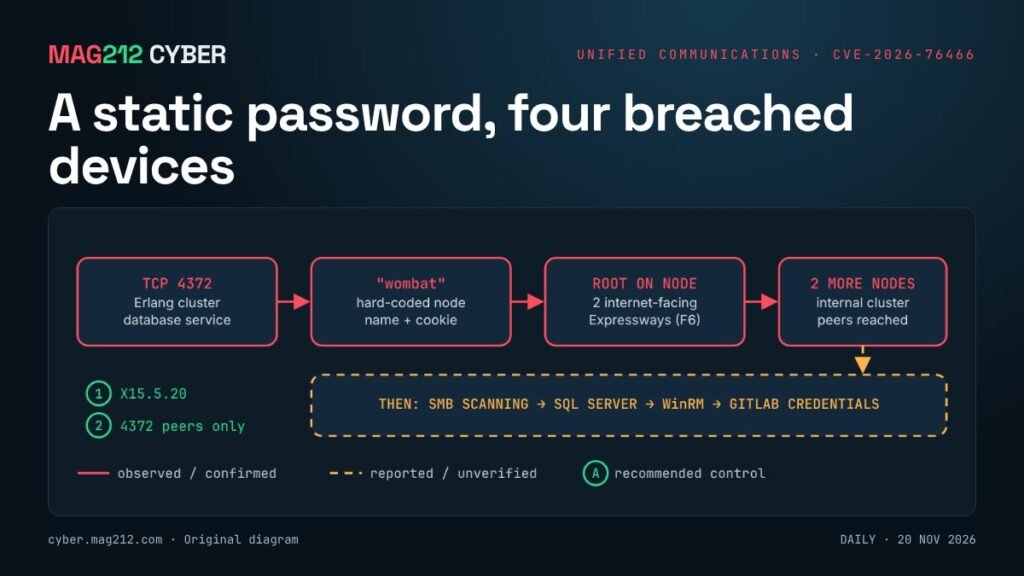
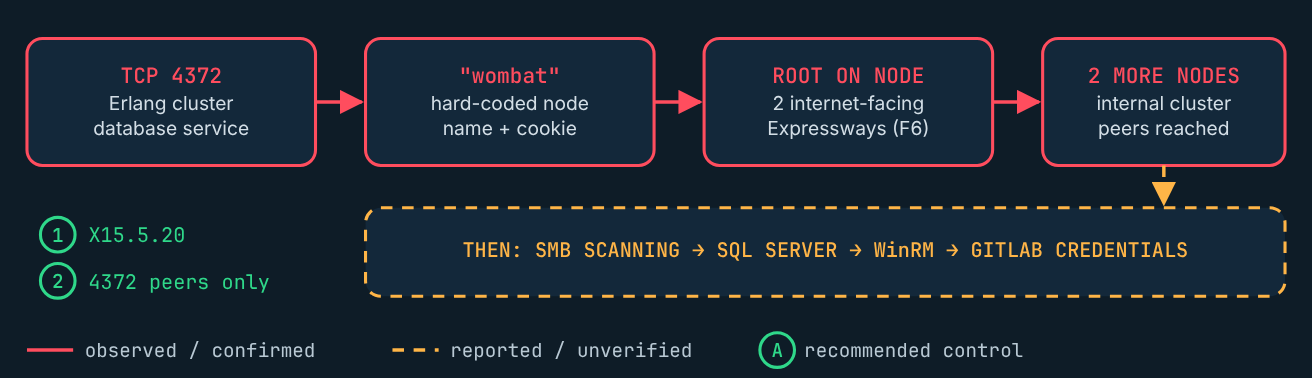
Expressway cluster members share a database service that listens on TCP 4372 and uses Erlang/OTP distribution. According to Ostorlab’s analysis, the public proof of concept connects as an Erlang node using a node name and cookie, both “wombat”, that are identical on every affected installation. Erlang distribution lets a trusted node run code on its peers, so that connection yields root. [3]
What the attackers did
Per THN’s account of F6’s investigation: [2]
- The attackers compromised two internet-facing Expressway devices.
- Through one of them, they reached two more cluster nodes on the internal network.
- They ran Python scripts, possibly AI-assisted according to THN, to scan for SMB services.
- They moved on to SQL Server and WinRM, and went after GitLab credentials.
No attacker has been named.
Who is affected
- Expressway-C and Expressway-E, virtual and appliance, only when configured in a cluster, running X15.5.3 and earlier or X14 and earlier. [1]
- Standalone (non-clustered) Expressway nodes appear not to be affected, based on Cisco’s wording. [1]
- Fix: upgrade to X15.5.20. Cisco lists no workaround. X14 and earlier have no fix in that train; migrate to a fixed release. [1]
Indicators
These come from F6 via secondary sources. No file hashes are public. [2][3]
- IP addresses: 66.179.31[.]32 and 18.130.47[.]116
- Log entry:
wombat@127.0.0.1in the Erlang system log (erlang.log) - Files: Python scripts in paths like
/mnt/harddisk/i1234/or/mnt/harddisk/i1234a/
How to check your devices
Cisco publishes no compromise checks. These read-only commands come from Ostorlab and were not tested by MAG212. Run them only on devices you administer. [3]
grep -R "wombat@127.0.0.1" /var/log/ 2>/dev/nullfind /mnt/harddisk -maxdepth 3 -type f -name '*.py' 2>/dev/null | grep -E '/i[0-9]{4}[A-Za-z]?/'From a network that is not a cluster peer, this should fail:
nc -vz expressway.example.com 4372Any hit means incident response. Rebuild from known-good images and rotate credentials the device could reach.
What to do now
- Upgrade every cluster node to X15.5.20 or migrate off X14. [1]
- Allow TCP 4371 and 4372 only between cluster peers. Neither Cisco nor F6 says this explicitly; it follows from where the bug lives. (MAG212 analysis)
- Hunt for the indicators above, and check firewall logs for the two IP addresses.
- If a device was exposed, review SQL Server, WinRM and GitLab access from it.
Related on MAG212 CYBER
- MAG212 CYBER Daily, 20 November 2026: The keys to vSphere (full issue and PDF)
- MAG212 CYBER Daily, 19 November 2026: A ten-year-old counter
- MAG212 CYBER Daily, 18 November 2026: One equals sign too many
- MAG212 CYBER Weekly, 14 November 2026
- Subscribe free to MAG212 CYBER
Sources
- [1] Cisco, “cisco-sa-vcs-static-cred-hr7EWZ8t: Expressway static credential vulnerability“, 21 Oct 2026.
- [2] The Hacker News, “Hackers exploit critical Cisco Expressway flaw“, 19 Nov 2026.
- [3] Ostorlab, “Cisco Expressway root RCE CVE-2026-76466“, 19 Nov 2026.
Written and edited by El Mostafa Ouchen for MAG212 CYBER. Facts checked against the sources above as of 20 November 2026, 6:00 AM PT.