
Apache Roller CVE-2026-129448: Pre-Auth XML-RPC Deserialization RCE Is Being Exploited. What to Do Now
From the MAG212 CYBER Daily, 19 November 2026. Every command is copied from official documentation or the cited analysis and was not tested by MAG212; run it only on systems you are authorised to administer.
Status: Actively exploited, according to the Apache Roller project’s advisory of 17 November 2026. CVSS 3.1 9.8. Fixed in Roller 6.1.6 and later; 6.1.7 is the recommended target. Apache gave no details on attackers, victims or payloads. Not listed in CISA’s KEV catalog in reports from 17 November; later status was not verified. [1][4][5]
What happened
On 17 November 2026, the Apache Roller project published CVE-2026-129448, an unauthenticated Java deserialization flaw in Roller’s XML-RPC endpoint, and stated: “This issue is being actively exploited.” Apache says it is the same vulnerability as CVE-2026-82384, published on 25 September, whose record listed only Roller 6.1.5 as affected. The new record covers Roller 4.0.0 up to 6.1.4. [1][2][5]
The bug was found by n0mi1k and reported by Matt Raible. [1]
Who is affected
- Apache Roller 4.0.0 through 6.1.4 (CVE-2026-129448) and 6.1.5 (CVE-2026-82384). [1][2]
- No special configuration is needed. The XML-RPC servlet is mapped regardless of settings, so turning off XML-RPC in Roller’s admin interface does not protect older versions. [1][2]
- 6.1.6 fixes this bug but is not fully safe. Roller 6.1.7, released on 11 November, fixes 15 more CVEs, including another deserialization flaw (CVE-2026-123374) that affects releases up to 6.1.6. [3][6]
Why this matters
Roller is often an old, quiet blog server that nobody has looked at in years, which is exactly what attackers look for. The bug needs no login and no special configuration, a public exploit framework has existed since September, and the original CVE record told scanners that only one version was affected. Many organisations may have marked vulnerable installs as safe. (MAG212 analysis)
How the attack works
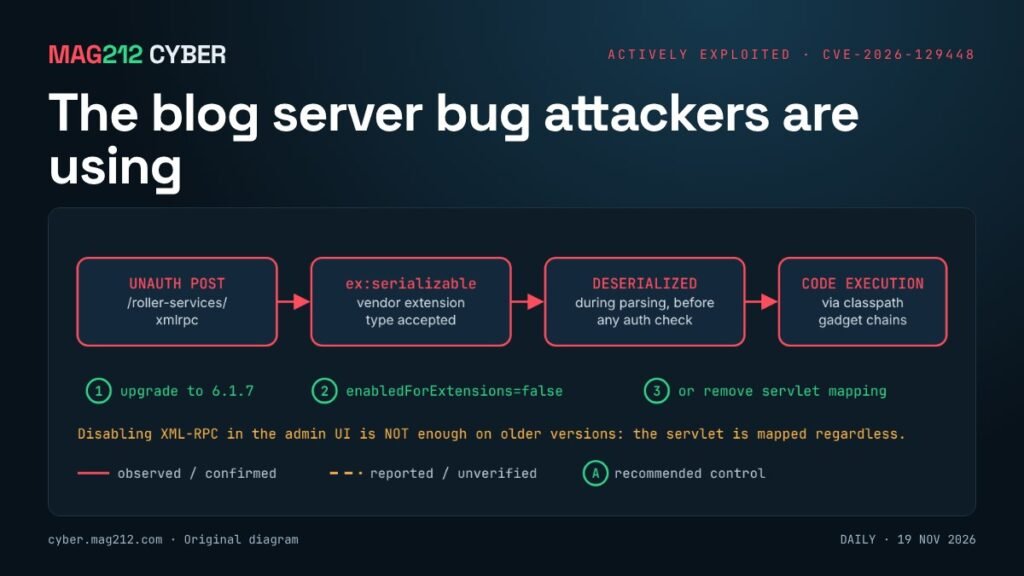
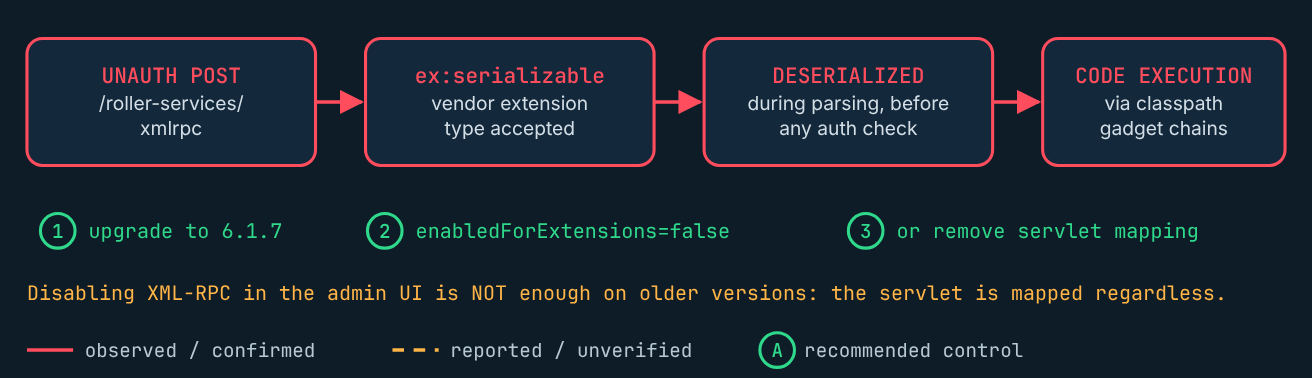
Roller’s XML-RPC servlet at /roller-services/xmlrpc was configured with enabledForExtensions=true, which turns on Apache XML-RPC’s vendor extension types. One of those, ex:serializable, carries a serialized Java object. When an unauthenticated POST request contains such a value, the server deserializes it while parsing the request, before any login check. [2][4]
Whether that becomes code execution depends on “gadget” classes available on the application or Tomcat classpath, which attackers chain together to run commands. A public Python tool for CVE-2026-82384 has been on GitHub since late September; it sends a payload the user supplies and ships no gadget chain itself. [4]
Our reading, not Apache’s: because the September record said “6.1.5 only”, scanners and asset tools that trusted it would have marked older, long-lived Roller installations as not affected for about two months. (MAG212 analysis)
How to fix it
- Upgrade to Roller 6.1.7. Read its release notes first: Apache says some changes affect existing sites. [3]
- If you cannot upgrade today, apply Apache’s workaround and restart Roller. In
WEB-INF/web.xml, set theenabledForExtensionsparameter of the XML-RPC servlet to false: [1]
<init-param><param-name>enabledForExtensions</param-name><param-value>false</param-value></init-param>Alternatively, remove the /roller-services/xmlrpc servlet mapping entirely. This configuration change was not tested by MAG212; test it on a copy first. [1]
- Block the endpoint at the edge if you do not use XML-RPC: deny
POST /roller-services/xmlrpcat your reverse proxy or web application firewall. [4]
What defenders should look for
No attacker infrastructure has been published. Corgea and SOC Prime suggest these behavioural signals: [4]
- POST requests to
/roller-services/xmlrpcor/roller/roller-services/xmlrpc, especially with bodies containingex:serializable, the extensions namespace, orrO0AB(the Base64 form of the Java serialization header). - The Tomcat process starting
sh,bash,curl,wget,pythonorpowershell.exe. - Unexpected outbound connections from the Tomcat or Roller process.
- New
.jspfiles underwebapps/, and Roller admin accounts nobody recognises.
How to investigate and recover
If an exposed Roller server ran a vulnerable version, assume it may be compromised: [4]
- Preserve web server and Tomcat logs and a disk image before changing anything.
- Search the logs for the XML-RPC requests above, going back to at least late September.
- Rebuild the server from a clean image on Roller 6.1.7 rather than cleaning it in place.
- Rotate credentials the Tomcat user could read: database passwords, API keys, mail credentials.
- Run Roller under a low-privilege account and restrict its outbound network access.
How to verify recovery
- The Roller version page or WAR file shows 6.1.7.
- A POST to
/roller-services/xmlrpcfrom outside is blocked or rejected. - No new
.jspfiles or unknown admin accounts appear after the rebuild.
Prevention and awareness
Old CVE records can understate who is exposed: when a project re-issues or widens a CVE, re-check assets you previously marked safe. Keep an inventory of internet-facing Java applications, including the forgotten ones like an old team blog, and remove what you no longer need.
Related on MAG212 CYBER
- MAG212 CYBER Daily, 19 November 2026: A ten-year-old counter (full issue and PDF)
- MAG212 CYBER Daily, 18 November 2026: One equals sign too many
- MAG212 CYBER Daily, 17 November 2026: Keys that outlived the job
- MAG212 CYBER Weekly, 14 November 2026
- Subscribe free to MAG212 CYBER
Sources
- [1] Apache Roller PMC (oss-security), “CVE-2026-129448: XML-RPC deserialization, actively exploited“, 17 Nov 2026.
- [2] Apache Roller PMC (oss-security), “CVE-2026-82384: XML-RPC deserialization in 6.1.5“, 25 Sep 2026.
- [3] Apache Roller PMC (oss-security), “Apache Roller 6.1.7: 15 CVEs fixed“, 11 Nov 2026.
- [4] Corgea Research, “CVE-2026-129448 / 82384: Apache Roller XML-RPC deserialization exploited“, 17 Nov 2026.
- [5] SecurityWeek, “Critical Apache Roller, Axis Vulnerabilities Exploited in Attacks“, 19 Nov 2026.
- [6] Apache Security, “Apache Roller project security advisories“, accessed 19 Nov 2026.
Written and edited by El Mostafa Ouchen for MAG212 CYBER. Facts checked against the sources above as of 19 November 2026, 6:00 AM PT.