
nginx2root (CVE-2026-123007): How a Ten-Year-Old nginx HTTP/2 Bug Leads to Pre-Auth RCE, and How to Patch
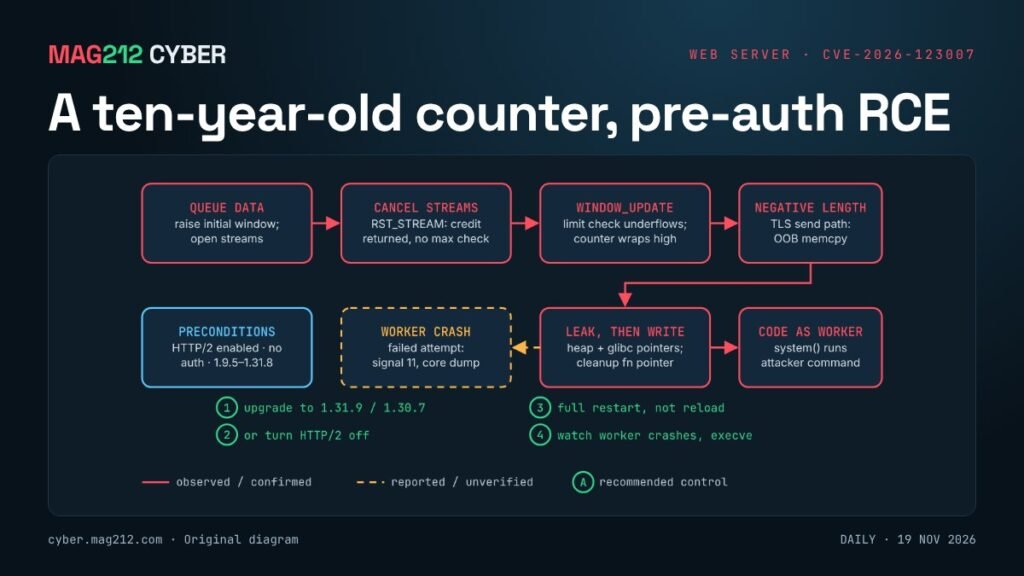
From the MAG212 CYBER Daily, 19 November 2026. Every command is copied from official documentation or the cited analysis and was not tested by MAG212; run it only on systems you are authorised to administer.
Status: Fixed on 18 November 2026 in nginx 1.31.9 (mainline) and 1.30.7 (stable), and in NGINX Plus 37.3.0.1 and 37.0.8.1. Remote code execution as the nginx worker user was demonstrated by Xint, Rapid7 and Wiz, and Rapid7’s proof of concept is public. No exploitation in the wild was reported as of 18 November, and the flaw was not in CISA’s KEV catalog. Severity: CVSS 4.0 9.2; Ubuntu also lists CVSS 3.1 8.1. [1][2][3][4][8]
What happened
On 18 November 2026, the nginx project released versions 1.31.9 and 1.30.7, fixing CVE-2026-123007, a memory-corruption bug in HTTP/2 flow control. nginx.org rates it “major” and says it affects every release from 1.9.5, published in September 2015, to 1.31.8. Xint named it nginx2root. [1][2][3][6]
Several teams found it independently. nginx’s changelog credits Xint, while Rapid7 (researcher Stephen Fewer) and Wiz each reported it to F5 separately and each built a working exploit. The same releases fix four more memory-safety bugs in nginx worker processes: CVE-2026-123633 (HTTP/2), CVE-2026-123634 (resolver), CVE-2026-121810 (HTTP/3) and CVE-2026-113425 (mail proxy). [3][4][5][6]
Who is affected
- nginx open source 1.9.5 through 1.31.8, with HTTP/2 enabled through
listen ... http2orhttp2 on. No login and no third-party module is needed: Wiz says serving ordinary static files is enough. [2][5] - NGINX Plus 37.1.0 to 37.2.0.1 and 37.0.0 to 37.0.7.1. Rapid7 and The Hacker News list no fix for R34 to R36. [1][4]
- Linux distributions: on 18 November Ubuntu listed nginx as vulnerable on every supported release from 16.04 to 26.10. Distribution fixes may be backported without changing the version number nginx reports. [8][6]
- Products that embed nginx (ingress controllers, appliances, gateways) need their own vendor’s update. CIRCL advises following each vendor’s advisory. [7]
The exploit as demonstrated needs an x86-64 build using glibc on a CPU with AVX-512, because it relies on how glibc’s fast memcpy behaves. No source shows other platforms exploitable for code execution, but they should be treated as at least crashable. [4]
Why this matters
nginx sits in front of a huge share of the internet, often as the first thing an attacker can touch. This bug needs no login and no special module, only HTTP/2, which most modern sites enable by default. A working proof of concept is public, three separate teams found the bug, and the fix needs a full restart rather than the usual reload. Expect scanning and exploit attempts to follow quickly. (MAG212 analysis)
How the attack works
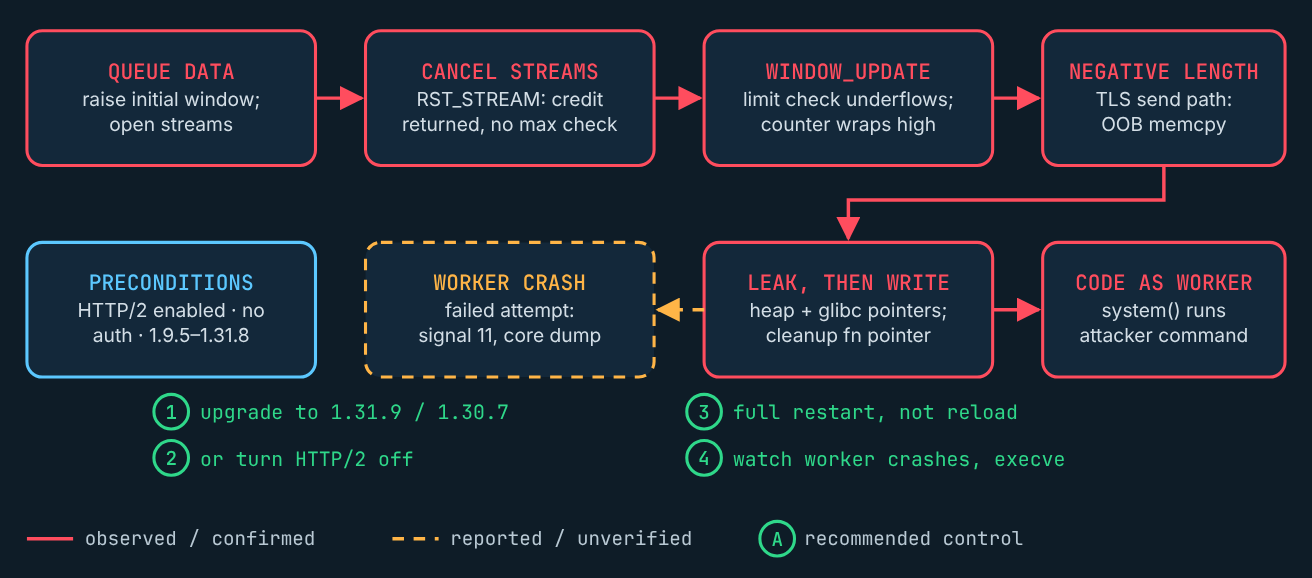
HTTP/2 lets each side tell the other how much data it may send, using a “window” that grows with WINDOW_UPDATE frames and shrinks as DATA is sent. Rapid7 and Xint describe the bug chain like this: [4][6]
- The attacker raises the initial window size and opens streams that have DATA queued for sending.
- The attacker cancels those streams with RST_STREAM. nginx’s cleanup routine,
ngx_http_v2_filter_cleanup(), returns the queued credit to the connection’s send window without checking the 2^31−1 maximum. - A later WINDOW_UPDATE check in
ngx_http_v2_state_window_update()subtracts in a way that underflows, so the unsigned counter wraps to a huge value. The HTTP/2 specification says this should close the connection; nginx keeps it open. - When sending, the huge window turns into a negative length, and
ngx_ssl_send_chain()copies far past the end of its buffer.
Rapid7’s proof of concept uses that out-of-bounds copy twice: first to leak heap and glibc addresses, which defeats address-space layout randomisation (ASLR), then to overwrite a request-pool cleanup pointer so that nginx calls system() with an attacker-chosen command. The command runs as the nginx worker user, not root. [4]
Root access needs a second, separate bug. Xint chained a Linux kernel SCTP flaw that has no CVE yet and says it escaped a Docker container to host root in its tests. CIRCL’s guidance: a vulnerable nginx does not by itself mean host root. [6][7]
The attack is heavy. Rapid7’s demonstration sent about 128 GB of HTTP/2 traffic in about two and a half minutes. That is about 17 minutes at 1 Gbit/s; below roughly 300 Mbit/s, nginx’s default one-hour connection limit gets in the way. A CDN or load balancer that terminates HTTP/2 in front of nginx may blunt the attack, so test the origin server directly. [4][5]
Fixed versions
| Product | Vulnerable | Fixed |
|---|---|---|
| nginx open source (mainline) | 1.31.0–1.31.8 | 1.31.9 |
| nginx open source (stable) | 1.9.5–1.30.6 | 1.30.7 |
| NGINX Plus | 37.1.0–37.2.0.1 | 37.3.0.1 |
| NGINX Plus | 37.0.0–37.0.7.1 | 37.0.8.1 |
| NGINX Plus | R34–R36 | none listed |
Source: Rapid7 and The Hacker News, matching nginx.org. F5’s own advisory, K000163926, did not load for us; confirm on F5’s site before deploying. [1][2][4]
How to check your servers
These read-only commands are taken from CIRCL’s TR-105 guidance and were not tested by MAG212. Run them only on systems you administer. [7]
Check the version and whether HTTP/2 is turned on in the configuration nginx will load:
nginx -v 2>&1sudo nginx -T 2>&1 | sed 's/#.*//' | grep -nE 'listen.*http2|http2 +on|listen.*quic'Check whether a listener actually negotiates HTTP/2. Replace example.org with your host, and test the origin directly if a CDN sits in front:
openssl s_client -connect example.org:443 -servername example.org -alpn h2 </dev/null 2>&1 | grep -E 'ALPN protocol|No ALPN negotiated'ALPN protocol: h2 means HTTP/2 is live. Do not publish raw nginx -T output: it contains your whole configuration, including paths and upstreams. Check distribution packages with dpkg-query -W 'nginx*', rpm -q nginx or apk info -v nginx, and read the package changelog, because backported fixes keep old version numbers. [7]
How to contain and remediate
- Upgrade to nginx 1.31.9 or 1.30.7, NGINX Plus 37.3.0.1 or 37.0.8.1, or your distribution’s fixed package. [1][2]
- Restart fully. A reload leaves the old binary running, and old workers keep serving existing connections. Validate first with
nginx -t, then restart, or do a live binary upgrade. Rebuild and redeploy container images; official Docker images for 1.31.9 and 1.30.7 were available on 18 November. [1][6][7] - If you cannot patch yet, turn HTTP/2 off. On nginx 1.25.1 and later, remove
http2fromlistenand sethttp2 off;in every server block sharing that listener, IPv6 included. On older versions, changelisten 443 ssl http2;tolisten 443 ssl;. This breaks gRPC and other HTTP/2-only applications, and it only covers CVE-2026-123007 and CVE-2026-123633. [5][7]
In CIRCL’s example, the affected server block keeps listen 443 ssl; and adds http2 off;, with the rest of its configuration unchanged. [7]
- Cover the other fixed bugs if you cannot upgrade: use fixed upstreams instead of request-derived DNS names (CVE-2026-123634), remove QUIC listeners and Alt-Svc headers (CVE-2026-121810), and firewall the mail proxy (CVE-2026-113425). [6][7]
- Reduce the root path. On hosts that do not need SCTP, CIRCL suggests blocking the kernel module with
echo 'install sctp /bin/false' | sudo tee /etc/modprobe.d/disable-sctp.conf. It does not unload a module already loaded or disable SCTP built into the kernel. For containers, assess the host kernel. [7]
What defenders should look for
There is no public network signature. CIRCL, Xint and Wiz suggest behaviour-based checks: [5][6][7]
- Worker crashes:
sudo grep -Ei 'worker process.*exited|signal 11|segfault' /var/log/nginx/error.logandsudo coredumpctl list nginx. - Long-lived connections on port 443 with very large inbound traffic but few logged requests. WINDOW_UPDATE and RST_STREAM frames never appear in access logs.
sudo ss -tinp state established '( sport = :443 )'shows per-connection byte counts. - Processes started by nginx workers, for example with auditd rules on
execveby the worker’s user ID, and unexpected outbound or DNS activity from the web server.
A clean access log does not prove a server was not attacked. If you find crash bursts or worker child processes from before you patched, preserve the logs and core dumps and investigate the host.
How to verify recovery
- The installed package version or changelog shows the fix, and the running nginx was restarted after the upgrade.
- Where you turned HTTP/2 off, the ALPN test no longer returns
h2. - Container images in production are rebuilt from fixed base images.
- NGINX Plus, ingress and appliance vendors have confirmed their fix status in writing.
Prevention and awareness
Inventory every place nginx runs, including inside products you do not think of as “nginx”. Record which listeners speak HTTP/2 and QUIC. Make full restarts part of your patch procedure for web servers, and alert on worker crashes as a security signal, not only an availability one. ASLR and position-independent builds help, but CIRCL warns not to close a finding just because they are enabled. [7]
Related on MAG212 CYBER
- MAG212 CYBER Daily, 19 November 2026: A ten-year-old counter (full issue and PDF)
- MAG212 CYBER Daily, 18 November 2026: One equals sign too many
- MAG212 CYBER Daily, 17 November 2026: Keys that outlived the job
- MAG212 CYBER Weekly, 14 November 2026
- Subscribe free to MAG212 CYBER
Sources
- [1] The Hacker News, “10-Year-Old NGINX HTTP/2 Flaw Lets Unauthenticated Attackers Execute Code on Servers“, 18 Nov 2026.
- [2] nginx.org, “nginx security advisories“, 18 Nov 2026.
- [3] nginx.org, “Changes with nginx 1.31.9“, 18 Nov 2026.
- [4] Rapid7 (S. Fewer), “CVE-2026-123007: Critical NGINX HTTP/2 integer underflow leads to RCE (fixed)“, 18 Nov 2026.
- [5] Wiz Research, “NGINX HTTP/2 RCE vulnerabilities“, 18 Nov 2026.
- [6] Xint (Theori), “nginx2root: remote code execution“, 18 Nov 2026.
- [7] CIRCL, “TR-105 NGINX2ROOT (TLP:CLEAR)“, 18 Nov 2026.
- [8] Ubuntu, “CVE-2026-123007“, 18 Nov 2026.
Written and edited by El Mostafa Ouchen for MAG212 CYBER. Facts checked against the sources above as of 19 November 2026, 6:00 AM PT.