
“This Is the Legal Department”: How Real‑Time MFA Phishing Calls Work, and Why Passkeys Stop Them
A plain-language lesson on the vishing playbook Okta and Unit 42 describe, with rules for staff, administrators and leaders
From the MAG212 CYBER Daily, 25 November 2026. This article was written with AI assistance and edited by El Mostafa Ouchen. Commands, where included, are generic and were not tested by MAG212; run them only on systems you are authorised to administer.
What you will learn
- How a “legal department” phone call can defeat one-time codes and push approvals
- Why passkeys and device-bound sign-in break the attack
- Four rules every employee can remember
- What administrators and business leaders should change this week
The short version
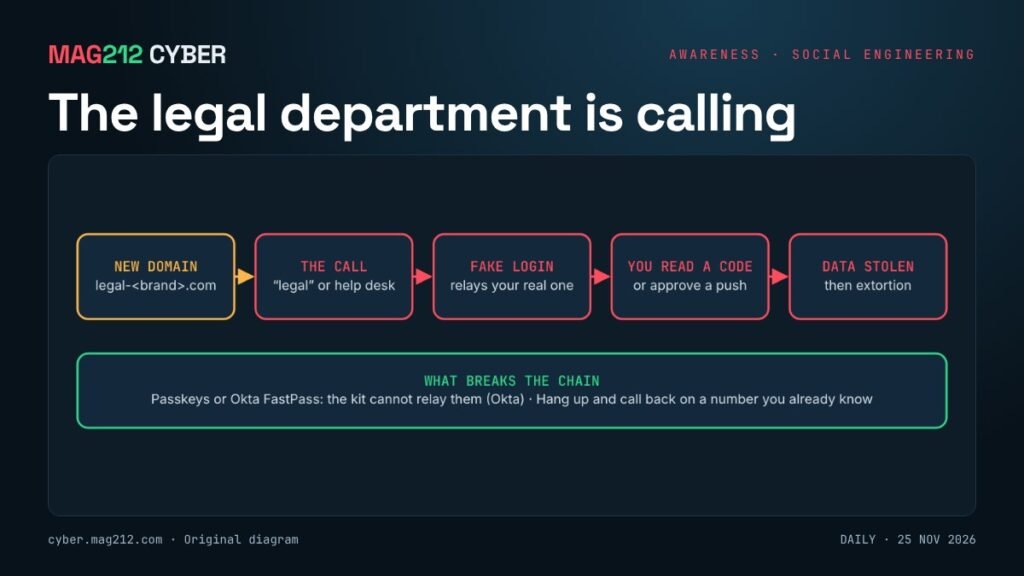
The Hacker News reports, citing Okta and a Unit 42 alert, that a vishing (voice phishing) crew Okta tracks as O-UNC-053 phones employees while posing as their company’s legal department or help desk. The caller steers the victim to a fake sign-in page and talks them into reading out a one-time code or approving a push prompt. The phishing kit relays the real login in real time. The Hacker News
Okta links the cluster to a data-leak site called INCEPTION and says it may be a rebrand of ShinyHunters; INCEPTION denies this. The Hacker News
Lesson 1: How the call works
- A new domain. The crew registers a domain for each target, often a day before the campaign. Since October 2026 they use a legal theme, with patterns like legal-yourcompany.com or yourcompany.legal.
- The call. Someone claiming to be from legal or the help desk calls and sends you to that page.
- The fake login. The page passes your username and password to the real identity provider (Okta or NetIQ were observed) as you type.
- The code or the push. The caller asks you to read out a code, or to approve the prompt that appears on your phone.
- The theft. With your session, they reach company SaaS apps, take data, and extort the company.
Unit 42 counts more than 70 such domains since October 2026. Domains seen in the campaign imitate well-known brands; that does not mean those companies were victims. The Hacker News
Lesson 2: Why codes and pushes fail here
A one-time code proves you have your phone. It does not prove which website you are typing it into. If you read it to a caller, or type it into a relay page, the attacker uses it within seconds.
Passkeys work differently: the browser only releases them to the real website’s domain, so a lookalike page cannot collect them. Okta says this kit is not designed to bypass phishing-resistant methods such as passkeys and Okta FastPass. The Hacker News
The lesson: the fix is not “train people harder”. It is giving them a sign-in method that cannot be phished. (MAG212 analysis)
Four rules for every employee
- No one from legal, IT or security needs your one-time code. Ever.
- Don’t approve a sign-in prompt you didn’t start.
- Hang up and call back on a number from the intranet or company directory.
- Report the call, even if you did nothing wrong.
For administrators
- Move privileged and help-desk accounts to passkeys or another phishing-resistant method first.
- Watch for newly registered domains that combine your brand name with “legal”.
- Alert on MFA approvals that follow a burst of denied prompts, and on sign-ins from new devices right after a phone call is reported.
- Require identity checks before the help desk resets MFA or passwords by phone.
For business leaders
- Fund phishing-resistant MFA for the people attackers call first: executives, finance, legal, IT and the help desk.
- Make “call back on a known number” a company rule, not a suggestion.
- Thank people who report suspicious calls, and never punish them.
Three questions for your next team meeting
- Who in our company would get this call first?
- Could a caller reset an account by phone today?
- How fast would we spot a lookalike domain with our name in it?
Related on MAG212 CYBER
- MAG212 CYBER Daily, 25 November 2026: Own the console, own the network (full issue and PDF)
- Own vCenter, Own Everything: A Practical Guide to VMware’s November Critical Patches
- When Attackers Own Your Firewall Manager: Lessons From the GT13 Check Point Intrusions
- When the Installer Becomes the Attack: Understanding Drupal’s Highly Critical Core Flaw
- Subscribe free to MAG212 CYBER
Sources
- The Hacker News: thehackernews.com
Written and edited by El Mostafa Ouchen for MAG212 CYBER. Facts checked against the sources above as of 25 November 2026, 7:00 AM PT.